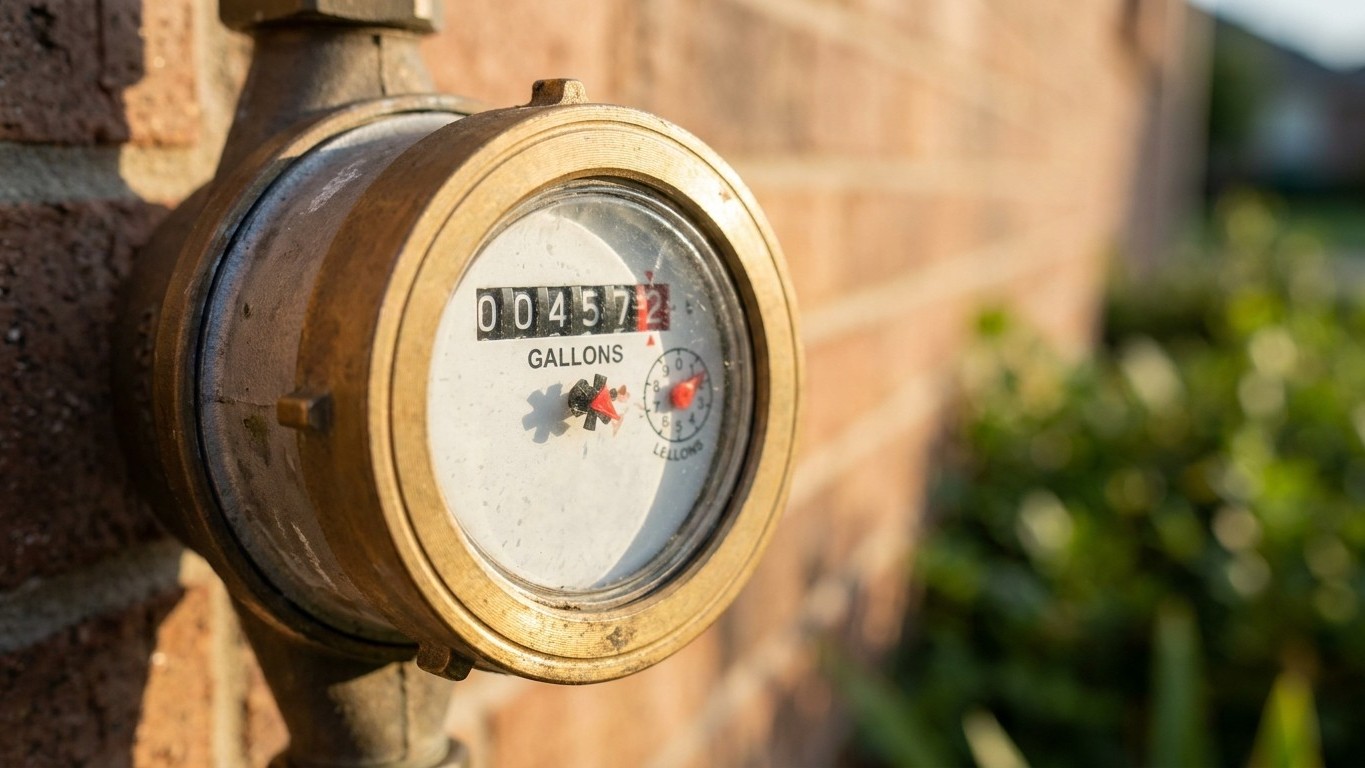

The fastest way to find a leak you cannot see is to stop using water entirely for a couple of hours and watch your water meter. If the dial keeps turning or the small leak indicator spins with every tap and toilet shut off, water is moving somewhere in the house whether you can hear it or not. That single test, done before you start pulling apart walls or crawling under sinks, tells you in minutes whether you actually have a hidden leak at all.
What is actually happening
Every water meter built in the last few decades has a small leak indicator, usually a red or blue triangle, star, or spinning dial, tucked into the meter face alongside the main numbers. That indicator is designed to move with even the tiniest continuous flow, far smaller than what you’d need to run a faucet or fill a glass. It exists specifically because utilities got tired of customers arguing about bills they couldn’t explain.
Here’s the mechanism worth understanding: your home’s plumbing is a closed loop between the meter and every fixture. When every valve is closed, no water should move past that meter at all. If it does, the water has only one place to go, and that place is a leak. The indicator doesn’t care whether the leak is behind drywall, under a slab, or inside a toilet tank. It just registers flow.
This is why the meter test outperforms walking around listening for drips. A pinhole leak in a copper line inside a wall cavity can lose water for months without a single visible stain, especially if the water tracks down a stud bay before it ever reaches a ceiling or baseboard. A slow toilet leak past a worn flapper can move dozens of gallons a day without ever making a puddle, because the water goes straight down the drain. Neither of those leaks makes a sound you’d notice over a running dishwasher or a television.
The test itself takes about ten minutes to set up and a couple of hours to confirm. Turn off every fixture, make sure the ice maker and any irrigation timer won’t kick on, and note the meter reading exactly. Come back in two hours. If the number has moved, or if the leak indicator has completed even a partial rotation, you have confirmed flow with no fixture running, which is the definition of a hidden leak. If nothing has moved, the problem you’re chasing is probably not a hidden leak at all, and you can rule out a whole category of expensive guesswork before you touch a single wall.
What this test won’t tell you is where the leak is. For that, you narrow the search fixture by fixture, which is where the checklist below comes in.
What to check, in order
Once the meter confirms a leak exists, work through the likely sources from cheapest and easiest to check toward the more disruptive ones. Most hidden leaks turn out to be one of the first three items on this list.
- The toilet flapper. Add a few drops of food coloring to the tank, wait fifteen minutes without flushing, and check the bowl. Color in the bowl means the flapper is letting tank water leak past it continuously, which can run for months unnoticed because it drains straight into the sewer line with no visible sign in the room.
- Every faucet and showerhead, even the ones you rarely use. Feel underneath and around the base with a dry hand. Dampness where there was none before points to a worn washer or cartridge, and a slow drip that never quite stops is often loud enough to hear in a quiet house but easy to tune out in a busy one.
- The water heater and its connections. Look at the floor around the base, the fittings at the top, and the drain valve near the bottom. A little corrosion or a damp shadow on the floor tells you the leak is at the tank itself rather than somewhere in the supply lines.
- Under every sink, along the supply lines and the trap. Run a dry paper towel along each connection point. If it comes back wet or even just slightly damp, you’ve found a slow seep that would otherwise take weeks to show as a stain on the cabinet floor.
- Outdoor spigots and any irrigation line. Turn the spigot on briefly and check the wall behind it and the ground beneath it after it’s off. A patch of grass that’s greener or wetter than the rest of the yard, even in dry weather, usually means an underground line is leaking along its run.
- Isolate the house from the yard. Close the main shut-off valve to any irrigation or outdoor system and repeat the meter test. If the meter stops moving, the leak is outside the house. If it keeps moving, the leak is inside, and you’ve just eliminated half the property from consideration.
Each of these checks costs nothing but time, and together they cover the sources responsible for the vast majority of hidden household leaks before you’d ever need to open a wall.
What it costs to leave it
The scale of this problem nationally is worth knowing, even though it says nothing about your specific house. According to the U.S. EPA WaterSense program, “Household leaks can waste nearly 1 trillion gallons of water annually nationwide,” and “The average household’s leaks can account for more than 9,300 gallons of water wasted every year.” The EPA also notes that “nine percent of homes have leaks that waste 50 gallons or more per day,” which is the tier of leak most likely to show up as a real jump in your bill.
The individual fixtures add up in ways that surprise most people. The EPA states that “A leaky faucet that drips at the rate of one drip per second can waste more than 3,000 gallons per year,” and that “A showerhead leaking at 10 drips per minute wastes more than 500 gallons per year.” A toilet is often the biggest single offender, since “An old or worn flapper can cause your toilet to flush on its own or silently leak thousands of gallons a year” without ever overflowing or making noise.
These figures are national averages compiled from a conservation campaign, not a prediction of what any one house is losing. Your actual number depends on your fixtures, your water pressure, and how long the leak has been running, none of which a national average can capture. That’s exactly why the meter test matters more than any of these figures: it’s the only measurement that belongs to your house specifically. The EPA does note that “Fixing easily corrected household water leaks can save homeowners about 10 percent on their water bills,” which gives you a rough sense of the payoff, but the meter, not a national statistic, is what tells you whether you’re one of the households losing water right now.
When to stop and call a plumber
Some of what’s on that checklist is safe to handle yourself. Some of it isn’t, and pretending otherwise is how a small leak turns into a five-figure repair.
Stop and call a licensed plumber the moment a leak is behind a finished wall or under a slab rather than at an exposed fixture. Cutting into drywall or tile to chase a leak you’ve only guessed at usually means opening more wall than necessary, and a plumber with a listening device or thermal camera can find the exact point in far less time than trial and error. The same goes for anything involving the main water supply line coming into the house. That line is under constant pressure whether any fixture is open or not, and a failure there can flood a basement in the time it takes to notice.
Anything touching a gas water heater is also outside DIY territory. A leak at the tank itself, or dampness near the gas connections or venting, is a combined water and gas safety issue, and it needs a professional regardless of how minor the drip looks.
The last line is the most important: any leak that has already wetted structure, meaning a soaked subfloor, a stained ceiling, or insulation that’s damp to the touch, needs professional attention right away. Water sitting inside a wall or floor cavity doesn’t dry on its own, and mold can start developing within 24 to 48 hours in that kind of hidden, damp space. Water damage from a leak like this moves quietly and gets expensive fast, precisely because nobody sees it happening.
Before a plumber arrives, or if a leak suddenly worsens, the first move is always to find and close the shut-off valve, whether that’s the fixture’s local valve or the main valve for the house. Knowing where that valve is and how to close it, covered in more detail on this site’s shut-off valve guide, is the one piece of preparation that limits damage no matter what’s actually causing the leak.
Common questions
How long should I run the water meter test?
Two hours with no water use anywhere in the house is usually enough to confirm flow, but if you suspect a very slow leak, such as a worn toilet flapper, leaving it overnight gives a clearer reading since the small leak indicator has more time to complete a visible rotation.
Can a hidden leak affect my water pressure?
It can, especially if the leak is significant enough to divert a meaningful share of flow before it reaches your fixtures, but pressure changes have many other causes too, so a drop in pressure alone isn’t a reliable way to confirm a hidden leak. The meter test remains the more direct check.
Is it normal for the leak indicator to move a little even without a leak?
No. With every fixture and appliance fully off, the indicator should not move at all. Any movement, even a slow partial turn, means water is passing through the meter somewhere in the system.
Should I check for a hidden leak before or after a big jump in my water bill?
Both, but don’t wait for the bill. A leak large enough to move your bill noticeably has often been running for a full billing cycle already, so checking the meter periodically, even without a suspicious bill, catches problems earlier and limits the damage and the cost.