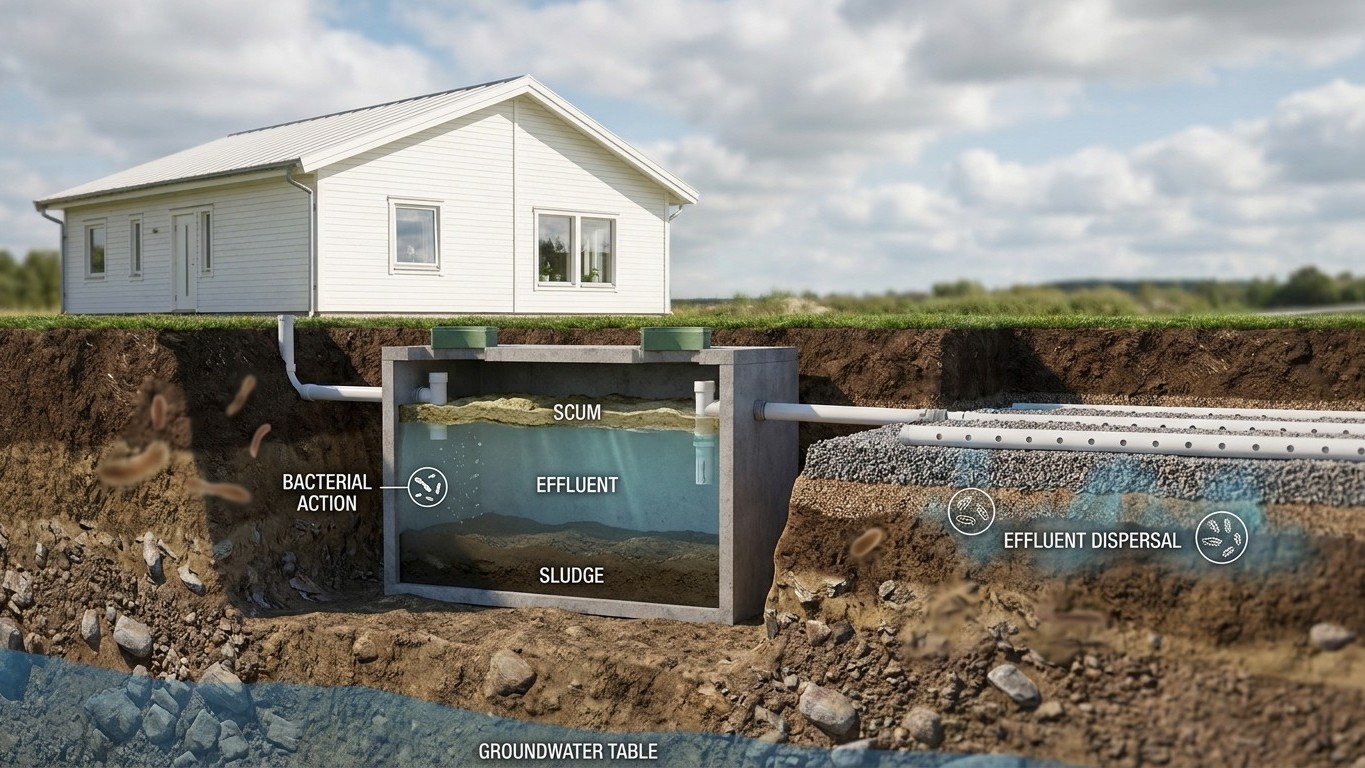

A septic system works in two stages: a buried tank that separates solids from liquid using gravity and bacteria, and a drain field that disperses the treated liquid into the soil. There’s no pump station, no chemical dosing, no moving parts in a standard gravity-fed setup. It runs on time and biology. That’s exactly why it needs different habits than a home on municipal sewer, and why small mistakes compound slowly until they surface as an expensive repair.
What is actually happening

Wastewater leaves the house and enters the tank, where it sits long enough for three layers to form. Solids sink to the bottom as sludge. Grease, oils, and lighter debris float to the top as scum. In between sits a layer of relatively clear liquid called effluent, and anaerobic bacteria living in the tank spend their time breaking down the organic material in both layers. This is a slow process by design. A typical tank holds wastewater for one to three days before it moves on, giving bacteria time to work before anything leaves the tank.
Only that middle layer of effluent is supposed to exit the tank. It flows out through an outlet baffle or filter into a network of perforated pipe buried in the drain field, sometimes called a leach field. There, it trickles into gravel and soil, where naturally occurring bacteria finish the treatment as the liquid filters down toward groundwater. The soil itself is doing chemical and biological work, not just physical filtering. That’s the second stage, and it’s the one that rarely announces problems until they’re already serious.
Why the tank and the field fail differently
The tank fails through accumulation. Sludge and scum build up over years, and if nobody pumps the tank, those layers eventually thicken enough that solids escape into the outlet pipe. The fix at that stage is straightforward: pumping. The drain field fails through clogging. A layer of biological slime called a biomat forms where effluent meets soil, and it thickens when the field receives more liquid, grease, or solids than the bacteria can process. Once a biomat clogs the soil’s ability to absorb liquid, effluent backs up and surfaces, or backs up into the house. There’s no simple fix for a saturated drain field short of replacing it, which is why what goes down the drain matters so much more here than in a sewer-connected home. A municipal treatment plant can absorb an off day. A septic system’s biology can’t, and the soil underneath has a finite absorption capacity that doesn’t come back once it’s overwhelmed.
What to check, in order
Start cheap and work upward. Most septic complaints trace back to one of these checks before anyone needs to call for service.
- Look at the ground over the drain field. Soggy patches, standing water, or grass that’s noticeably greener and taller than the surrounding lawn all point to effluent surfacing because the soil underneath can’t absorb it fast enough. This is often the first visible sign of a field in trouble, and it shows up outdoors long before drains back up indoors.
- Run water in more than one fixture and listen. A single slow drain usually means a local clog in that one line. Gurgling or slow drainage across multiple fixtures at once, especially the lowest drain in the house, points toward the main line or the tank itself rather than one fixture.
- Note how long since the tank was last pumped. Households on a septic system typically need pumping every few years depending on tank size and household size; a homeowner who can’t remember the last pumping date has an easy first step, since sludge and scum accumulation is the most common and cheapest cause of a system starting to struggle.
- Smell near the tank lids and the drain field. A persistent sewage odor outdoors, not just after heavy rain, suggests gas or effluent escaping where it shouldn’t, which is worth noting before any service call so the technician knows where to look first.
- Track household water use over a week. Back-to-back laundry loads, long showers, or a water softener discharging frequently can push more liquid into the tank than it’s built to handle in a short window, overwhelming the field temporarily even when the system is otherwise healthy.
What it costs to leave it
A struggling septic system rarely announces itself with a dramatic failure first. It shows up as slow, quiet water loss and wasted capacity, the same way household leaks do on any plumbing system. On a national scale, the U.S. EPA’s WaterSense program notes that “household leaks can waste nearly 1 trillion gallons of water annually nationwide,” and that “the average household’s leaks can account for more than 9,300 gallons of water wasted every year.” Those figures describe leaking fixtures generally, not septic systems specifically, but they illustrate a pattern worth taking seriously: small, ignored problems add up to a lot of wasted capacity over a year, capacity a drain field doesn’t have to spare.
The EPA also notes that “nine percent of homes have leaks that waste 50 gallons or more per day.” A household on a septic system running that kind of hidden loss isn’t just wasting water. It’s pushing extra volume through a tank and field that were sized for normal use, shortening the time before the field shows signs of stress. Even small fixture leaks matter at that scale: “A leaky faucet that drips at the rate of one drip per second can waste more than 3,000 gallons per year,” and “a showerhead leaking at 10 drips per minute wastes more than 500 gallons per year.” A running or leaking toilet is worse still, since “an old or worn flapper can cause your toilet to flush on its own or silently leak thousands of gallons a year.”
These are national aggregates, useful for scale but not for estimating what any one household is actually losing. That number is on the water meter, not in a nationwide average. The EPA notes that “fixing easily corrected household water leaks can save homeowners about 10 percent on their water bills,” which hints at how much of this is avoidable once it’s found. A homeowner who wants their own figure, not a national one, can check how to spot a hidden leak using the water meter on this site’s guide to finding hidden leaks, since that’s the only measurement that actually belongs to their house.
When to stop and call a plumber
Most of what happens between the tank and the drain field is diagnosable from the yard and the drains inside the house. Some situations aren’t, and pushing past that boundary risks turning a manageable problem into a costly one.
Call a licensed plumber, or a septic service specifically, once a problem moves behind a wall or underground beyond what a homeowner can see. Effluent surfacing over the drain field, sewage backing up into the lowest drain in the house, or a smell that persists near the tank all mean the system needs professional inspection rather than more waiting. Anything involving the main water supply line, rather than an individual fixture, also belongs to a professional, since a mistake there affects the whole house’s pressure and safety, not just one drain.
A gas water heater is its own line to stop at. Anything beyond adjusting a thermostat, on a system that involves a gas line and a combustion vent, should go to a licensed plumber or the gas utility, not to trial and error. And any leak, from a supply line, a drain, or a septic backup, that has already wetted drywall, subfloor, Insulation, or framing needs professional attention regardless of how small it looks on the surface. Water damage to structure is quiet at first and expensive later, and by the time it’s visible, it’s usually already spread further than it appears. Waiting to see if it dries out on its own is the single most common way a small plumbing issue becomes a major repair.
Common questions
How often does a septic tank need to be pumped?
It depends on tank size, household size, and how much wastewater the home generates, so there’s no single number that applies everywhere. A homeowner who doesn’t know the last pumping date, or who’s noticed slow drains or a lawn that stays wet over the drain field, has enough reason to schedule an inspection rather than guess.
Can I use regular household cleaners with a septic system?
Bacteria in the tank do the work of breaking down waste, and anything that disrupts that bacterial population, in large enough quantities, slows the whole process down. Rather than naming specific products, the safer approach is moderation and spacing out heavier cleaning tasks, since the tank’s biology needs time to recover between disruptions.
Why does my yard smell near the drain field after rain?
Heavy rain saturates soil that the drain field also relies on to absorb effluent, so a system that’s already borderline can show odor or standing water specifically after storms even if it seems fine the rest of the time. That’s a sign the field’s absorption capacity is being tested, not necessarily that it’s failed outright.
Is a garbage disposal safe to use with a septic system?
A garbage disposal adds solid material directly into the tank, which increases how quickly sludge accumulates and shortens the interval between pumpings. It’s not automatically a problem, but it does mean the tank needs closer attention to its pumping schedule than a household without one.