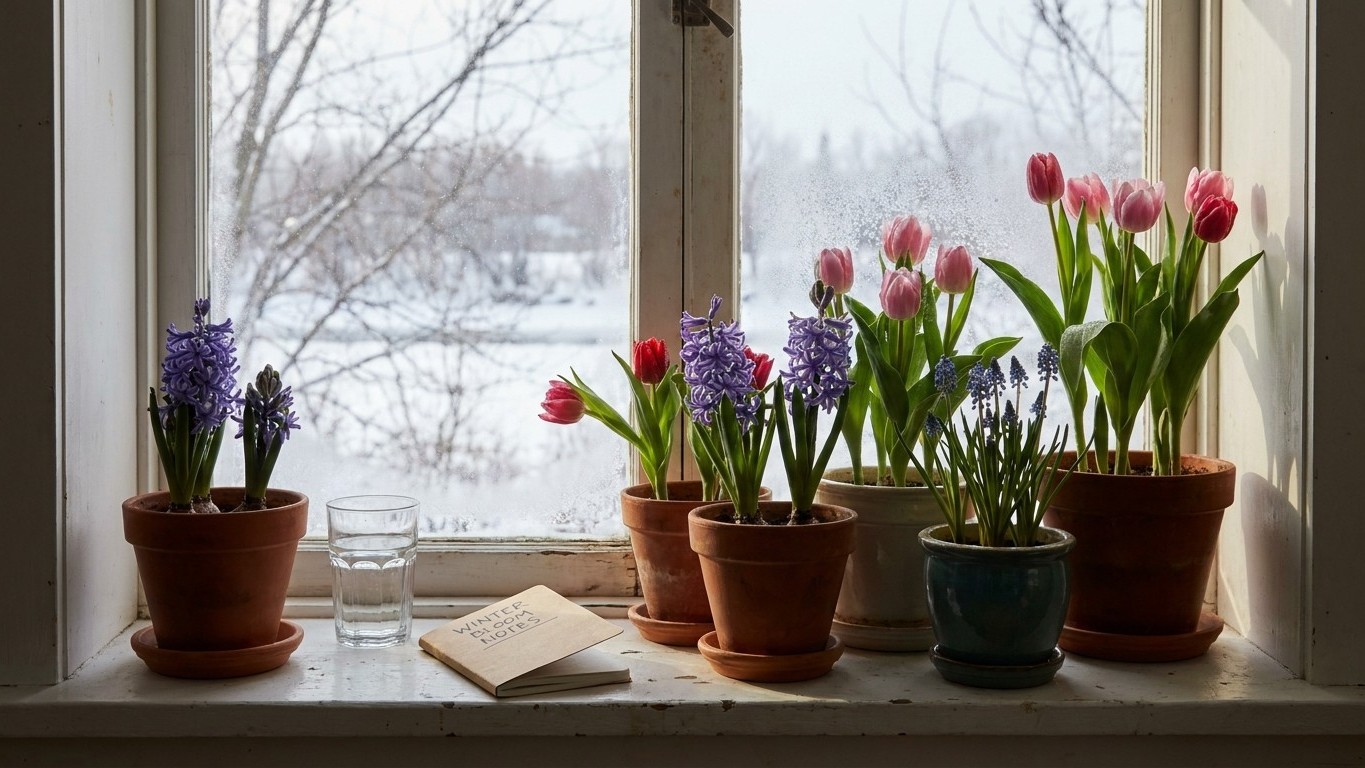

Forcing spring bulbs indoors works reliably in Quebec, and it solves a specific problem: getting tulips, hyacinths, or daffodils to bloom weeks before the ground outside even thaws. The technique doesn’t fight the climate here so much as work around it, using a refrigerator or a cold garage to supply the chill a bulb needs before it will flower on schedule.
Why this matters in Quebec

The number that frames everything here is 6.7°F. That’s the mean daily minimum of the coldest month at the Montreal reference station, according to Environment and Climate Change Canada’s 1981-2010 Climate Normals. Paired with a Canadian hardiness zone of 5b for that same reference city (Natural Resources Canada, 1991-2020 normals), it tells you something specific: Quebec’s ground does not lack cold. A bulb planted in a garden bed here gets far more than the 12 to 14 weeks below 45°F that most spring bulbs need to break dormancy and bloom.
So forcing indoors in this territory isn’t a rescue from a mild winter, the way it might be in a warmer US state where the ground barely dips below freezing. Here, the reason to force is timing, not scarcity. You force because you want hyacinths blooming on a windowsill in February, months before anything outdoors would dare push through the snow, and the only way to get there is to control the cold artificially instead of waiting for the calendar.
Containers change the equation, though, and this is where the 6.7°F figure actually bites. Garden soil insulates a bulb from below and from the sides; only the top few inches freeze hard in most winters, and the bulb sitting deeper stays buffered. A pot has no such buffer. Air at 6.7°F surrounds a container on every side, and the root ball inside freezes through, not just at the surface. A bulb rated for zone 5b in open ground can still die in a pot exposed to that same zone 5b air, because the pot offers none of the insulation the ground does. That’s a separate risk from the forcing process itself, and it matters most for anyone storing forcing pots outdoors between potting and bloom, rather than in a garage or refrigerator.
How to do it here
The sequence below assumes you’re forcing indoors for winter bloom, using cold storage you control, rather than relying on outdoor exposure. Each step is something you can check yourself, with a thermometer or your own eyes, rather than a guess.
- Choose full-size, firm bulbs meant for forcing. A forced bulb draws entirely on its own stored energy with no chance to build reserves first, so undersized or soft bulbs rarely produce a strong bloom.
- Pot the bulbs in a well-draining container, with the growing tip sitting just above the soil surface. Water once, thoroughly, then start counting weeks from that point.
- Move the pot to a steady cold, dark space between 32°F and roughly 45°F for the number of weeks the species requires (commonly 12 to 14 for hyacinths, crocus, tulips and daffodils). An unheated garage works only if it holds that range consistently; check with a thermometer, because on Quebec’s coldest nights an unheated but attached garage can still dip below freezing at the pot’s own location, not just at the outdoor reference station.
- Or use a dedicated refrigerator drawer, kept away from apples, pears, or any ripening fruit. Ripening fruit releases ethylene gas, and ethylene kills the flower bud forming inside a chilling bulb, leaving you with leaves later and no flower.
- Check soil moisture every couple of weeks. It should stay barely damp, never wet. Cold plus soggy soil rots a bulb long before it finishes its chilling period.
- Once the chilling weeks are complete and roots show through the drainage holes, or shoots have reached an inch or two, move the pot to a cool, dim room in the 60 to 65°F range for a week before giving it full light and warmth. Rushing straight to a bright, warm spot shocks the stem and often shortens it.
- Finish in normal light and room temperature until the buds open.
If a forcing pot is stored outdoors instead of in a garage or fridge, the container itself needs to be rated at least two Canadian zones hardier than the bulb requires, or it needs to be moved into a sheltered, unheated structure and mulched heavily. Left exposed at zone 5b air temperatures, a standalone pot freezes through on every side, which a garden bed never does.
Which bulbs are worth it
Not every bulb rewards the effort of forcing. Species with a short cold requirement move through the process faster and tend to hold their shape indoors; tall, top-heavy varieties often bloom fine outdoors in a bed but flop or lean once forced into a shallow pot with no wind resistance to build a sturdy stem against. Since tulips and hyacinths used for forcing rarely bloom well a second time even if planted out afterward, forcing them costs nothing in the long run, they were a one-season purchase either way.
- Hyacinths
- Crocus
- Paperwhite narcissus (needs no cold period at all, making it the easiest option for indoor bloom)
- Dwarf and species tulips
- Muscari (grape hyacinth)
On the other side, some bulbs sulk through forcing more often than not:
- Tall trumpet daffodils
- Large-cup narcissus varieties
- Fritillaria
- Alliums
- Tall single and double late tulips
The pattern holds across the list: shorter stems and shorter chilling needs force cleanly, while tall or slow-to-chill varieties either topple in a pot or simply refuse to flower on the accelerated schedule.
What goes wrong, and when you can still fix it
All leaves, no flower
The bulb never finished breaking dormancy internally, which usually means the cold period ran short. If the flower bud never fully formed inside the bulb before it was moved to warmth, there’s no way to recover it this season. The bulb can be planted out in the garden, where a full Quebec winter will chill it properly, and it may bloom in a later year.
Flower on a stem too short to see
This points to a bulb moved into heat and light before it had grown enough roots to support upward growth. Energy went into a premature, stunted bloom instead. There’s no fixing that stem once it’s hardened; the only adjustment is timing next season, waiting until roots are visible through the drainage holes before moving the pot into warmth.
Rot in the pot
Soft, mushy bulb tissue during or after the cold period almost always traces back to drainage that never worked, or soil kept too wet through the chilling weeks. A rotted bulb is not salvageable this season. Next time, confirm the pot drains freely before potting, and keep the soil barely damp rather than moist throughout the cold storage weeks.
Related guides
- Growing Spring Bulbs in Containers in Quebec
- Forcing Spring Bulbs Indoors in Rhode Island