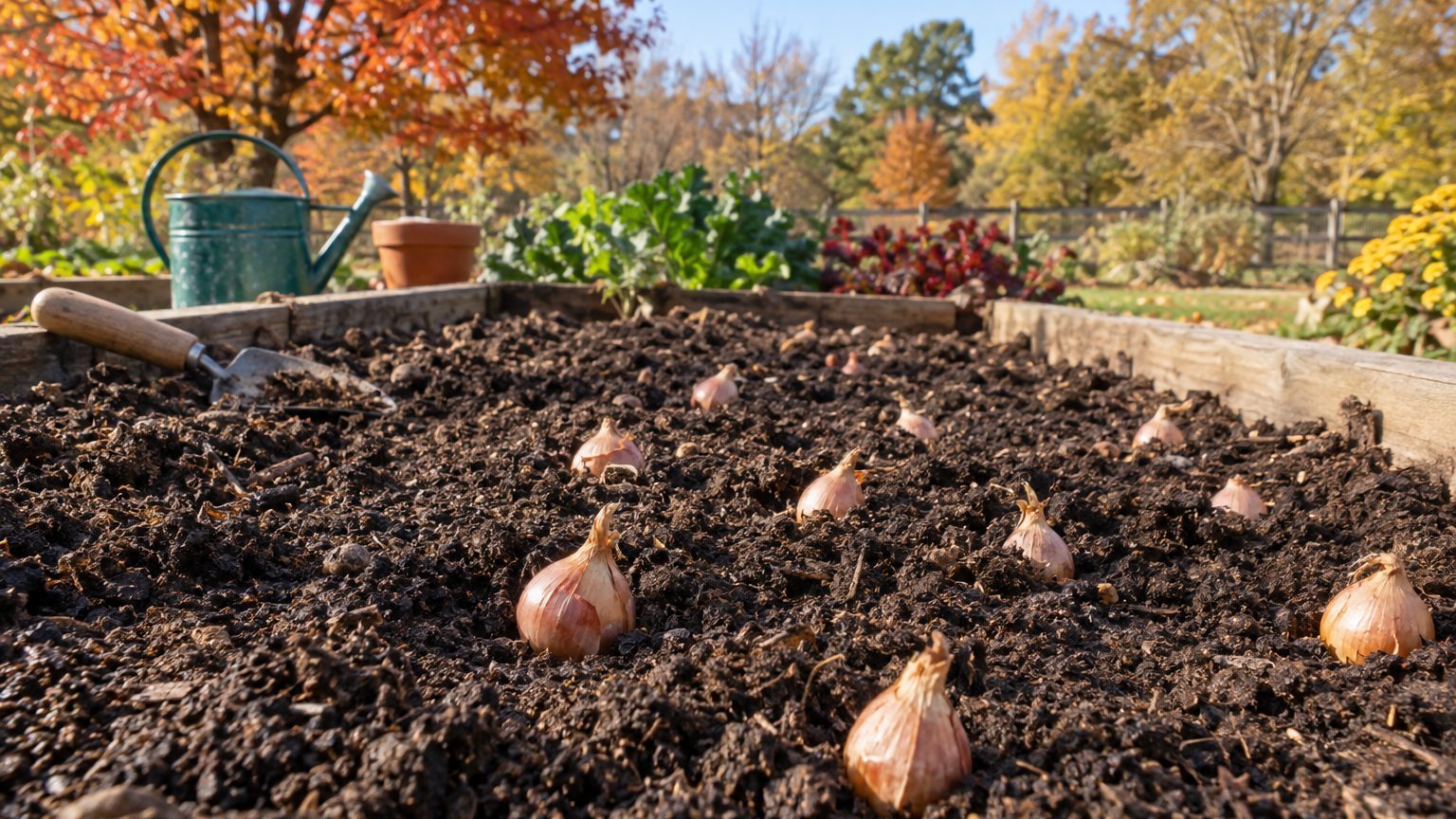

Plant shallots on Prince Edward Island in spring as soon as the soil can be worked, or in fall once the ground has cooled but before it locks up. Charlottetown’s average last spring frost is May 16 and its average first fall frost is October 17. Both are midpoints, not guarantees, so treat them as the center of a planting window rather than a date to circle.
The short answer for Prince Edward Island
Two windows work. In spring, shallot sets go in the moment the soil is workable, which is usually before the last frost rather than after it, because shallots shrug off light frost. In fall, they go in late, after the soil has cooled, so the bulbs root without pushing much top growth. Both windows hang on frost dates from Environment and Climate Change Canada’s 1981-2010 normals for the Charlottetown A station.
What the two frost dates actually measure
Last spring frost: on average May 16. First fall frost: on average October 17. These are mean dates, the midpoint of what happened across the years in the record. They are not a probability band and not a safe date. In one year out of two, the last spring frost falls later than May 16. In the other half of years, the first fall frost arrives before October 17. A gardener who reads “May 16” as “safe after this” will be wrong about every second spring.
The gap between the two mean dates is about 154 days. That is the frost-free stretch in an average year, and it shrinks in a cold one. The figures come from a single station, so a province is not one climate here. Northern and upland districts run weeks behind Charlottetown. And if you compare this page with US pages on this site, note that the Canadian normals cover 1981-2010 while the US figures cover 1991-2020.
Turning the window into a plan
For spring, start when a handful of soil crumbles instead of smearing, and keep going through the weeks around May 16. You do not need to wait for the frost date to pass, since shallot sets are among the hardier things you can put in a garden bed. What they cannot take is cold, saturated ground, where sets rot before they root.
For fall, aim for the weeks around and after October 17, once the soil has cooled and before it freezes hard. This page has no ground-freeze date for the Island, so it cannot name a closing day for that window. Use your own soil (see the last section) and a few seasons of notes. The full growing sequence, from bed preparation to curing, is in Growing Shallots in Prince Edward Island.
What will not work here
Starting late in spring fails first. With roughly 154 frost-free days between the two mean dates, a shallot planted in mid-June has lost a big share of its growing time before it begins. Bulbs that size up as the cool fall closes in are hard to cure, and wet, undersized shallots are the ones that rot in storage. Slow varieties and shallots grown from true seed suffer most, because they need the longest run. If a variety’s days to maturity look long against a season that ends around October 17, in half of years earlier, pick a different one. The shortlist is in The Best Shallots to Grow in Prince Edward Island.
Planting too early in fall fails in the opposite direction. The mean daily minimum of the coldest month at Charlottetown is -12.1 °C (10.3 °F, if you are comparing with US sites). It is an average of the daily lows, so individual nights run colder. A shallot that has sent up several inches of green in a warm October spends the winter with tender growth exposed to those nights. Bare, unmulched soil adds a second problem: repeated freeze and thaw can heave shallow bulbs out of the ground. Fall planting here works when roots form but tops stay small, and a layer of mulch is worth the effort.
Treating May 16 as a starting gun is another trap. It is the midpoint of a spread, and half of springs bring frost after it. For shallots that rarely matters, since the crop tolerates light frost. For anything tender you tuck in nearby, it matters a great deal. Don’t let a shallot calendar set the date for beans or basil.
Tight spacing is a quieter failure. The Island is surrounded by water, and a maritime climate tends toward air that dries slowly after rain or fog. This page holds no humidity figure, so it can’t say how much. But foliage that stays wet for long stretches invites fungal trouble, and crowded shallot clumps make it worse. Give plants room to dry out between showers.
The last failure is borrowed advice. A calendar from a US state or from mainland Canada rests on different frost dates and a different winter. The Canadian hardiness zone also does not translate into a USDA zone (more on that below), so a guide that says “zone 5” tells you little unless it names its system.
What changes across Prince Edward Island
Natural Resources Canada rates the reference city, Charlottetown, as hardiness zone 5b in the Canadian system, using 1991-2020 normals. That is one city. It is not a ruling for the whole Island, and this page has no zone figures for other districts. So there is no single answer for the province, only a starting point at Charlottetown that shifts as you move away from it.
The Canadian zone system is built on seven climate variables, where the USDA system uses one. NRCan itself says there are no simple conversions between the two. Zone 5b in Canada is not the same thing as a USDA 5b, and the two numbers should never share a scale. Whenever you read a zone, check which system it belongs to.
What does shift for readers in the north of the Island or on higher ground? The frost dates are the most reliable guide: districts there run weeks behind the Charlottetown A station. In practice that means:
- Spring planting moves later, since the soil thaws and warms later.
- The fall window moves earlier, because frost and hard ground arrive sooner than October 17.
- Mulch in fall matters more, and the margin for slow varieties shrinks.
How many weeks to shift depends on your own spot, which is why this page stops short of giving one number. To see where your municipality sits, open the Plant Hardiness Zone by Municipality tool from Natural Resources Canada and look it up on the map yourself. Use the result as one input, next to your own frost record, not as a substitute for it.
Where to check this for your own county
On the Island, the place to start is the provincial agriculture pages: Prince Edward Island Agriculture. Canada does not run state-style extension offices, so the provincial department fills that role. Look for two things there. The first is a planting calendar for your part of the province, ideally written for garlic and onion-family crops, since shallots are usually handled alongside them. The second is a list of varieties trialled locally, because a variety that thrives in a trial plot a few miles from you is worth more than any ranking on a general page.
Whether you garden in Prince, Queens or Kings County, ask about three more things if the agriculture staff can help: nearby frost records, when the ground typically freezes in your district, and how fall-planted shallots have fared after hard winters. This page lacks that last data, and it is the piece that decides the fall window.
A county or district recommendation beats a provincial one every time. It rests on closer weather records and on trials grown in conditions like yours. This page is the provincial view, built from one reference station and one reference city. It is a sound starting frame, but where local advice disagrees with it, go with the local advice.
One practical note: pages on government sites get reorganized. If the link above lands somewhere unexpected, search the site for “garlic,” “onions” or “vegetable production” rather than “shallots,” which may not have its own page.
Checking this against your own garden
Your own observations outrank every date above. Three are worth watching, and none needs equipment beyond your hands and a notebook.
- Soil warmth by feel. Push a hand or trowel into the bed in early spring. Soil that is cold and sticky is not ready; soil that crumbles and no longer numbs your fingers is. Beds on a south-facing slope or sheltered by a wall reach this point days or weeks before a low, shaded corner. Note which bed wins each year.
- The first flush of male flowers. Catkins on local alder or hazel shedding pollen show that spring is truly moving along your stretch of the Island. Write down the date. After a few years you have a personal marker that tracks your microclimate better than a distant weather station.
- The first true leaves. Watch when the first real green appears on early weeds, on rhubarb, or on any shallots left over from last fall. A garden that wakes two weeks after a neighbor’s is telling you how far behind Charlottetown it runs.
Keep those three dates alongside your planting date and your harvest date. After two or three seasons, they tell you more than any frost average.
Common questions
Can I plant shallots in spring on Prince Edward Island?
Yes, and it is the lower-risk choice. Plant sets as soon as the soil can be worked, without waiting for May 16, the average last spring frost at Charlottetown. Shallots tolerate light frost. Skip any day when the ground is frozen or waterlogged.
Is May 16 a safe planting date?
No. It is a mean date, so in one year out of two the last spring frost falls later. It is the midpoint of a window, and the station behind it is Charlottetown A, so northern and upland districts run weeks behind.
Should I plant in fall or spring?
This page has no local trial data comparing the two, so it cannot declare a winner. Spring is the safer default, because the coldest month’s mean daily minimum is -12.1 °C and fall-planted bulbs have to survive it. If you want to try fall planting, plant a small test row, mulch it, and plant around and after October 17 rather than earlier.
Does hardiness zone 5b here match a USDA zone?
No. Zone 5b is the Canadian system’s rating for the reference city, Charlottetown, and it is based on seven climate variables. NRCan says there are no simple conversions to USDA zones. When you follow a US planting guide, use frost dates instead of zone numbers.