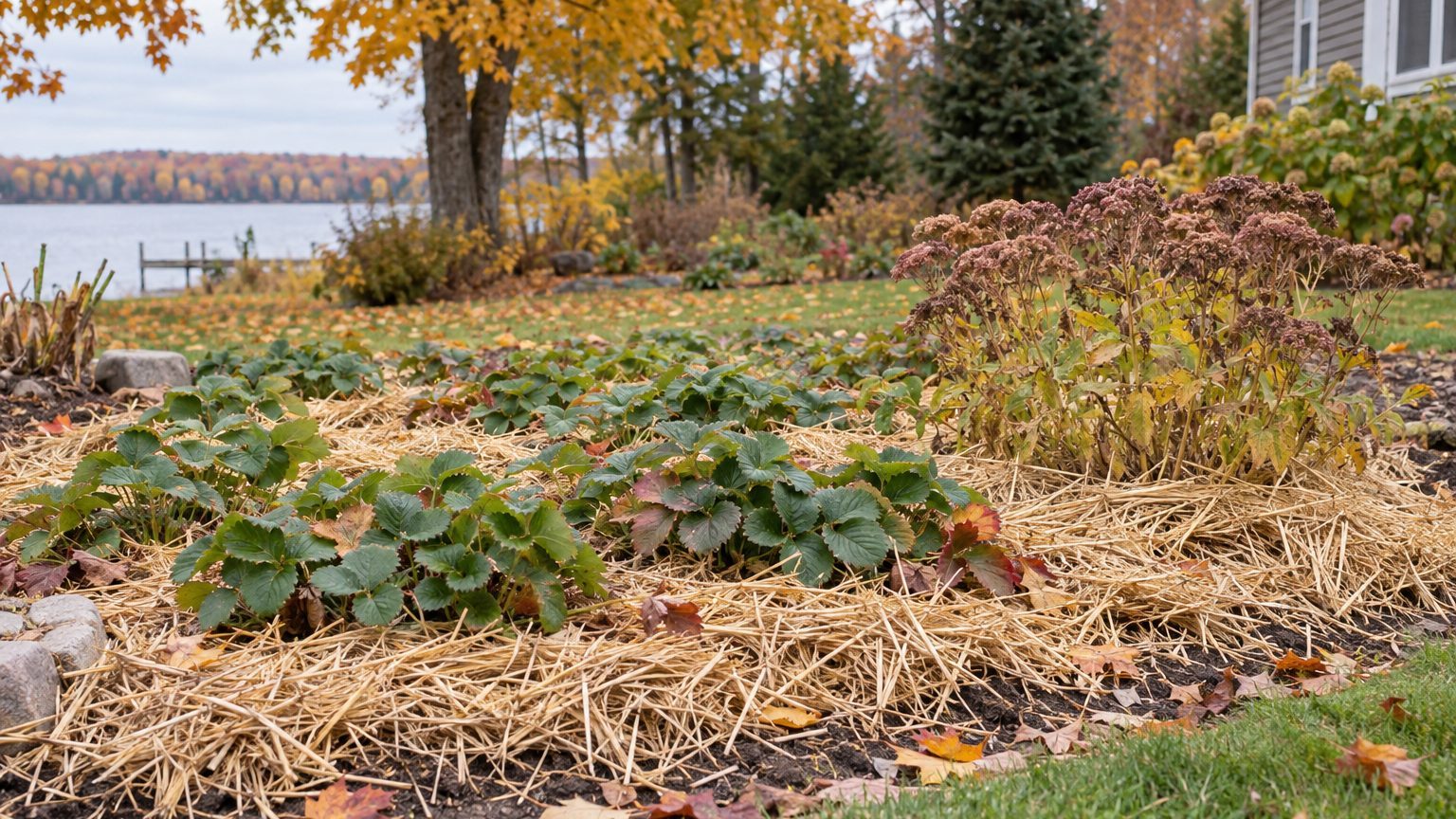

Wait for the ground to freeze. On Prince Edward Island, winter mulch for strawberries and perennials goes down weeks after the first fall frost, which averages October 17 at Charlottetown, and not on the night the first frost arrives. The mulch is there to keep the soil frozen, not to keep it warm. Spread it in October while the soil is still soaking up warmth and you invite rot and rodents.
When to put winter mulch down in Prince Edward Island
Winter mulch works backward from what most gardeners expect. A blanket of straw does not generate heat. It slows the exchange between soil and air, so whatever temperature the ground has when you cover it is more or less the temperature it holds. Cover warm, damp soil in October and you have built a cozy, moist shelter. Cover soil that has already stiffened and you have built a freezer door that stays shut until spring.
Why the first frost is not the signal
Environment and Climate Change Canada’s 1981-2010 normals for the Charlottetown A station put the average first fall frost on October 17. That is a mean, not a deadline. In roughly one year out of two the first frost lands later than that, so treat October 17 as the middle of a window, never as a safe date to mark on the calendar.
The same station records a mean daily minimum of -12.1 °C in the coldest month, so the ground does freeze here, and it stays frozen for a long stretch. The first frost only tells you that growth is slowing. A single frosty night is followed, most years, by mild afternoons and a thawing surface. Put winter mulch on after the soil surface has started to freeze and stays hard through the afternoon, which comes several weeks after the first frost, not on it.
The practical test needs no thermometer. Push a trowel into the bed on a cold afternoon. If it goes in easily and the soil is cool and damp, wait. If the top layer is crusty in the morning and has not fully softened by midday, the window is open. Most years you will have days to spare before the real cold and snow settle in, but a hard cold snap can arrive fast, so have the straw bought and stacked by the shed before the first frost, not after.
Shifting the window across the Island
Charlottetown is one station on a long, narrow province, and it is not the whole Island. Districts that are colder, more exposed or higher run on an earlier calendar for fall chores: their first frost comes sooner and their ground freezes sooner, so the mulching window opens earlier there too. In a milder pocket near the coast the window opens a little later. Watch your own soil, not the average.
One more caution on sources: the frost normals cover 1981-2010, while Natural Resources Canada’s hardiness map uses 1991-2020. Both are useful, but they are different slices of time. For more fall timing, the First and Last Frost Dates in Prince Edward Island page lays out the spring side of the same calendar, and the wider Prince Edward Island guides cover related seasonal jobs.
Strawberries
Strawberries are the plant most worth mulching on the Island, and the reason is the crown. That compact, woody base where leaves and roots meet sits right at the soil surface, with the growing points for next summer’s flowers tucked inside. It has almost no insulation of its own.
What the cold actually does
Two things go wrong without cover. The first is bare cold: with a mean daily minimum of -12.1 °C in January (ECCC normals, Charlottetown), an exposed crown in a winter with thin snow cover takes the full force of the wind and the lowest temperatures. The second is heaving. When the soil freezes, thaws in a mild spell, and freezes again, it expands and contracts and slowly pushes shallow-rooted plants upward. Strawberry roots are shallow, and after a few cycles a plant can sit on top of its bed with its roots exposed to drying air.
This is why the timing from the first section matters so much. Straw laid on early does not stop the first thaw cycles, it just sits there on warm soil. Straw laid after the ground has begun to freeze keeps it frozen through those mild spells, which is the entire point.
What to use and how deep
Clean straw is the standard choice. It is light, it stays fluffy, and it lets some air move through. “Clean” means free of weed seed and not moldy. Hay is full of seed and will give you a lawn of grass in the strawberry bed come May. Pine needles and shredded leaves can work in a pinch, but whole leaves mat into a wet sheet.
For depth, the figure from FACTS is the guidance from NC State Extension: “A 2-inch to 3-inch layer of mulch suppresses most annual weed seeds and makes it easy to hand-pull any that do germinate.” That sentence is about weeds, not strawberry crowns specifically, but it gives the right order of magnitude. Fluffy straw settles as it gets wet, and more is not better. A thick, heavy pile traps moisture against the crowns, which is how you swap frost damage for rot. For the general logic of keeping mulch off stems and crowns, see Mulching Without Killing the Plant.
Pulling it back in spring
Uncovering is as important as covering. Pull the straw off the crowns in spring once the snow is gone and the plants begin to push new growth, and leave it loosely between the rows. New leaves that grow pale and yellowish under the mulch are the signal that it should have come off already. Keep the straw close by, because a hard frost after growth starts is still possible, and you can drape it back over the plants for a night. Everything else about the crop, from varieties to planting, is in Growing Strawberries.
Perennials and borderline plants
Not every perennial needs a winter blanket. Natural Resources Canada rates Charlottetown at hardiness zone 5b, in the Canadian system, using 1991-2020 normals. That is not a USDA zone and it does not convert to one, because the Canadian system draws on seven climate variables and the USDA system on one. A plant tagged with a Canadian zone number is judged against that scale, so read the label’s system before trusting the number.
In practice, mulch earns its place in three groups. The first is plants sold as borderline for zone 5b, the ones whose tags push toward a milder zone. The second is anything planted this season, since young plants have had less time to build deep roots and are the first to be pushed out by heaving. The third is shallow-rooted perennials that sit near the surface, such as coral bells and garden mums, along with the evergreen-leaved types that dislike a bare, wind-scoured bed. Established, locally hardy perennials, planted years ago and rated for the zone, mostly do fine without help, especially where snow reliably blankets the garden.
A ring, not a pile
How you place the mulch matters as much as whether you use it. Build a loose ring around the plant and keep the material clear of the crown itself. Piling it directly on top holds moisture against the buds, and a wet crown in a thaw is how perennials rot. Leave a small gap at the center and let the ring do the work of insulating the soil around it.
For depth, NC State Extension is the source in FACTS, and it offers two sentences with two purposes. For beds: “A 2-inch to 3-inch layer of mulch suppresses most annual weed seeds and makes it easy to hand-pull any that do germinate.” For woody plants: “Provide a 3-inch layer of mulch to reduce water loss and maintain uniform soil moisture and temperature around roots.” Both land in the same range, and neither says to go deeper. A mulch ring that climbs the stem like a volcano is a different problem from a cold one.
Apply the ring only after the surface of the soil has started to freeze, using the same signal as for strawberries, and pull it back from the crown when growth begins in spring. Perennial herbs follow the same rule, and Getting Perennial Herbs Through the Winter covers the ones that need the most protection.
What goes wrong
Four mistakes account for most winter mulch failures, and each leaves a distinct trail.
- Mulching too early: the soil stays warm, damp and unfrozen under the cover, and plants keep growing slowly when they should be dormant. The sign is soft, dark crowns in spring.
- Mulch that mats: whole leaves and wet, compressed straw form a dense layer that holds water. Look for slimy, discolored material and a sour smell when you lift it. Use fluffy material and keep to the 2-inch to 3-inch range.
- Voles: they like a quiet, insulated space and a heap of mulch laid over unfrozen ground is exactly that. Tunnels at the base of plants and chewed crowns are the giveaway. Waiting until the ground freezes, and keeping the mulch away from stems, takes away most of the appeal.
- Forgetting to uncover: plants smothered after growth begins turn pale, thin and leggy, and they stay damp, which invites disease.
The common thread is timing in both directions. Mulch goes on after the freeze starts and comes off when growth begins. Check the beds on the first mild spring days once the snow is gone, and pull the cover back rather than waiting for the weather to feel settled. A frost after uncovering is easy to handle if the straw is still on hand; a rotted crown is not.
Common questions
Should I mulch right after the first frost?
No. The average first fall frost at Charlottetown is October 17 (ECCC, 1981-2010 normals), but that is a mean, and in about half of years the first frost comes later. A frost does not mean the ground is frozen. Wait until the soil surface stays hard through the afternoon.
Can I use leaves instead of straw?
Shredded leaves can work, since they stay loose. Whole leaves, especially large ones, tend to mat into a wet layer that holds water against the crown. If you use leaves, shred them first and keep the layer within the 2-inch to 3-inch range.
Do I still need mulch if snow comes early?
Deep snow is excellent insulation, but it is not guaranteed, and a thin or late snowfall leaves crowns exposed. Mulch is the backup that works whether or not the snow arrives on time, and it also helps against the thaw and refreeze cycles that snow alone does not always prevent.
How do I know when to take it off in spring?
Pull it back when the snow has gone and you see new growth starting, or when leaves under the mulch begin to look pale. Keep the straw nearby, because a late frost can mean putting it back over the plants for a night. Local spring timing is covered by the frost dates for the Island, which also run on average figures and not on certainties.