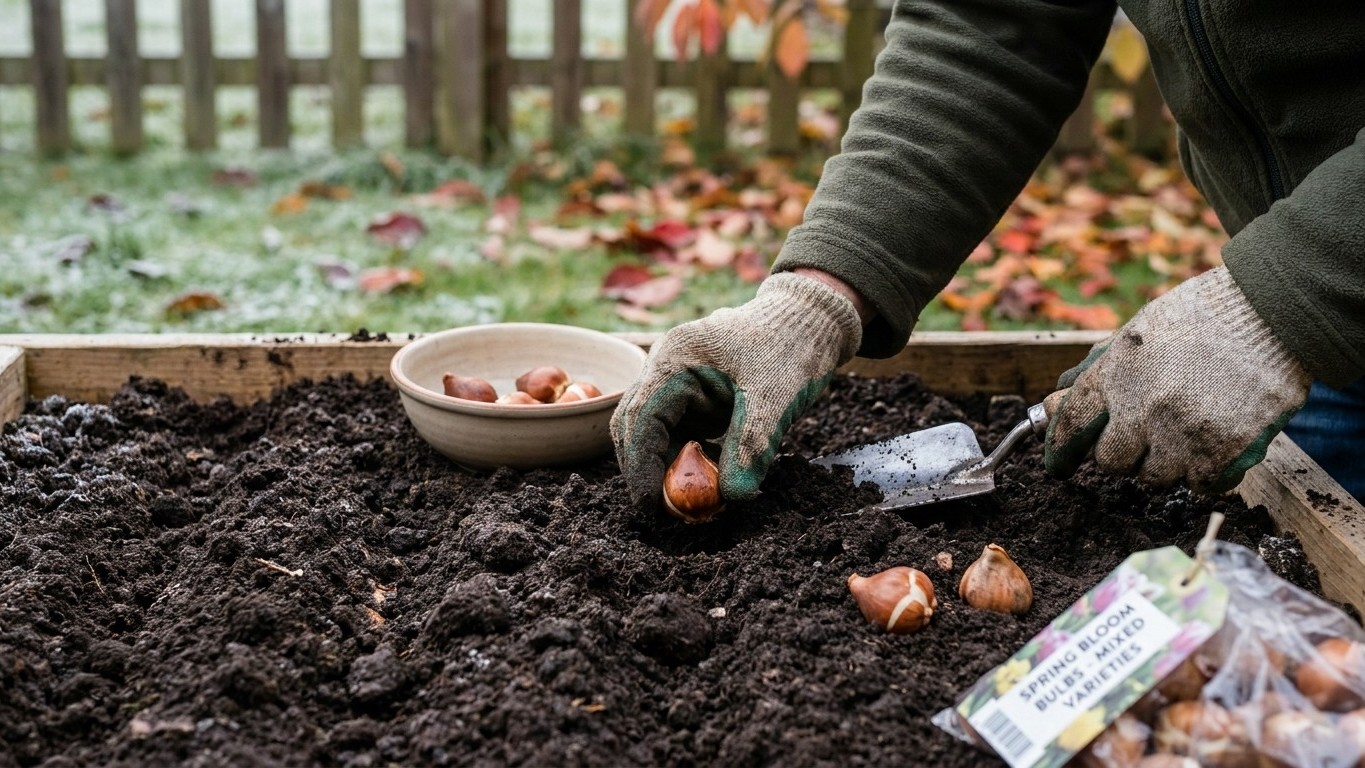

Quebec’s winters supply plenty of cold for spring bulbs, but timing decides whether they root well before that cold arrives, and species decides whether they survive it. Tulips, daffodils, and crocus generally do fine here. Tender imports and a few borderline hybrids don’t. The rest of this guide walks through the calendar, the cold requirement itself, and which bulbs to skip.
When to plant bulbs in Quebec

October 5. That’s the average date of the first fall frost recorded at the MONTREAL/ST-HUBERT A station, and it’s the number every planting calendar in this region should be built around. Spring bulbs need roughly six weeks of soil contact before the ground freezes solid, which puts the ideal planting window at mid-September through mid-October for most of southern Quebec, with northern and upland areas running a couple of weeks earlier.
Plant too soon and the soil is still warm enough to trigger top growth. A bulb that pushes green shoots in October has no chance against a hard freeze in November; the foliage dies back, and the bulb spends its stored energy recovering rather than building next year’s flower. Wait too long, on the other hand, and the bulb goes into frozen or half-frozen ground without enough time to grow the root system it needs. It may still sprout in spring, but the display is thin, the stem is short, and some bulbs simply rot before they root at all.
The frost date is an average, not a promise
Here’s the part most planting charts skip: October 5 is a mean, calculated from three decades of data. That means in roughly half of all years, the first hard frost lands later than that, and in the other half it lands earlier. Treat the date as the center of a window, not a deadline you can plan against with confidence. If your neighborhood tends to warm up mid-fall or sits in a low frost pocket, planting on the early side of the window costs you nothing and protects against a surprise freeze.
Whether your winter is cold enough
A spring bulb isn’t just dormant over winter, it’s working. Most spring-flowering bulbs need twelve to fourteen weeks with soil temperatures below about 45°F to complete the internal process that builds a flower stem inside the bulb. Skip that cold exposure and the bulb still produces leaves, sometimes vigorous ones, but no flower, or a bud so short it never clears the foliage. That figure, twelve to fourteen weeks below 45°F, is the one number worth remembering before buying any bulb, anywhere.
Quebec doesn’t just meet that threshold, it clears it with room to spare. The mean daily minimum for the coldest month at the Montreal reference station is 6.7°F, and that cold holds for months, not weeks. There’s no scenario in which a properly hardy bulb planted here goes without its chill requirement. That margin means no gardener in this region needs to pre-chill Spring Bulbs in a fridge before winter, though Forcing Spring Bulbs Indoors in Quebec remains a useful option for gardeners who want blooms ahead of the outdoor season fridge before planting, though gardeners short on garden beds can still get a full spring display by Growing Spring Bulbs in Containers in Quebec refrigerator before planting, a step that growers in much milder climates have to fake artificially because their ground never gets cold enough on its own.
Where pre-chilling still comes up is with bulbs sold as houseplants or forced for indoor bloom out of season, and the rule there is worth knowing anyway: twelve weeks in a fridge, stored away from apples, pears, or any ripening fruit, because the ethylene gas those fruits give off kills the flower bud developing inside the bulb. In Quebec, that step is optional theater for anyone planting outdoors in fall. The ground does the work for free.
| Bulb type | Weeks of cold required | What Quebec delivers | Verdict |
|---|---|---|---|
| Tulips | 12–14 weeks below 45°F | Months below 45°F, coldest-month minimum 6.7°F | Chill requirement met several times over; no pre-chilling needed |
| Daffodils | 12–14 weeks below 45°F | Months below 45°F | Fully met; reliable perennializer |
| Crocus | 8–10 weeks below 45°F | Months below 45°F | Met easily; often the first bulb up in spring |
| Hyacinths | 12–14 weeks below 45°F | Months below 45°F | Cold requirement met; drainage is the real risk, not chill |
| Alliums | 10–12 weeks below 45°F | Months below 45°F | Fully met; hardy and low-maintenance |
Which bulbs suit Quebec
The bulbs that do well here share one trait: they’re rated hardy well below the region’s Canadian zone 5b classification, so a hard winter is well inside their tolerance rather than pushing against the edge of it. Daffodils, Siberian squill, grape hyacinth, and snowdrops are all listed hardy to Canadian zone 2 or 3, which gives them a wide cushion. Species tulips and Darwin hybrid tulips, along with alliums, are typically rated to zone 3, still comfortably below what this territory throws at them most winters.
- Daffodils (Narcissus), hardy to roughly Canadian zone 2
- Siberian squill (Scilla siberica), hardy to roughly Canadian zone 2
- Snowdrops (Galanthus), hardy to roughly Canadian zone 3
- Grape hyacinth (Muscari), hardy to roughly Canadian zone 3
- Species and Darwin hybrid tulips, hardy to roughly Canadian zone 3
- Alliums, hardy to roughly Canadian zone 3
A hardiness range is a guideline, not a wall. A bulb rated for a colder zone than yours will still struggle if it’s planted in a low spot where meltwater pools, or on an exposed slope with no snow cover to insulate the soil. The same allium that sails through winter against a south-facing foundation wall can rot in an open, wet corner of the same yard.
Bulbs that disappoint here
A few bulbs sold at garden centers each fall aren’t built for this. Ranunculus and anemone coronaria are tender corms from Mediterranean climates; they’re not rated to survive ground freezing at all, and planted outdoors in Quebec they simply rot over winter unless dug up and stored indoors, which most gardeners never bother doing. Crown imperial (Fritillaria imperialis) is marginal here too, less because of cold and more because it demands sharp drainage that heavy clay soils rarely provide, so it often shows one strong year followed by decline. And many showy hybrid tulip varieties, while cold-hardy enough to survive, simply don’t perennialize well anywhere, Quebec included; expect one full display and a thinner one each year after, regardless of how well you planted them.
What digs them up here
Squirrels and voles aren’t opportunistic about which bulbs they raid, they’re selective, and the difference comes down to chemistry rather than convenience. Daffodils and anything in the onion family, including alliums, contain compounds that make them bitter or mildly toxic, and both squirrels and voles generally leave them alone. Tulips and crocus have no such defense. They’re starchy, unprotected, and often the first thing dug up the same week they’re planted.
- Left alone: daffodils, alliums, snowdrops, grape hyacinth, Siberian squill
- Frequently dug up: tulips, crocus
The one measure that consistently works is a physical barrier: lay galvanized wire mesh flat over the planting bed right after digging, pin it down, and leave it in place until the ground freezes solid, which is usually enough to break the scent trail that draws diggers in the first place. Repellent sprays and granules get pitched hard every fall, but they wash off with the first rain or watering and need constant reapplication to do anything at all. If tulips or crocus are going in this year, plan on the mesh, not the spray bottle.
Where to check for your own county
Every figure in this guide, the October 5 frost date, the 6.7°F coldest-month minimum, the Canadian zone 5b rating, comes from the Montreal reference station. Quebec spans several degrees of latitude and multiple hardiness zones, and a planting calendar built for the Montreal area can run two to three weeks off in either direction once you get into the Laurentians, the Gaspé, or the Eastern Townships.
For local guidance specific to your county, Quebec’s provincial agriculture ministry, MAPAQ, is the right first stop, along with any regional horticultural advisory tied to your area. A frost date and a hardiness zone written for the provincial reference city are a solid starting point, not a substitute for what actually happens in your own backyard.