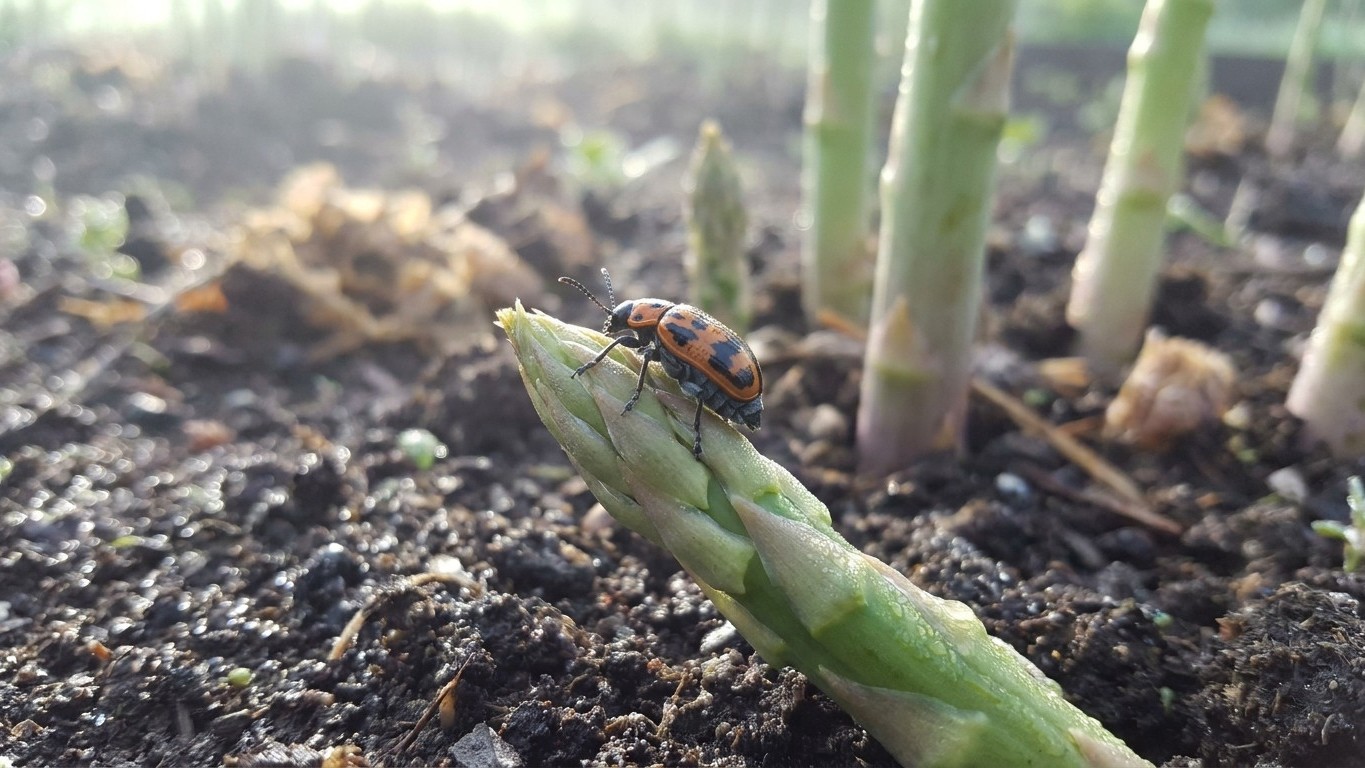

Asparagus beetles start showing up in Quebec gardens the moment spears push through the soil, usually between mid-May and early June, and they stick around feeding on ferns well into summer. The two species that matter here, the common asparagus beetle and the spotted asparagus beetle, overwinter as adults right in the garden bed, then wake up as soon as daytime temperatures settle into the 50 to 55 degree Fahrenheit range. Cutting old ferns to the ground in fall and picking off adults by hand in spring remain the two most reliable ways to keep populations from spiraling.
When Asparagus Beetles Actually Arrive in Quebec

Quebec’s asparagus season is short, roughly mid-May through late June or early July depending on the region, and the beetles time their emergence almost perfectly with that window. They don’t migrate in from somewhere else. Adults spend winter tucked inside hollow old stalks, under loose bark on nearby fence posts, or in leaf litter left near the asparagus bed. As soon as soil and air temperatures climb into that mid-50s range, consistently, not just for a warm afternoon, they crawl out and head straight for the first spears breaking ground.
This matters for timing your defense. A single warm stretch in April rarely triggers full emergence in most of Quebec, since nighttime lows still dip too low. The real activation point tends to land closer to the third week of May in the Montreal and Monteregie areas, and slightly later, into early June, in the Quebec City region and the Saguenay. Growers in warmer microclimates along the St. Lawrence sometimes see beetles a week earlier.
Because Quebec’s growing season is compressed compared to states further south, these beetles usually complete one full generation and start a partial second one before cold weather shuts things down in fall. In longer-season regions of the U.S., two or even three generations are common. That shorter window is actually a small advantage for Quebec gardeners: less time for populations to explode means damage, while still real, tends to be more manageable if you catch the first wave early.
What Triggers the Second Wave
Eggs laid by the first generation of females hatch into larvae within about a week, feed on fern tissue for 10 to 14 days, then drop to the soil to pupate. A new set of adults emerges roughly three to four weeks after the first spring wave, usually in July. This second wave targets the fern growth that develops after harvest ends, the exact foliage the plant needs to rebuild energy reserves in its crown for next year’s crop. Damage at this stage doesn’t hurt this year’s spears, but it can quietly shrink next spring’s harvest.
Telling the Two Species Apart
Both beetles feed on asparagus, but they don’t behave quite the same way, and knowing which one you’re dealing with helps you predict the type of damage to expect.
- Common asparagus beetle (Crioceris asparagi): about a quarter inch long, metallic blue-black body with cream or pale yellow squares along the wing edges and a reddish band near the head. This is the one that chews spear tips and leaves dark, tar-like eggs standing upright on the stalks.
- Spotted asparagus beetle (Crioceris duodecimpunctata): slightly larger, orange-red with twelve black spots. It feeds mostly on ferns and berries rather than young spears, so it does less visible damage to the part you actually eat.
The common asparagus beetle causes the more obvious economic problem because its egg-laying and feeding scar the spears directly. Even light feeding leaves brown, roughened patches on spear tips that make them unmarketable, even though the plant tissue underneath is perfectly fine to eat.
What Actually Stops Them
Control works best as a layered approach across the season rather than one single fix. Nothing on this list eliminates the beetle permanently from a garden, but combined, they keep numbers low enough that damage stays cosmetic instead of crop-threatening.
Fall Cleanup Removes Their Winter Home
Cutting asparagus ferns down to about 2 inches above soil level after the first hard frost, then removing and destroying the debris rather than composting it in place, eliminates the hollow stalks and loose plant matter where adults overwinter. This single step does more to reduce next spring’s population than almost anything applied during the growing season, because it attacks the beetle at its most vulnerable point: sheltering through a Quebec winter with nowhere else to go.
Daily Harvesting During Spear Season
Females lay eggs directly on emerging spears. Harvesting daily, or at minimum every other day, during the six-to-eight-week cutting window removes egg masses before they hatch and before the spears develop visible scarring. Gardens that only harvest a couple times a week give the eggs time to hatch right on the stalk, and by the time you notice, larvae have already started feeding.
Hand-Picking and Physical Barriers
Adult beetles are slow-moving and don’t fly off in a panic the way some pests do, which makes hand-picking genuinely effective on a home-garden scale. Early morning, when temperatures are cooler, is the best time since beetles are less active and easier to knock into a container of soapy water. For beds under an acre, checking plants every two to three days during peak emergence in late May catches most of the population before egg-laying ramps up.
Floating row covers, installed right after the first spears appear and before beetles emerge, physically block adults from reaching the plant. Because asparagus doesn’t need pollinators to produce edible spears, covers can stay on for most of the harvest window without hurting yield. Remove them if you’re also trying to save seed from female plants, since berry production does depend on pollinator access.
Natural Predators Already Working in Quebec Gardens
A small parasitic wasp, Tetrastichus asparagi, specifically targets asparagus beetle eggs and has established itself in many parts of eastern Canada without any introduction effort on the gardener’s part. Avoiding broad-spectrum insecticides preserves this wasp population, which in established gardens can knock out a meaningful share of eggs on its own. Ladybugs and lacewings also feed on beetle larvae when they’re present in the bed, another reason to think twice before reaching for a broad insecticide at the first sign of a beetle.
When Treatment Becomes Necessary
If hand-picking and cultural practices aren’t keeping pace, insecticidal soap or a spinosad-based product, both commonly available and registered for home garden use in Canada, target larvae effectively with lower impact on beneficial insects than broad-spectrum options. Neem oil works as a repellent and mild larvicide but needs reapplication after rain, which in a typical Quebec spring means fairly often. Any product used should carry a Pest Management Regulatory Agency registration number on the label, since that confirms it’s approved for use in Canada and lists the correct application rate for edible crops.
Timing treatment to target larvae rather than adults tends to work better, since larvae can’t fly away and are actively feeding, which means they contact treated surfaces more directly. Spraying adults often just scatters them to a neighboring row rather than reducing the overall population.
Preventing Next Year’s Problem Now
The choices made during this year’s harvest set up how bad next spring looks. Beds that get cut back cleanly in fall, harvested daily during spear season, and left free of nearby wood debris or old fence posts tend to carry over noticeably fewer overwintering adults than beds where ferns are left standing or debris piles up nearby.
Crop rotation isn’t really an option with asparagus, since established beds stay productive for 15 years or more in the same spot. That permanence is exactly why sanitation matters more here than with annual vegetables: whatever overwinters in or near the bed this year is what you’re dealing with again next May, in the same location, without the reset that comes from moving a crop to new ground.
Home gardeners sometimes plant tomatoes near asparagus rows on the theory that the smell disrupts beetle behavior. There’s no solid research confirming this actually reduces beetle numbers, though it doesn’t hurt to try alongside the methods that do have evidence behind them. What’s better documented is that healthy, vigorous fern growth after harvest, meaning ferns that get to grow undisturbed and well-watered through summer, produces stronger root reserves that help the plant tolerate some beetle feeding without a real yield hit the following spring.