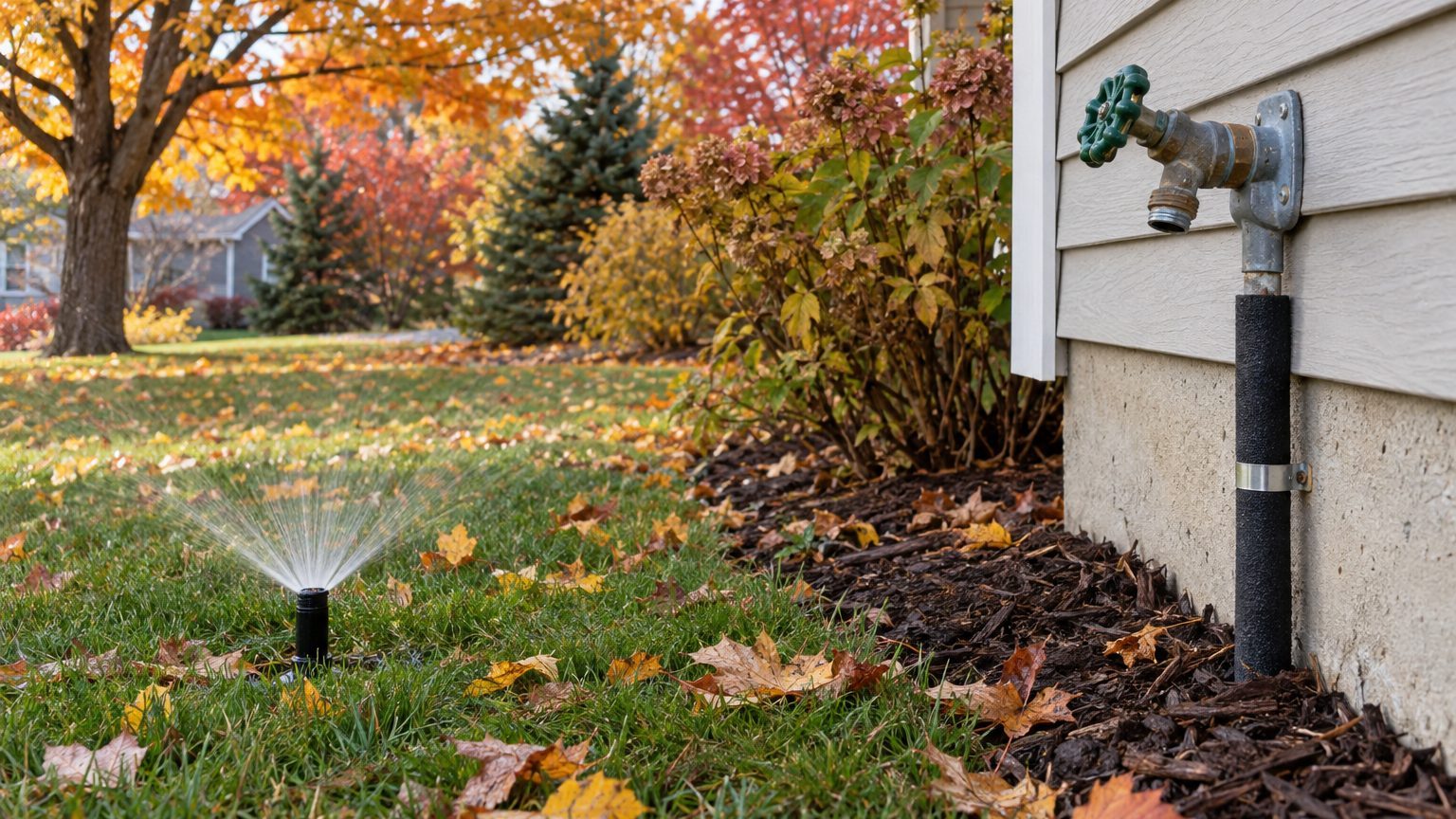

Drain the system before the first hard freeze, not after the first light one. In the Montreal area, that means the weeks around early October, since Environment and Climate Change Canada puts the average first fall frost on October 5. Sprinkler lines, valves and outdoor taps are all part of the same job, and the order matters: irrigation first, then faucets and hoses. Colder districts north of the island and on higher ground should move the work earlier.
When to do it in Quebec
Finish before the first hard freeze, not after the first light one: a skim of frost on the lawn tells you the season is turning, but it rarely freezes a buried pipe. Plan the work for the weeks around October 5, and have the lines empty before overnight lows drop well below freezing. That date comes from Environment and Climate Change Canada’s Canadian Climate Normals for 1981-2010, read at the Montreal/St-Hubert A station, and it is an average, not a deadline.
An average has a catch. It is the midpoint of a spread, so in about one year out of two the first frost lands later than October 5, and in the other half it lands earlier. Treat it as the center of a window, never as a safe date. A homeowner who waits for the 5th because “that’s when it freezes” will get caught in every year the cold arrives ahead of schedule, and those years are not rare.
Why a full blowout is not optional here
Nothing about this climate lets you skip the job. The mean daily minimum of the coldest month at the Montreal reference station is -14.1 °C (6.7 °F), according to the same 1981-2010 normals. Ground and exposed pipe spend long stretches far below freezing, and water left in an irrigation line has nowhere to expand. A mild-winter region can get away with a quick valve shutoff and a hope. Quebec cannot, so a complete drain or blowout is the standard, not the extra mile.
Moving the date for your own district
The Montreal/St-Hubert station is one point on the map, and a province is not one climate. Farther north and at higher elevation, the first fall frost tends to arrive earlier, so the fall tasks (draining, blowing out, disconnecting) shift earlier too. Never later. If your property sits in the Laurentians, the Eastern Townships hills or anywhere north of the St. Lawrence plain, start before October gets going rather than during it.
For context, Natural Resources Canada’s plant hardiness map places Montreal in Canadian zone 5b (1991-2020 normals). That is the Canadian system, built on several climate variables, and it does not convert to a USDA zone. Also keep in mind that the Canadian normals cited here cover 1981-2010, while US figures elsewhere cover 1991-2020, so the two will not line up neatly. For the full picture of the provincial calendar, the Quebec guides cover the rest of the season.
One practical habit helps more than any date. Starting in late September, check the overnight forecast every few days. When a run of nights approaches freezing, you are inside the window, and the blowout should happen on the next dry afternoon.
Sprinkler lines: drain or blow out
Water expands when it freezes, and the pipe has no give. A buried polyethylene line may stretch a little, but fittings, valve bodies, risers and sprinkler heads are rigid or thin-walled, and they crack. Nothing looks wrong in November. The damage shows up in spring, when you pressurize the system and water sprays from a split, or a valve weeps a steady trickle into the soil. A cracked valve body is the usual casualty, and the part is far more costly in labor than in material.
There are three ways to empty a system, and they are not equal in this climate.
| Method | How it works | Fit for Quebec |
|---|---|---|
| Manual drain | You shut the supply and open drain valves at low points so gravity pulls water out | Works only on systems built with those drains, and often leaves pockets behind |
| Automatic drain | Valves at the heads or low points open when pressure drops and let water seep out | Acceptable as a backup; not a guarantee after a hard cold winter |
| Compressed-air blowout | Air pushed through each zone forces water out of pipes, valves and heads | The method this climate calls for |
Gravity drains leave water in dips, sagging runs and the low side of every head. Automatic valves can stick open or closed with grit, so a system that relied on them one year may fail the next. With a coldest-month minimum of -14.1 °C, anything that remains in the lines will freeze, and the only way to be sure the lines are empty is to push the water out with air.
How a blowout is done, and where it goes wrong
The sequence is the same in every yard. Shut off the water supply to the system, then open the test or drain point to release pressure. Connect the compressor to the blowout port, and run the zones one at a time, starting with the one farthest from the connection. Stop each zone as soon as the heads emit only mist. Cycling through the zones a second time clears what the first pass left behind.
The danger is air, not water. Too much pressure, or too much time on a single zone, can overheat plastic parts and burst a fitting. Never stand over a head or a pipe while air runs through it, and wear eye protection. Follow the pressure limits of your pipe and sprinkler heads, and do not guess at them. The backflow preventer or vacuum breaker is a delicate assembly, and it should be drained according to its own instructions.
A professional is the sensible choice if you do not own a compressor with enough capacity, if you cannot find the blowout port, if the system has several zones with different pipe materials, or if you are not sure what the pressure limits are. A single mistake costs more than a service visit. Book the blowout before the first week of October, because contractors fill up fast once the forecast turns. Call early and you avoid the rush that follows the first cold snap.
With the system empty, the garden side of fall is next. The same attention to timing applies when winterizing a lawn, since irrigation and turf care often overlap in the same weeks.
Outdoor faucets and hoses
This is the job most homeowners get wrong, and it takes ten minutes. Disconnect every hose, splitter, timer and sprayer from every outdoor tap. Drain the hoses, coil them, and store them indoors. Then go inside, find the shutoff valve that feeds each outdoor faucet, and turn it off. Return outside and open the faucet so whatever remains in the line can run out. Leave the outdoor tap open through the winter, so any last water has room to expand.
That is all. There is no cutting, no soldering, no taking apart of the faucet. If you cannot find the interior valve, if it leaks when you turn it, or if it will not close, stop there and call a plumber. Anything beyond turning valves is not a homeowner’s job.
The full routine is laid out in Winterizing Outdoor Faucets Before the First Freeze, and the timing is the same as for the irrigation lines: before the first hard freeze, in the weeks around October 5 for the Montreal area. Disconnect the hoses at the same time you schedule the blowout, and close the interior valves the same week.
Why a frost-free faucet still fails with a hose attached
A frost-free faucet does not resist freezing because of some special material. It works because the valve seat sits deep inside the heated part of the wall, and the stem slopes slightly downward so the water in the barrel drains out when the tap is shut. That slope is the whole trick. If the tap is closed and nothing is attached, the barrel empties on its own and nothing is left to freeze.
Attach a hose, and the trick fails. The hose holds water against the spout, the barrel cannot drain, and the water sits in the pipe just outside the warm wall. It freezes, expands, and splits the pipe, often behind the wall where you cannot see it. Even a short hose with a spray nozzle on the end will do it, and so will a hose that looks empty but holds a few ounces in a kink. Frost-free design only works with a clear spout. The basics are covered in more detail in the article on frost-free outdoor taps.
A faucet that has no interior shutoff, or one whose handle turns without stopping the flow, needs attention before winter. That repair belongs to a plumber, not to a weekend project. The cost of the visit is small next to the cost of a split pipe inside a wall.
What goes wrong here
Three failures account for most of the damage, and each one is tied to how fast this climate turns.
The early cold snap
Because October 5 is an average, a cold stretch can arrive in late September before anyone has touched a valve. The lines are still full, the hoses are still attached, and the forecast gives one night of notice. In spring the result is a pressurized system that sprays from a crack, a head that will not pop up, or a valve that leaks at the base. The prevention is a plan, not luck. Pick a weekend in the window, keep the compressor booked or the contractor on call, and treat any forecast of nights approaching freezing as the signal to go.
If the cold arrives first, shut the supply to the system and open the drains, and then wait for a thaw before using any compressed air on lines that may still be frozen. Forcing air into a plugged, iced pipe can burst it. When a hard freeze has already come and the lines may hold ice, a professional should assess the system. For plumbing inside the house, the wider picture is in the guide to frozen pipes.
The forgotten hose and the flooded valve box
The forgotten hose is almost always the one at the back of the house, the one behind the shrubs or the one attached to a rain barrel adapter. It shows up in spring as a wet spot on the basement wall, a drip from the interior side of the tap, or a faucet that sprays sideways when you turn it on. The prevention is a walk around the property with a short list: every tap, every hose, every splitter, every timer.
The valve box is the third trap. These underground boxes hold the zone valves, and they fill with groundwater, meltwater or leaks. If water sits in the box when the temperature falls, it freezes around the valves and cracks them. In spring the symptom is a zone that will not shut off, or a box that is full of water again after you pump it out. Check the lids, clear out debris, make sure the soil slopes away from the box, and confirm that the box drains. Open each valve box in the fall, before the first hard freeze, and look for standing water. If it holds water, the drain path needs attention before winter, not after.
Common questions
Is October 5 the deadline for winterizing in Quebec?
No. October 5 is the average first fall frost at the Montreal/St-Hubert A station, from Environment and Climate Change Canada’s 1981-2010 normals. In about one year out of two the frost comes later, and in the other half it comes earlier. Treat it as the middle of your window, finish before the first hard freeze, and move the work earlier if you live north of Montreal or at higher elevation.
Do I need a compressed-air blowout every year?
In a climate where the coldest month’s mean daily minimum is -14.1 °C (6.7 °F), yes. Manual and automatic drains can leave water in low spots, and anything left will freeze. A blowout is the method that empties the lines reliably. If you do not own the equipment or are unsure of your system’s pressure limits, hire a professional.
Does a frost-free faucet need any winter prep?
It needs one thing: nothing attached to it. Remove the hose, splitters and timers, shut the interior valve, and leave the outdoor tap open so any remaining water can drain. A hose left on will trap water in the barrel and can split the pipe inside the wall.
What if the hard freeze comes before I have drained the system?
Shut off the supply, open the drains, and wait for a thaw before using compressed air on any line that may be frozen. Forcing air into ice can burst pipes and fittings. If you suspect a freeze has already reached the lines, have a professional check the system before spring start-up, and turn it on slowly in the spring while watching for leaks.