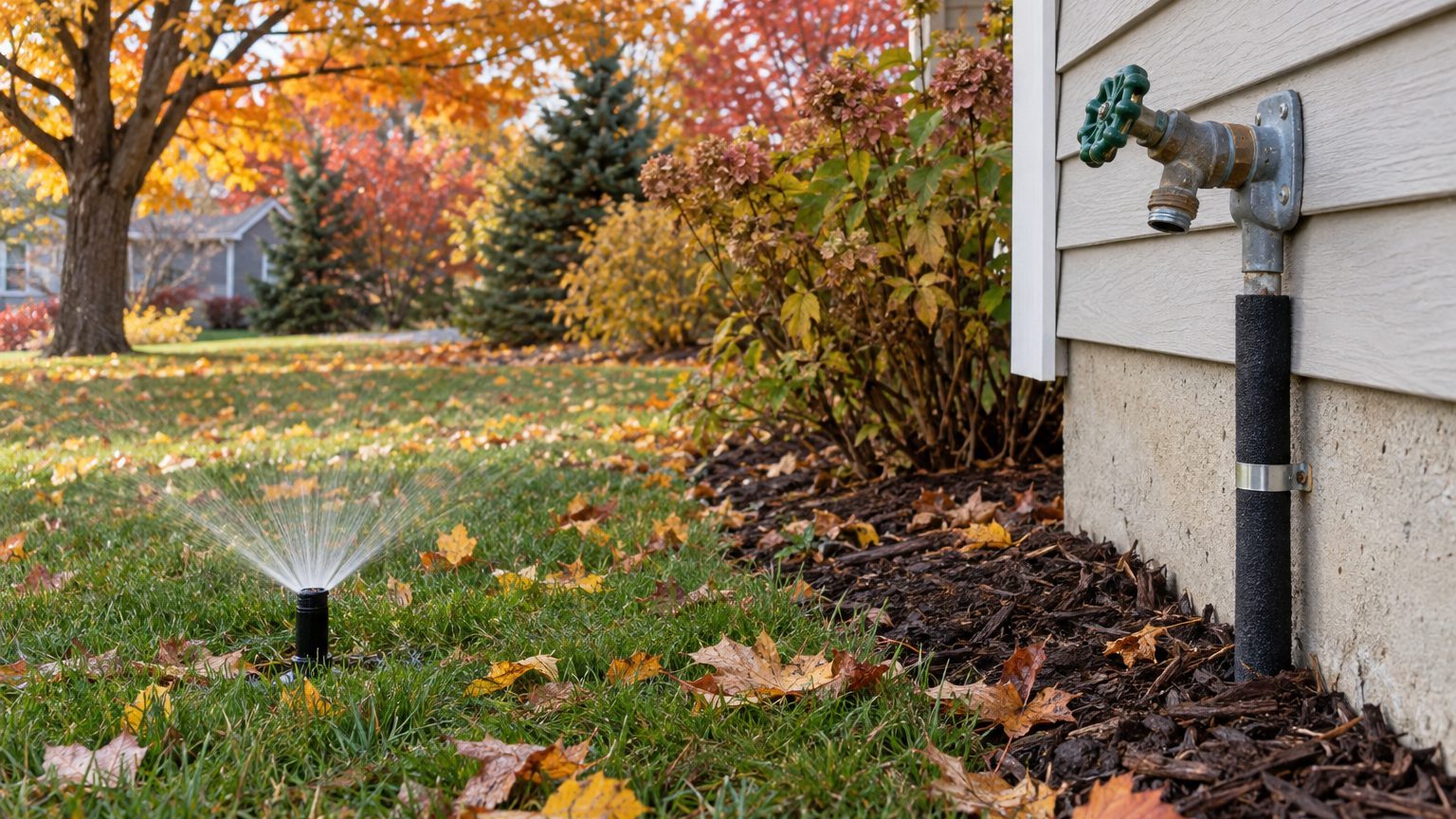

Finish before the first hard freeze, not after the first light one. For most of North Carolina, that means handling sprinklers and outdoor faucets in the weeks before late October. Mountain homes should go earlier, and coastal homes get a little more runway. It’s October 12, so the calendar is already tight. The job is lighter here than in Minnesota or Vermont, though, and part of it is nothing more than turning valves.
When to do it in North Carolina
Aim to have everything drained and shut down before Charlotte’s first-freeze window of October 30 to November 8, and treat the front edge of that window as your deadline: finish before the October 30 to November 8 window for the first 32°F freeze. The rule is before the first hard freeze, not after the first light one.
The window comes from NOAA’s NCEI U.S. Climate Normals for 1991-2020, which put the first 32°F freeze at the Charlotte station in a 30 to 70 percent probability band between those two dates. Charlotte sits in the Piedmont, so it works as a midpoint. A probability band is not a promise, either. Some years the first freezing night shows up ahead of it, and a pipe has no way of knowing it was supposed to be safe until October 30.
The light-versus-hard distinction matters because the two do different damage. A light frost is a dip to freezing around dawn that melts off by mid-morning. It blackens basil and glazes the car, and it rarely threatens buried pipe. A hard freeze settles in overnight and stays for hours, long enough for water standing in a fitting or faucet to turn solid. Waiting for the first light frost as your signal sounds sensible, but it leaves you reacting to a warning when the actual threat may be a few nights behind it.
Why a full blowout is often unnecessary here
The same NOAA normals list 31.8°F as the mean daily minimum of Charlotte’s coldest month. An average night in the dead of winter bottoms out a hair under freezing. That’s mild by northern standards, and buried lines in soil that stays warmer than the air above it are less exposed than the parts sticking up into the cold. For many Piedmont and coastal-plain yards, a compressed-air blowout every single fall is more than the climate demands.
What is worth doing is protecting the exposed parts. Shut off the water supply to the system, drain the low points, insulate the backflow preventer and any above-ground pipe, and disconnect every hose. Then keep a cold-snap plan ready for the nights that run well below that average. An average conceals extremes, and the USDA Plant Hardiness Zone Map 2023 is built on exactly the number that decides pipe damage: the average annual extreme minimum, the single coldest night of the year. The map puts the state somewhere between 5b and 8b, so your yard may differ a lot from Charlotte’s.
Direction matters. The farther west and higher you go into the Blue Ridge, the earlier the first fall freeze arrives, so mountain homeowners should finish well before the Charlotte window rather than inside it. Coastal-plain properties generally see freezes later in fall, which buys extra days but not an excuse to skip the job. Other parts of the state are covered in our North Carolina guides. And since the same weeks also mark the start of lawn season’s end, Winterizing a Lawn fits on the same fall to-do list.
Sprinkler lines: drain or blow out
Why trapped water splits things
Water expands as it freezes. In a sprinkler system, that expansion has nowhere to go: ice forms a plug in one stretch of pipe, and the pressure builds against the closed valve or fitting beyond it. The pipe itself sometimes survives. The failures tend to land at the weak points, like valve bodies, risers, couplings, and above all the backflow preventer, which sits partly above ground and takes the full force of cold air. The damage is a slow-motion crime. It happens in January and gets discovered in April, when the water comes back on and starts leaking out of a crack nobody knew about.
Three ways to empty a system
A manual drain relies on valves at the low points of the system. You close the supply, open those valves by hand, and let gravity pull the water out. It works well on systems that were installed with proper slope and with those valves, and it costs nothing but attention. The weak spot is the homeowner’s memory: miss one valve and you’ve left a pocket.
Automatic drain valves do the same job without being asked. Each sits at a low point and opens on its own when line pressure falls after you shut off the supply, letting that section drain. They’re convenient, but debris can stop them from sealing or opening fully, so they deserve a look each season rather than blind trust.
A blowout pushes compressed air through each zone, forcing water out through the heads. It clears the pockets that gravity leaves behind, which is why it’s the standard in cold climates. It’s also the method with the most ways to go wrong: too much pressure can crack fittings and heads, running air through dry heads for too long can overheat them, and zones must be cleared one at a time, with eye protection on and nobody standing over the pipes.
What this climate calls for
In Charlotte and across much of the Piedmont and coastal plain, a drain-and-insulate routine with working low-point valves is a reasonable baseline, given that coldest-month nights average 31.8°F. Add a blowout if your system has any section that can’t be drained by gravity, or if you simply want the margin. In the mountains, and on the colder edges of the Piedmont, I’d treat the blowout as the default every fall, since freezes arrive sooner and run harder. Book a blowout before late October, ahead of the October 30 to November 8 window, if you’re in the mountains or can’t confirm your low points drain.
When a professional makes sense
Call one if you don’t know where the drain valves are, if the system has no drains at all, if the backflow preventer is above ground and you aren’t sure how to isolate it, or if you don’t own a compressor with enough capacity for sprinkler work. Homeowner-grade compressors often can’t deliver the volume of air, and renting one without knowing the right pressure for your pipe type is how fittings get cracked. A technician will also tell you what shape the system is in. That’s worth having once.
Outdoor faucets and hoses
The sequence, step by step
This is the easy part of the job, and it needs nothing but your hands. Order matters, though:
- Unscrew every hose, splitter, timer, and sprayer from every outdoor faucet.
- Drain the hoses, coil them, and store them in a garage or shed.
- Find the interior shutoff valve for each outdoor faucet (often in a basement, crawl space, or utility room) and turn it off.
- Go back outside and open the faucet fully so the water left in the line can run out.
Leave the outside tap open for the season. That gives any remaining water room to expand rather than pressing against closed metal. The full routine is laid out in Winterizing Outdoor Faucets Before the First Freeze. If you can’t find an interior shutoff, or the valve won’t turn, stop there. Anything past turning valves, such as replacing a stuck valve or adding a shutoff, is a plumber’s job, and forcing a corroded valve is how a minor chore becomes a flooded crawl space.
Why a frost-free faucet still fails with a hose attached
Frost-free faucets are the tidy answer to cold, and they earn their reputation. The valve seat sits at the end of a long stem, deep inside the heated wall, and the barrel slopes slightly downward so water runs out the spout after you shut it off. Remove the slope’s ability to drain and you’ve defeated the design.
A hose left attached does exactly that. The nozzle end is closed, so water stays trapped in the hose and the barrel instead of draining. Cold air reaches the part of the faucet that sticks out beyond the warm side of the wall, the trapped water freezes, and the split often happens in the pipe behind the siding, where you can’t see it. Nothing shows until spring, when the interior valve opens and water sprays inside the wall. Frost-Free Outdoor Taps explains how to tell whether yours is installed with the right pitch.
For homes in the Charlotte area, unscrew every hose before the October 30 to November 8 window opens, and do it sooner in the mountains. With coldest-month nights averaging 31.8°F per NOAA, one night below freezing is enough to hurt a connected hose and the tap behind it. Hoses are cheap, but wall repairs are not.
What goes wrong here
The most likely failure in North Carolina is simple timing. Climate normals describe typical years, and plenty of years aren’t typical. An early cold snap can arrive before anyone has gotten around to draining, especially when October stays warm and the job slides down the list. The result is a cracked backflow preventer or a split fitting, and you won’t see it until spring. The fix costs nothing: do the shutdown early, and treat the Charlotte window of October 30 to November 8 as the last call, not the plan.
The forgotten hose is next. It usually hides behind a shrub, on a spigot at the back of the house, or on a faucet that serves a pool or garden shed. In spring it announces itself as a wet spot on the wall, water dripping from a basement ceiling, or low pressure from the tap once you open the interior valve. Prevention is a walk around the house with a checklist, counting faucets, before the first hard night. If a pipe does freeze, read Frozen Pipes before reaching for a heat source.
The valve box is the sneaky one. The buried plastic boxes that house sprinkler valves collect runoff, and a box with standing water can freeze solid around the valves inside. In spring you find a zone that won’t turn on, a hissing sound, a soggy patch of lawn, or water pooled in the box when you lift the lid. Check boxes before winter. Make sure the lid sits properly, clear out debris, and confirm the valves aren’t sitting in water. Check the forecast daily from the last week of October into the first week of November, and drain the same day a 32°F night appears in it.
Common questions
Does one light frost mean it’s too late?
No. A light frost is a warning, not a deadline missed. A brief dip to 32°F at dawn rarely freezes buried lines. Treat it as proof the season has turned and finish the job within days, before a longer freeze catches the exposed parts.
Do coastal homes still need to winterize?
Yes, though the job can be lighter. The coastal plain gets freezes later in fall and loses them earlier in spring than Charlotte does, so draining, shutting off the supply, insulating the backflow preventer, and disconnecting hoses often cover it. A hard freeze can still arrive in any year, and one night is enough to split a connected faucet.
Can I leave a hose on a frost-free faucet?
Not safely. The faucet only protects itself if water can drain from the barrel after you shut it off, and an attached hose blocks that. Take the hose off every fall, even when the faucet is labeled frost-free.
When do I turn the sprinklers back on in spring?
Wait until the nights in your area have stopped dipping to freezing, then restart the system with the valves opened slowly and the zones checked one at a time. The calendar shifts by location: the Blue Ridge runs several weeks later in spring than Charlotte, so a mountain restart that matches a Piedmont date would be premature.