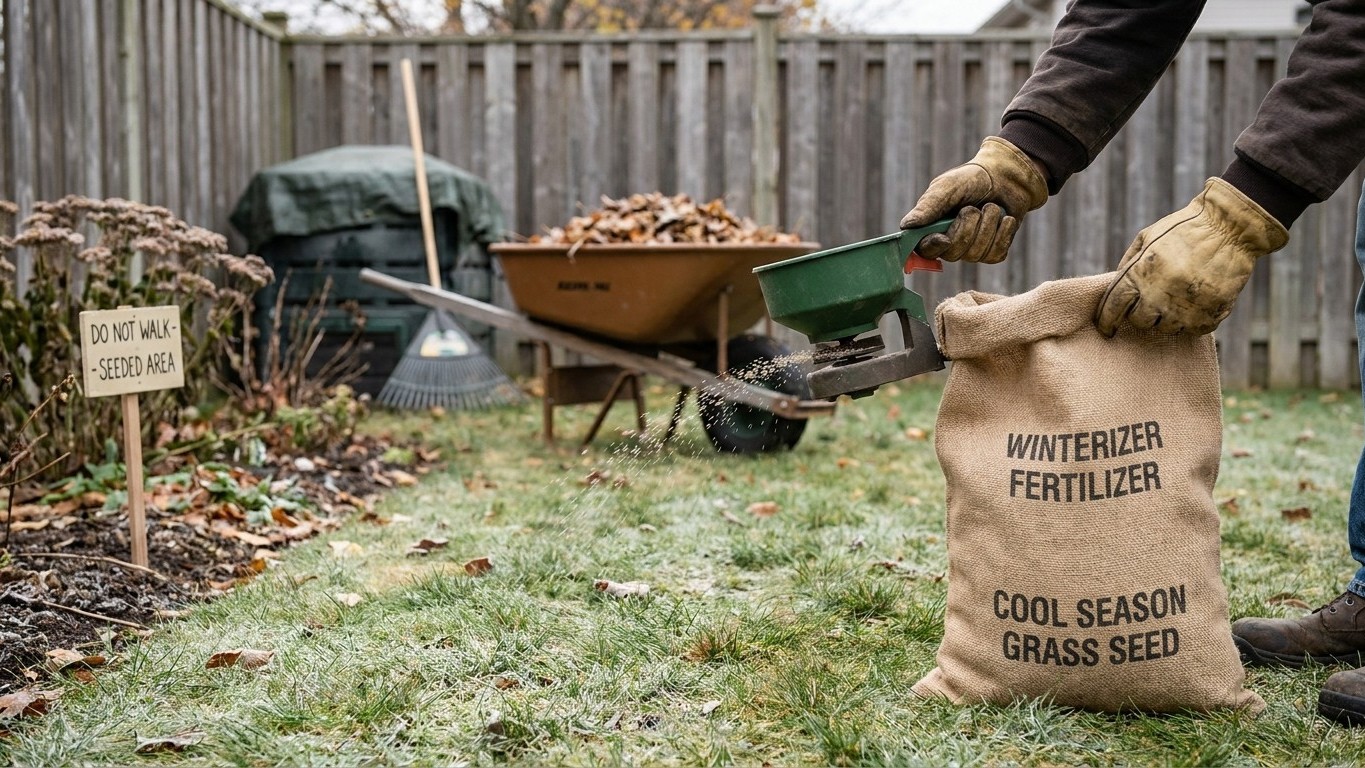

Your lawn won’t tell you if you get this wrong — not until spring. Right now, tan or green, mowed or shaggy, it all looks the same, but a lawn cut too tall going into winter traps moisture against the crown and invites fungal disease, while one cut too short heads into cold weather without enough leaf tissue to survive dormancy. So before the ground locks up, check your grass type against its mowing range and take the last cut down to the low end of it — gradually, over two or three mows, not all at once.
Why this matters
Skip the last mow or leave the leaves piled up, and the lawn doesn’t tell you right away. The grass goes dormant, the color fades to tan or brown, and everything looks the same whether the work got done or not. The failures from a skipped winterizing pass don’t show up until spring green-up, when matted patches, thin spots, and dead grass under old leaf piles finally reveal themselves. By then you’re looking at reseeding instead of a quick fix.
The mistakes show up in spring, not now
A lawn left too tall going into winter holds moisture against the crown of the grass under snow or cold rain, which is exactly the condition that lets fungal disease take hold over winter. A lawn left too short is stressed heading into cold weather with less leaf tissue to store the carbohydrates it needs to survive dormancy and green up again in spring. Both mistakes are invisible in November. Both are obvious in April.
Leaves matter for the same reason. A thin scattering, mulched fine into the turf, breaks down and feeds the soil. A thick, wet mat smothers the grass underneath it, and by the time you can see the dead patch, the grass has already been dead for weeks. If you kept up with regular lawn care through spring and summer, winterizing is a short list of finishing jobs, not a rescue mission.
When to do it
Cool-season grass and warm-season grass are on opposite clocks, so the timing question splits in two before you even get to a calendar.
Cool-season grasses
Fine fescues, Kentucky bluegrass, perennial ryegrass, and rough bluegrass are all cool-season species, and Penn State Extension notes they put on their strongest growth as temperatures drop in fall, not in the heat of summer. That means the winterizing jobs, the last mow, the final feeding, the leaf clearing, land while the grass is still green and actively growing, right up until the first hard freeze knocks it into dormancy. Doing these jobs after the grass has already browned off wastes the fertilizer and risks scalping dormant crowns with the mower.
Warm-season grasses
Bermudagrass, zoysiagrass, centipedegrass, St. Augustinegrass, bahiagrass, carpetgrass, and seashore paspalum are warm-season species. HGIC’s species-specific maintenance calendars, including HGIC 1216 for bermudagrass, HGIC 1217 for zoysiagrass, HGIC 1215 for centipedegrass, and HGIC 1218 for St. Augustinegrass, lay out each grass’s fall slowdown. These grasses start shutting down for the year earlier than cool-season turf does, so the last mow and last feeding happen on an earlier schedule relative to the first frost, sometimes well before the ground itself is anywhere near freezing.
Check your own first frost date, not the calendar month, before scheduling the last mow. Neither clock runs on a fixed date, so pull the local frost window from your state extension service or NOAA’s climate data rather than guessing from a neighbor’s schedule in a different county.
How to do it

Mowing the last cut
Lower the cutting height gradually over the last two or three mows rather than dropping it all at once, and land at the bottom of your grass’s normal range. Penn State Extension puts Kentucky bluegrass, perennial ryegrass, and rough bluegrass at 2 to 3 inches, and fine fescues at 2.5 to 3.5 inches. Clemson Cooperative Extension’s HGIC 1214 lists tall fescue at that same 2.5 to 3.5 inches, and for warm-season lawns puts bermudagrass at 0.75 to 1.5 inches, zoysiagrass at 0.75 to 2 inches, centipedegrass at 1.5 to 2 inches, St. Augustinegrass at 2.5 to 4 inches, bahiagrass at 3 to 4 inches, carpetgrass at 1 to 2 inches, and seashore paspalum at 1 to 1.5 inches. Never scalp below the low end of that range; a too-short cut going into dormancy strips the leaf tissue the plant needs to survive winter. Full mowing guidance, including blade sharpness and clipping return, is in HGIC 1205.
Fertilizing and liming
If a soil test calls for lime, fall is a good window because the material has months to react with the soil before spring growth starts. For fertilizer, HGIC 1201 covers the pounds of nitrogen per 1,000 square feet appropriate for each grass type, and the right rate depends on your species and how much you’ve already applied that season, so pull the specific number from that fact sheet rather than guessing. Applying too much nitrogen too late in fall pushes soft new growth that has no time to harden off before cold weather arrives.
Aerating and a last deep watering
Core aeration relieves compacted soil and works best while the grass is still growing enough to recover from the holes, which for cool-season lawns means doing it before the first hard freeze rather than after. A last deep watering before the ground actually locks up helps roots enter dormancy without drought stress, especially on sandy soil that drains fast. Neither job needs doing every fall, just when the lawn shows compaction or has gone through a dry stretch.
Clearing leaves and finishing seeding
Rake or mulch-mow leaves before they mat down into a wet layer on the turf. A light scattering, chopped fine with the mower, breaks down and feeds the soil. A thick, unbroken layer needs to come off with a rake or blower. If you’re still filling in thin or bare patches, get any remaining seed down before the soil cools too far for germination. See Overseeding: Thickening a Thin Lawn Without Starting Over for the seed-to-soil contact and watering steps that make fall seeding actually take.
- Lower the mower gradually to the bottom of your grass’s normal range
- Apply lime or fertilizer only if a soil test or HGIC 1201 calls for it
- Rake or mulch-mow leaves before they mat down
- Finish any overseeding before soil cools too far for germination
- Aerate compacted soil and give one last deep watering if the season’s been dry
What goes wrong
Snow mold and matted grass
Leaving the lawn too tall into winter, especially under snow cover or a run of cold, wet weather, creates the damp, shaded conditions that let fungal disease set in at the crown of the grass. The tell is a matted, grayish or pinkish patch that shows up as snow melts or the ground thaws, not while it’s covered. By the time you see the patch, the fungus has already been active for weeks, and the fix is raking the area open to air and light rather than any fall-season correction, since the damage happened months earlier.
Leaves left too long
A wet mat of leaves left on the lawn all winter smothers the grass under it the same way a tarp would. The grass beneath turns yellow, then dies outright, and you won’t see the bare patch until the surrounding lawn greens up around it in spring. For what to do with debris left over from winter, see Spring Lawn Cleanup: What to Do First and What to Leave. Leaves that get mulched fine with the mower before they mat down don’t cause this problem, which is why timing the leaf jobs to before the pile gets thick and wet matters more than the total number of times you rake.
Scalping and late fertilizing
Dropping the mower height too far in one pass, rather than over several cuts, scalps the crowns and leaves bare or thin strips that don’t fill back in until well into the following growing season. Fertilizing too late in fall, after growth has already slowed, pushes soft green tissue that has no time to harden before cold weather, and that new growth is often what gets hit hardest by the first hard freeze. Both mistakes trace back to skipping the gradual approach in favor of getting it over with in one visit.
How this changes across the country
The cool-season and warm-season split decides which grasses even grow in a given region, not only when the winterizing jobs happen.
In cool-season territory, fine fescues, Kentucky bluegrass, perennial ryegrass, and rough bluegrass dominate lawns, and the last mow and last feeding land in fall while the grass is still growing hard. In warm-season territory across the South, from bermudagrass and zoysiagrass to centipedegrass, St. Augustinegrass, bahiagrass, carpetgrass, and seashore paspalum, the grass is already slowing well before frost, so the same jobs happen earlier relative to when the ground might actually freeze, if it freezes there at all.
The transition zone
States that sit between the two regions, such as parts of Tennessee, North Carolina, and Virginia, grow both cool-season tall fescue and warm-season grasses like bermudagrass and zoysiagrass depending on the yard, and neither the pure cool-season nor pure warm-season calendar fits cleanly. The species on the ground, not the state on the map, decides which set of winterizing jobs applies, so identify the grass before picking a timing rule.
| Species | Season | Mow height (in) | Shade tolerance | Drought tolerance | Wear tolerance |
|---|---|---|---|---|---|
| Fine Fescues | Cool | 2.5-3.5 | Excellent | Good | Poor |
| Kentucky Bluegrass | Cool | 2-3 | Fair | Fair | Good |
| Perennial Ryegrass | Cool | 2-3 | Fair | Fair | Good |
| Rough Bluegrass | Cool | 2-3 | Excellent | Poor | Poor |
| Tall Fescue | Cool | 2.5-3.5 | Good | Fair | Fair |
| Bahiagrass | Warm | 3-4 | Poor | Excellent | Good |
| Bermudagrass | Warm | 0.75-1.5 | Very poor | Excellent | Excellent |
| Carpetgrass | Warm | 1-2 | Fair | Very poor | Poor |
| Centipedegrass | Warm | 1.5-2 | Fair | Fair | Poor |
| Seashore Paspalum | Warm | 1-1.5 | Poor to fair | Fair to good | Good |
| St. Augustinegrass | Warm | 2.5-4 | Excellent | Good | Fair |
| Zoysiagrass | Warm | 0.75-2 | Excellent | Good | Very good |
Figures for the cool-season species come from Penn State Extension’s lawn establishment guidance. Figures for tall fescue and the warm-season species come from Clemson Cooperative Extension’s HGIC 1214.
Common questions
What if snow falls before I get the last mow done?
Don’t try to mow through it. Wait for a thaw and take the height down then, even if that means mowing later than planned. A tall, snow-covered lawn for a few extra weeks does less damage than running a mower over frozen, snow-covered turf.
Can I aerate after the grass has already gone dormant?
Skip it once the top growth has browned off. Aeration works by letting the grass recover through the holes, and a dormant lawn can’t do that until it resumes growing, so a fall aeration job running late is better pushed to the next active growing season than forced onto dormant turf.
Should I bag the clippings from my last mow of the season?
Not unless they’re clumping thick enough to mat down on top of the grass. A light, chopped-fine layer of clippings breaks down the same way mulched leaves do and returns nutrients to the soil. Only rake or bag if the last cut left visible clumps sitting on the surface.
Is it too late to overseed if there’s already been a frost?
A light frost won’t necessarily stop germination outright, but cooling soil slows it down a lot, and seed put down once the ground is consistently cold may just sit until the following growing season. If you’re this late, treat it as an early start on next season’s seeding rather than a fix for this fall’s bare spots.