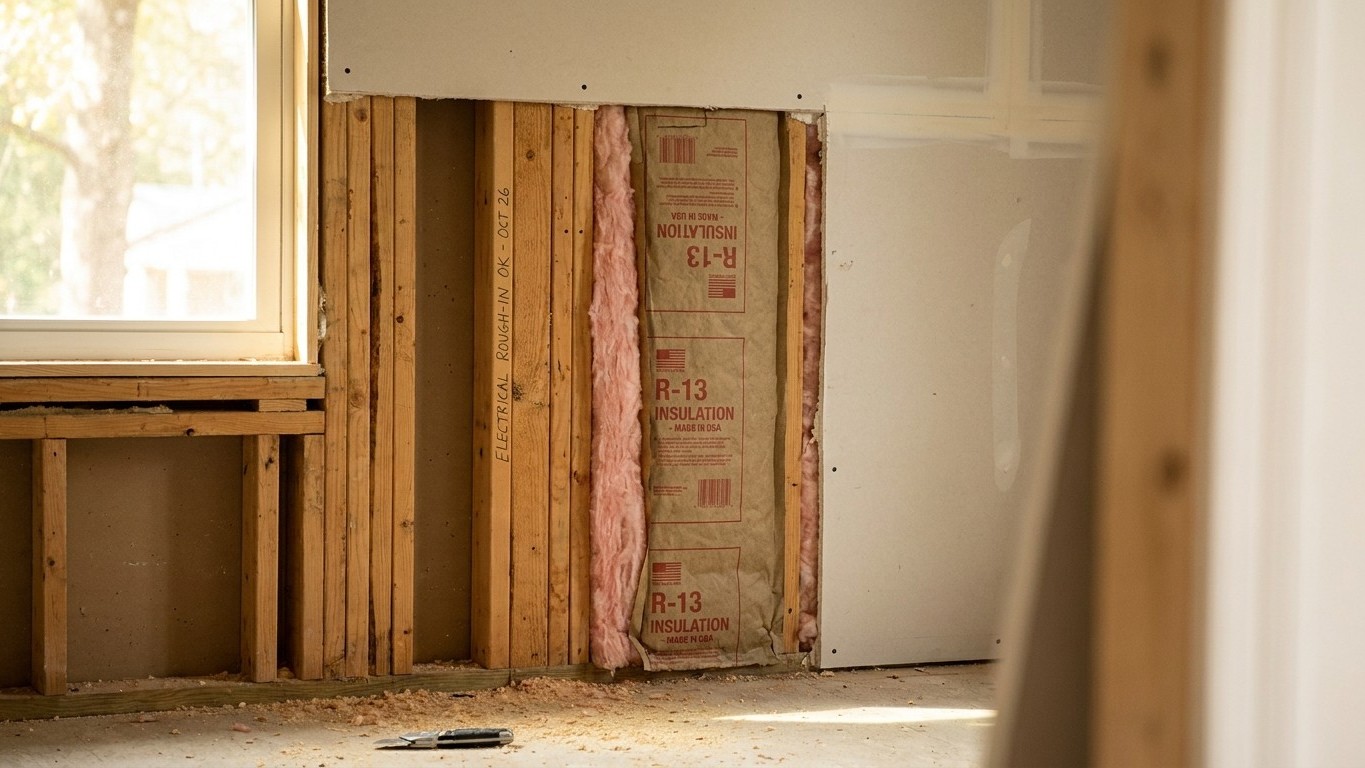

Yes. Every one of Iowa’s 99 counties sits in a cold climate zone under the 2021 International Residential Code, so the exception that removes the vapor retarder requirement in warmer parts of the country does not apply here. A frame wall in Iowa needs an interior vapor retarder of the class set by the code’s table, whether the county is in zone 5A or zone 6A.
What the code asks for in Iowa

The rule itself, from the 2021 IRC, Section R702.7: a vapor retarder of the class given by Table R702.7(2) “shall be provided on the interior side of frame walls.” That’s the baseline requirement for residential construction nationwide, and it’s written to apply unless one of the code’s own exceptions removes it.
Iowa doesn’t get that removal. The state’s 99 counties split between two IECC climate zones: 84 counties in zone 5A, 15 counties in zone 6A. Both are cold, moist zones. The code’s exception, the one that says “a vapor retarder shall not be required in Climate Zones 1, 2 and 3,” has no reach here, because neither 5A nor 6A appears on that list. So the practical answer for Iowa doesn’t split the way the county map does. A homeowner in one of the 15 counties sitting in zone 6A and a homeowner in one of the 84 counties in zone 5A are both under the same basic obligation, even though their zones aren’t identical.
What differs between the two zones, and what the table actually assigns as the required class for each, isn’t something this page can hand a reader without the local code adoption in front of it. That’s a detail for the building department, not a blanket answer for the whole state. What can be said plainly: “not required” in the code’s language is never the same thing as “forbidden.” The exception for zones 1, 2 and 3 lifts an obligation in those places. It doesn’t ban a vapor retarder there, and it certainly doesn’t touch Iowa, where the obligation stands.
None of this tells an individual reader what to put in their own wall. The code sets a baseline, model jurisdictions adopt it (sometimes with amendments, sometimes years behind the current edition), and the version actually enforced on a given permit is the one the local building department has on file. That’s the office to call before framing goes up, not a national code text. A wall built with the wrong vapor control doesn’t announce the mistake. It rots quietly inside the cavity, and the owner usually finds out only when the drywall comes off for some unrelated repair, years later.
Why the answer is the opposite in a warm climate
The reason Iowa’s answer flips for a builder working in Florida or coastal Texas comes down to which direction the moisture is moving, not to a difference in how strict the rules are.
In a cold climate like Iowa’s, the warm, moisture-laden air sits inside the house all winter. Push it toward the wall cavity and it hits cold sheathing near the exterior, where it can condense. An interior vapor retarder stops that water vapor before it reaches that cold surface. That’s the entire logic behind R702.7 in a heating-dominated climate: block moisture from the warm side before it travels toward the cold side.
Flip the climate and the physics flips with it. In a warm-humid zone, the humid air is outside for most of the year, and it’s the air conditioned interior that runs cool. Put a Class I retarder, something like sheet polyethylene, on the interior side of that wall and it becomes the cold, impermeable surface the vapor hits from the other direction. The U.S. Department of Energy’s Building America program spells out exactly what happens next: “If the wall contains a vapor retarder on the interior side of the insulation, the water vapor will condense on this cool, impermeable surface,” and the result is “ruined insulation, mold, and structural rot of framing members.”
That single sentence is the whole reason the code doesn’t apply one rule nationwide. It isn’t bureaucratic inconsistency. It’s the code following the water. Iowa’s winters push moisture from inside out, so the retarder belongs on the inside. A warm-humid state’s summers push moisture from outside in, so the same material in the same spot causes the damage it was meant to prevent. Same code section, opposite instruction, because the climate itself is opposite.
The three classes, and why the word matters
The IRC doesn’t just say “install a vapor retarder.” It grades retarders by how much moisture they let through, measured in perms, and sorts them into three classes.
| Class | Example materials | Permeance |
|---|---|---|
| Class I | Sheet polyethylene, nonperforated aluminum foil | 0.1 perm or less |
| Class II | Kraft-faced fiberglass batts, vapor retarder paint | Above 0.1 up to 1.0 perm |
| Class III | Latex or enamel paint | Above 1.0 up to 10.0 perm |
That table is why calling polyethylene sheeting “a vapor barrier” without qualifying it is misleading. It’s a Class I retarder specifically, the tightest of the three, and the entire disagreement between how a wall gets built in Iowa versus how one gets built in a warm-humid state isn’t about whether to use a retarder at all. It’s about which class belongs on the interior side, or whether an interior one belongs there at all.
Here’s the detail most homeowners miss entirely: ordinary latex wall paint is a Class III vapor retarder. Anyone who’s painted an interior wall with a standard latex product already has one on their wall, whether they meant to install a “vapor retarder” or not. That’s part of why the class distinction matters more than the yes-or-no question. Most walls already have some retarder value built in through paint or facing; the code question is whether that level is sufficient for the zone, or whether something tighter, like a Class I or Class II product, is required.
One more distinction worth keeping straight: a vapor retarder is not an air barrier. They solve different problems, vapor diffusion versus bulk air leakage, even though some products (a well-sealed polyethylene sheet, for instance) can do both jobs at once.
Where the rule stops
R702.7 lists exceptions where the interior vapor retarder requirement doesn’t apply, separate from the zone-based exception already covered above. Three of them:
- Basement walls
- The below-grade portion of any wall
- Construction where accumulation, condensation, or freezing of moisture will not damage the materials involved
The basement exception is the one most Iowa homeowners actually run into, because so many houses here have a basement or a walkout foundation. A poured concrete or block foundation wall holds moisture and releases it slowly, sometimes over years, depending on soil conditions and drainage around the footing. That assembly needs the ability to dry inward, toward the conditioned space, at least part of the time. Trap it behind an impermeable interior sheet and the wall has nowhere to send that moisture, which sets up the same condensation problem described above, just against concrete instead of wood sheathing.
That’s a different assembly with its own set of rules, and it deserves its own answer rather than a paragraph here. The basement wall guide on this site covers how that exception plays out in practice.
Who actually decides, in Iowa
The 2021 IRC is a model code. It becomes law only once a state or a local jurisdiction adopts it, sometimes with amendments, sometimes on a delay measured in years. Iowa’s building departments, city by city and county by county, are the ones holding the actual code edition in force for a given address, along with any local amendments layered on top of it. That’s the office to call before a wall gets closed up, not this page and not the code text alone.
This question carries real weight in Iowa because of how much winter the state actually sees. Des Moines averages about 6,178 heating degree days a year against roughly 1,070 cooling degree days, a lopsided split that measures fuel demand rather than temperature itself: every degree the daily mean sits below 65°F adds to that annual total. A state carrying that much heating demand, with essentially all of its counties in zones 5A or 6A, is exactly the kind of climate the code’s interior vapor retarder requirement was written for.
None of that changes the basic answer for an individual reader building or renovating a specific wall: the local building department, working from the code edition it has adopted, is the only authority that can confirm what’s required at that address. A wall built with the wrong vapor control doesn’t fail in a way anyone notices right away. It fails slowly, inside the cavity, and the damage tends to surface only once the wall is opened up for some other reason entirely.