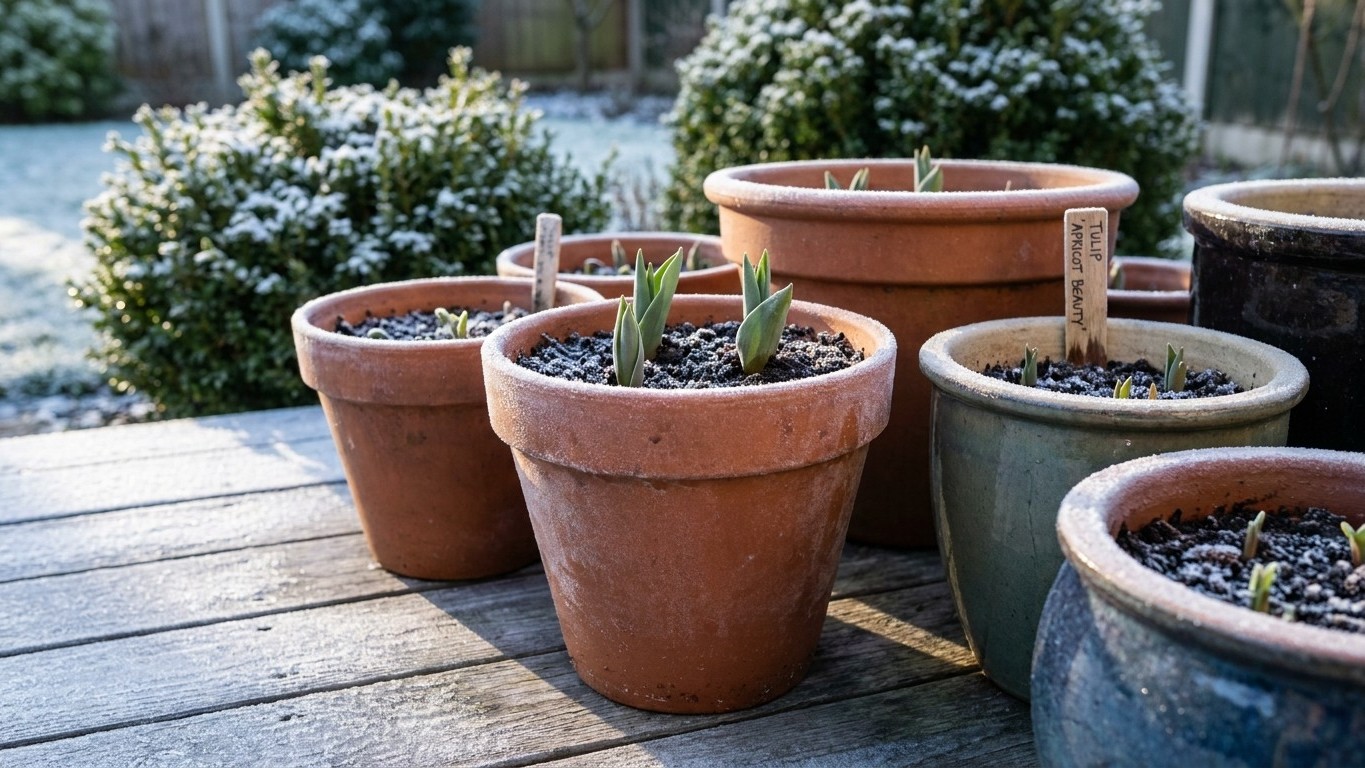

Rhode Island’s winters run cold enough that spring bulbs don’t need help meeting their dormancy requirement outdoors. The catch is the container itself: a pot has no earth mass around it, so it can freeze solid, root ball and all, at temperatures the same bulb would shrug off in a garden bed. That’s the threat to plan for here, not a shortage of cold.
Why this matters in Rhode Island

The average low in the coldest month at the Providence reference station sits at 22.1°F, according to NOAA NCEI’s 1991-2020 Climate Normals. That’s a full 23 degrees below the 45°F threshold spring bulbs need to satisfy before they’ll flower, and it holds for weeks at a stretch, not a single cold snap. In practical terms, the state’s outdoor air delivers the chilling period a tulip or daffodil bulb needs without any intervention from the gardener.
That figure rules out one problem and points straight at another. A gardener in a milder climate, one where winter minimums stay closer to 45°F, has to fake the cold: a refrigerator drawer, an unheated garage, six to eight weeks of artificial chill before the bulb will bloom. Rhode Island doesn’t have that problem. The ground here gets cold enough, long enough, on its own.
Containers flip the equation. USDA’s Plant Hardiness Zone Map, built on the 1991-2020 normals, places the state across zones 6a to 7b, a range wide enough that a bulb rated hardy for Providence can still be at risk in the cooler pockets of the state, and vice versa. A bulb planted in the ground in zone 6a is insulated by the soil mass around it; the frost line moves down from the surface, but the bulb several inches deep stays buffered. Set that same bulb in a container above ground and the pot has no such buffer. Cold reaches it from every side at once, top, bottom, and both walls, and the root ball can freeze straight through.
Horticultural extension guidance commonly treats an exposed, unprotected container as roughly two hardiness zones colder than the ground it sits on. Applied to a Providence-area zone of 6a to 7b, that means an unprotected pot behaves more like zone 4a to 5b during a hard winter. A bulb that’s perfectly hardy in a Rhode Island garden bed can still die in the same yard if it’s left in a pot on the patio all winter with no protection. That’s the mechanism driving nearly every failure with container bulbs in this state, and it’s worth remembering before blaming the bulb.
How to do it here
The sequence below assumes two different goals: bulbs meant to bloom indoors ahead of spring, and bulbs meant to overwinter outdoors in a pot and flower on their own schedule. Both start the same way, then split.
- Match the bulb to the pot’s exposure. If the container will sit outside all winter unprotected, choose bulbs rated at least two zones hardier than 6a to 7b, or plan to move or insulate the pot instead.
- Pot up in fall, in a well-draining mix. Use a container with drainage holes; a pot that holds standing water around bulb roots invites rot regardless of how cold-hardy the bulb is.
- Decide whether you’re forcing indoor bloom or wintering outdoors. For indoor forcing, the bulb needs roughly 12 to 14 weeks below 45°F before it will flower. An unheated garage that stays above freezing works, and so does a spare refrigerator drawer, provided it’s kept away from apples, pears, or any ripening fruit. Ripening fruit releases ethylene gas, and ethylene damages the flower bud inside a chilling bulb before it ever has a chance to open.
- For pots left outdoors, add protection rather than relying on the pot alone. Move containers against a house foundation out of prevailing wind, group them together so they insulate one another, or sink the whole pot into a garden bed or a mound of mulch so the surrounding soil does the buffering the container can’t.
- Check the cold period on a calendar, not a guess. Twelve weeks minimum before checking for root growth; pulling a bulb out of the cold early is the single most common reason a forced bulb blooms on a stem too short to see.
- Bring forced pots into bright, cool light first, not straight to a warm windowsill. A gradual transition over several days lets the stem finish elongating before the flower opens.
- Water sparingly during the cold period, then normally once growth resumes. Bulbs in active cold storage need just enough moisture to keep the mix from drying out completely.
Which bulbs are worth it
A bulb with a short cold requirement forces faster and tolerates a container’s limits better than one that needs a long chill and a tall stem to show off. Height matters more in a pot than in a bed, because a top-heavy stem in a lightweight container tips the whole thing over. And for bulbs that were never going to perform a second year regardless of how they’re grown, forcing costs nothing extra: the bulb was a one-season purchase either way.
Bulbs that force reliably
- Paperwhite narcissus, no cold period required at all, blooms fast, ideal for a first attempt
- Crocus, short chill requirement, short stem suits a small pot
- Muscari (grape hyacinth), compact growth, forgiving of a shorter cold period
- Iris reticulata, dwarf habit, sturdy stem for its size
- Hyacinth, moderate chill requirement, heavy bloom that rarely repeats well outdoors afterward, so forcing it indoors wastes nothing
Bulbs that sulk in containers
- Large trumpet daffodils (the classic tall types), stems flop in lightweight pots
- Large Darwin hybrid tulips, long chill requirement combined with height that topples easily
- Giant allium varieties, both the chill period and the mature height work against a pot
- Fritillaria, prone to rot in container conditions where drainage isn’t close to perfect
What goes wrong, and when you can still fix it
Leaves but no flower
This means the cold period ran short. The bulb had enough stored energy to push foliage but never finished differentiating the flower bud inside it before being warmed. There’s no fixing it this season; the bloom simply isn’t there to force forward. The bulb can go into a garden bed for next year, where Rhode Island’s winter will finish the job the container didn’t.
Short flower stem, bloom buried in the leaves
This is a bulb warmed too early, before the stem had time to elongate at cool temperatures. Once the flower starts opening this low, nothing brings the stem up to match it this season. Note the timing for next time: a slower transition from cold storage to a warm windowsill, spread over several days instead of one, gives the stem room to finish growing first.
Rot in the pot
Soft, mushy bulbs almost always trace back to standing water. Roots need oxygen, and a container without drainage holes, or one sitting in a saucer that never empties, suffocates them and opens the door to fungal rot. A rotted bulb won’t recover this season or any other; it’s done. The fix applies to the next planting only: drainage holes, a mix that includes grit or coarse sand, and a pot that’s never left standing in its own runoff.