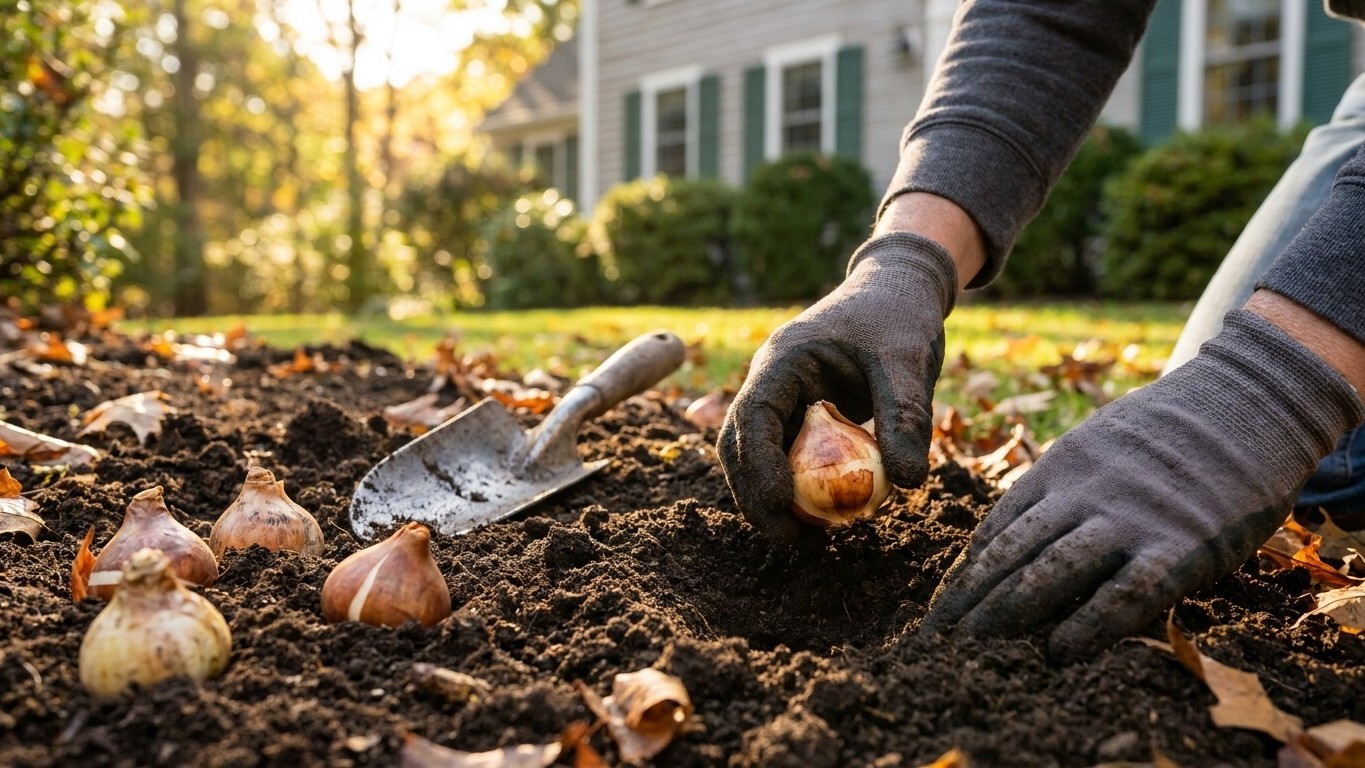

Plant Spring Bulbs in Rhode Island from mid-September through the third week of October, and expect nearly every classic variety, tulips, daffodils, crocus, hyacinths, to come back reliably. The state’s winters run cold enough to satisfy the chill requirement that makes these bulbs flower at all, with no pre-chilling needed anywhere from Woonsocket to Westerly. For gardeners without in-ground space, Growing Spring Bulbs in Containers in Rhode Island follows the same seasonal timing with a few adjustments for pot depth and insulation, while Forcing Spring Bulbs Indoors in Rhode Island offers a way to enjoy blooms well before the outdoor season even begins.
When to plant bulbs in Rhode Island

The target date is six weeks before the ground locks up for winter, and in Rhode Island that math starts with the average first fall frost. At the Providence reference station, that frost lands between October 24 and November 3. Counting back six weeks puts the ideal planting window at roughly mid-September through mid-October, with some flexibility to keep working right up to the frost date itself since the ground stays diggable for a few weeks after the first cold snap.
Six weeks matters because it is the minimum time a bulb needs to grow roots before the soil goes cold enough to stop that growth. Plant too early, while soil temperatures are still in the 60s, and the bulb may push top growth above ground. That green shoot gets hit by the first hard freeze and the bulb spends its stored energy recovering instead of building next spring’s flower. Plant too late, after the ground has already started to firm up, and the bulb goes in without enough time to anchor itself. Come spring it may emerge weak, bloom on a short stem, or simply sit dormant for a full year while it catches up.
The frost dates above are averages pulled from three decades of NOAA climate data, not a guarantee. By definition, an average frost date means roughly half of all years see frost arrive earlier than October 24, and half see it arrive later than November 3. A gardener who waits until the calendar hits late October to start planting is gambling on the late half of that range. The safer play is to treat mid-September as the start of the window rather than the deadline, especially in a state where microclimates shift things around by a week or two from one town to the next.
Whether your winter is cold enough
Every spring bulb needs a stretch of cold to flower. Most standard varieties, tulips, daffodils, hyacinths, require somewhere between twelve and fourteen weeks with soil temperatures below about 45F. Skip that requirement and the bulb still grows leaves, but the flower stalk stays stunted or never forms at all. This is the number every gardener needs before buying a single bag of bulbs, because it is the yardstick for judging whether any given variety has a chance in the ground it’s headed for.
Rhode Island clears that bar with room to spare. The state sits in USDA Hardiness Zones 6a to 7b, based on the 2023 Plant Hardiness Zone Map, and the coldest month at the Providence reference station averages a daily minimum of 22.1F. That’s well under the 45F chilling threshold, and it holds for roughly thirteen weeks running from early December through late February. For the most cold-demanding common bulbs, that’s enough to meet the requirement without stretching to the ragged edge, though gardeners in the milder coastal fringe (zone 7b, closer to Newport County) have less cushion than those inland in zone 6a and might keep a bit more mulch on their hyacinths in an unusually mild winter.
Because the requirement is met naturally in the ground, pre-chilling isn’t something most Rhode Island gardeners ever need to bother with. It only comes into play for tender or specialty varieties bred for warmer climates, and the method is the same everywhere it’s needed: twelve weeks in a refrigerator, kept away from ripening fruit, since the ethylene gas fruit gives off as it ripens will kill the flower bud sealed inside the bulb.
| Bulb | Cold required | Rhode Island delivers | Verdict |
|---|---|---|---|
| Tulips | 12-14 weeks below 45F | ~13 weeks, avg. low 22.1F | Meets requirement, no chilling needed |
| Daffodils | 12-15 weeks below 45F | ~13 weeks, avg. low 22.1F | Meets requirement, no chilling needed |
| Hyacinths | 13-15 weeks below 45F | ~13 weeks, avg. low 22.1F | Meets requirement, tighter margin in zone 7b coastal areas |
| Crocus | 8-10 weeks below 45F | ~13 weeks, avg. low 22.1F | Meets requirement comfortably, early bloomer |
| Alliums | 10-12 weeks below 45F | ~13 weeks, avg. low 22.1F | Meets requirement, no chilling needed |
Which bulbs suit Rhode Island
The bulbs below have hardiness ranges that cover Rhode Island’s zone 6a-7b span and cold requirements the state’s winter satisfies without help. None of them need to be dug up, stored, or replanted each year.
- Daffodils (Narcissus), hardy zones 3-9
- Tulips (Tulipa), hardy zones 3-8
- Crocus, hardy zones 3-8
- Hyacinths, hardy zones 4-8
- Ornamental alliums, hardy zones 3-9 depending on species
- Snowdrops (Galanthus), hardy zones 3-7
- Grape hyacinth (Muscari), hardy zones 3-8
- Scilla, hardy zones 2-8
A handful of popular bulbs will disappoint here, and it’s worth knowing exactly how before spending money on them. Freesia, hardy only to zones 9-10, won’t survive a Rhode Island winter in the ground at all, it needs to be lifted and stored or grown strictly as an annual. Ranunculus, rated for zones 8-10, tends to rot outright in the wet, freeze-thaw winters common near the coast rather than simply failing to bloom. Anemone coronaria, hardy to zone 7 at best, might limp along in a sheltered zone 7b pocket near Narragansett Bay but will freeze out reliably in the colder 6a interior. Ixia and sparaxis, South African natives rated for zones 8-10, need a mild, dry winter that Rhode Island simply doesn’t offer, and they rot in heavy or poorly drained soil long before spring arrives.
None of these hardiness ranges are hard lines. A tulip planted against a south-facing foundation wall in a protected courtyard often outperforms the same bulb in an exposed, windswept bed a few miles away, even within the same zone. Drainage matters as much as temperature. Bulbs that rot in Rhode Island’s winter usually fail because of standing water in heavy clay, not cold alone, so raised beds or amended soil can push the odds back in a gardener’s favor even for borderline choices.
What digs them up here
Squirrels and voles are selective, and the pattern isn’t random. Bulbs that taste bitter or contain toxic alkaloids get left alone, while starchy, mild bulbs get eaten on sight or dug up and cached for later. That chemistry decides which of the bulbs recommended above need protection and which don’t.
- Bulbs rodents avoid: daffodils (contain lycorine), ornamental alliums (oniony, unpalatable), snowdrops (toxic alkaloids), scilla (toxic to mammals)
- Bulbs rodents target: tulips, crocus, hyacinths, grape hyacinth
For anything on the second list, the one measure that consistently works is a layer of galvanized wire mesh laid flat over the planting bed right after planting, pinned down at the edges, and left in place until the ground freezes solid. Once frozen ground sets in, digging becomes too much work for a squirrel or vole and the mesh can come up. Repellent sprays and granules sold for this purpose wash off in the first hard rain and need reapplying constantly to do anything at all, which makes them a poor match for a six-week planting window when the weather is doing exactly that.
Where to check for your own county
Every figure in this guide, the frost dates, the hardiness zone range, the 22.1F coldest-month minimum, comes from the Providence reference station. Rhode Island is small, but it still stretches across enough latitude and elevation change that a planting calendar built around the capital can run up to three weeks off for a garden in the Blackstone Valley or out toward the western hills. Coastal towns tend to warm and cool more slowly than inland ones, which shifts both the safe planting window and the effective length of winter chill.
The University of Rhode Island Cooperative Extension tracks these local variations at the county level and is the most reliable source for adjusting the dates and zone assumptions in this guide to a specific address. Their staff and county offices can confirm local frost timing, soil conditions, and any pest pressure specific to a given area, which matters more the farther a garden sits from Providence itself.