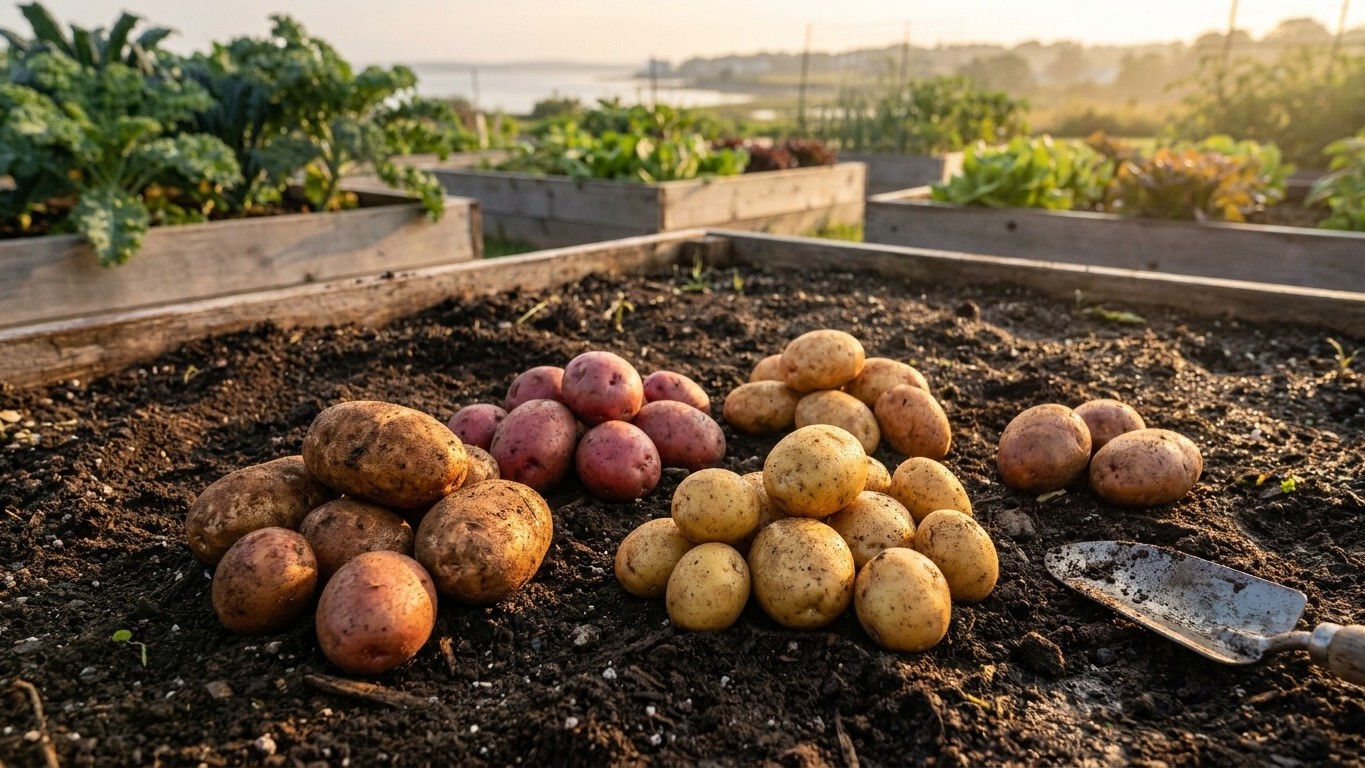

Rhode Island’s short, cool coastal season favors early and mid-season potato types over late ones, because the state’s frost window and its run of hot summer days both work against a long-season crop. Soil temperature, not the calendar, is what actually starts the clock, according to Utah State University Extension.
The short answer
The variety that “suits” Rhode Island is less about the name on the seed bag and more about the season class it belongs to. Utah State University Extension and the University of Maine Cooperative Extension both publish potatoes by season class, early, mid-season, or late, and for a state with Rhode Island’s frost pattern, early and mid-season types are the safer bet for most home gardens.
Here’s the figure that actually matters: at the Providence-area reference station (NOAA station USW00014765), the last spring frost falls somewhere between April 7 and April 17, according to NOAA’s National Centers for Environmental Information 1991-2020 Climate Normals. That’s not a single date, it’s a probability band, and it’s measured at an airport, not in your backyard. Gardens inland, at elevation, or away from the moderating effect of the bay will often see their last frost run later than that window, sometimes by a week or two.
That frost window sets the front end of the season. The back end is set by heat, not cold. Tuber set and fill, the actual bulking-up of the potato underground, is inhibited once soil temperatures climb above 90°F, per Utah State University Extension and the University of Maine’s Bulletin #2077. Rhode Island summers don’t hit that mark as often as inland regions further south or west, but shallow, unmulched soil in a sunny raised bed can still get there on a string of hot July afternoons. An early or mid-season type is more likely to finish its bulking before that heat ceiling becomes a problem, which is the practical reason those season classes are the ones extension programs recommend for short, coastal-influenced seasons like Rhode Island’s.
None of this is about picking a trendy heirloom over a plain one. It’s about matching the biological clock of the plant to the two hard limits the climate imposes: a frost date that arrives later than most people plan for, and a heat ceiling that can shut down bulking before the season even feels “late.” Get those two right and the variety name becomes a matter of taste, russet types for baking, red-skinned types for boiling, rather than a make-or-break decision.
What actually decides it
The frost window mechanism
Frost doesn’t kill a potato plant’s ability to eventually produce, but it does knock back the foliage, and foliage is what feeds the tubers below. Planting too early into cold, wet soil also invites seed piece rot before the plant even emerges. The NOAA data for the Providence-area station shows the 30 to 70 percent probability band for the last 32°F freeze falling between April 7 and April 17. Inside that window, the risk of frost is real but not universal, which is exactly why extension guidance ties planting to soil temperature rather than a date on a calendar. A gardener forty minutes inland needs to shift their own mental window later, because the reference station’s frost date is a coastal one, and inland Rhode Island cools faster at night.
The heat ceiling mechanism
Above 90°F in the soil, the plant’s tuber-forming hormones stall, and the tubers already forming stop sizing up. This is the mechanism that determines season class choice, not tradition or taste. Watering more doesn’t reverse it, because the problem isn’t drought stress, it’s temperature signaling inside the plant. A late-season variety that needs the entire summer to bulk is gambling that Rhode Island won’t produce enough 90°F soil days to interrupt it. An early or mid-season variety is largely finished bulking, or close to it, before the hottest stretch of summer even arrives. That’s the entire logic in one sentence: race the heat, don’t fight it.
Soil temperature as the real starting gun
Potatoes go in the ground once soil reaches 50°F, which Utah State University Extension and the University of Maine Cooperative Extension place at roughly 14 to 21 days before the last frost date, not after it. That instruction sounds counterintuitive, plant before the frost risk has passed, but it works because the seed piece is underground, insulated from the air frost that would damage exposed leaves. The plant typically doesn’t break the surface until the worst of the frost risk has faded. A gardener who waits for the frost date to pass before checking soil temperature is often planting a week or two later than they need to, which shortens the very window that early and mid-season varieties depend on.
How to do it
- Buy certified seed potatoes, not tubers from a grocery bag. Certified seed has been inspected for viral disease; uncertified seed carries virus loads that stunt yield and can persist in soil for future plantings.
- Check soil temperature with a simple probe thermometer at planting depth, roughly 4 inches down, rather than relying on air temperature or the calendar.
- Plant once soil reaches 50°F, which typically falls 14 to 21 days before the local last frost date, per Utah State University Extension and the University of Maine Cooperative Extension.
- Choose an early or mid-season class for the bulk of the planting, reserving any late-season type for a small trial row rather than the whole bed.
- Cut seed pieces to include at least one eye each, and let cut surfaces callus for a day or two before planting to reduce rot risk in cool, damp spring soil.
- Hill soil around emerging stems as they grow, which protects developing tubers from sun exposure and helps buffer soil temperature swings.
- Monitor soil temperature again as summer peaks; if it’s tracking toward 90°F, prioritize harvesting early and mid-season types before that heat fully sets in rather than leaving them in the ground “just in case.”
- Harvest by digging rather than by date, checking tuber size and skin set instead of counting weeks, since neither source publishes a fixed days-to-maturity figure for any variety.
What goes wrong
- Planting by the frost date instead of soil temperature. Waiting until after April 17 “to be safe” often means planting into soil that’s already climbed well past 50°F, wasting the early weeks of the short season. Check soil temperature directly and plant 14 to 21 days ahead of the local last frost, per Utah State University Extension.
- Choosing a late-season variety for a small backyard bed. A late type asks for a longer bulking window than Rhode Island’s summer reliably offers before soil heat above 90°F stalls it. Shift the bulk of the planting to early or mid-season types and treat any late variety as a limited experiment.
- Using uncertified seed from a previous harvest or a grocery store. Virus carried in uncertified seed doesn’t always show obvious symptoms the first season, but it depresses yield and spreads. Source certified seed potatoes each planting.
- Ignoring inland and elevation differences from the reference station. The April 7 to April 17 window comes from an airport-based station; gardens further from the coast or at higher elevation often see frost linger later. Track your own soil and frost history rather than applying the reference figure directly.
- Assuming more water fixes stalled tuber growth in a heat wave. Once soil crosses the 90°F threshold, the limiting factor is temperature signaling inside the plant, not moisture. Mulch to buffer soil temperature and dig early-maturing rows before the hottest stretch rather than trying to irrigate through it.
- Cutting seed pieces too small or planting them without curing the cut surface. Small pieces run out of stored energy before roots establish, and uncured cuts rot in cool, wet spring soil. Cut generous pieces with at least one eye and let them callus before planting.
Common questions
Can I plant a late-season potato variety in Rhode Island at all?
You can, but Utah State University Extension and the University of Maine Cooperative Extension’s season-class framework suggests it carries more risk here than an early or mid-season type, because the longer bulking period runs a higher chance of overlapping with soil temperatures above 90°F, which stalls tuber fill.
Does the April 7 to April 17 frost window apply to the whole state?
No. That figure comes from the Providence-area NOAA reference station. Inland and higher-elevation parts of Rhode Island commonly see their last frost land later than that window, so check local soil and frost patterns rather than applying the reference date directly.
Why do extension sources avoid giving a days-to-maturity number for potato varieties?
Neither Utah State University Extension nor the University of Maine Cooperative Extension publishes a fixed days-to-maturity figure, because actual maturity shifts with soil temperature, moisture, and weather in a given season. They classify varieties instead by season class, early, mid-season, or late.
Is certified seed really necessary if my grocery store potatoes are sprouting anyway?
Sprouting doesn’t mean disease-free. Grocery and uncertified seed can carry viral loads without visible symptoms, and that virus can depress yield and linger in garden soil. Certified seed has been inspected specifically to avoid that risk.