
Herbs grow well across Rhode Island once the soil warms in mid-spring, but the state’s winter cold means most Mediterranean types survive here as annuals or container plants rather than permanent perennials. The growing window runs roughly six and a half to seven months, and the real limiting factor isn’t summer heat, it’s how cold the coldest month gets.
When the soil is warm enough in Rhode Island

Every gardener asks the same question first: when can I actually put herbs in the ground? According to NOAA NCEI’s 1991-2020 Climate Normals, the last spring frost at the reference weather station falls between April 7 and April 17, based on 32°F freeze probabilities in the 30-70% band. That’s the figure as measured, not a rounded estimate, and it’s worth sitting with for a second before rushing outside with trays of seedlings.
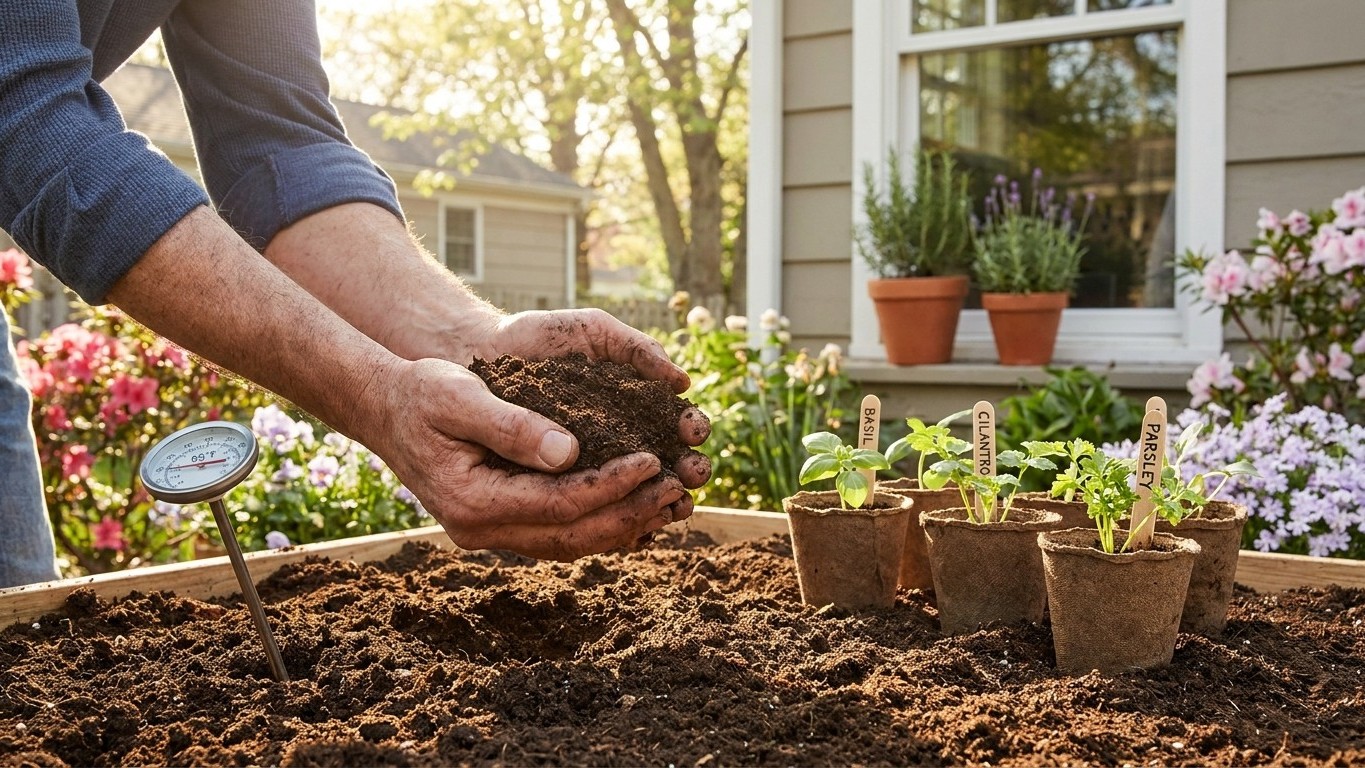
Here’s the catch that trips up a lot of new gardeners: frost date is a proxy, not the actual green light. Herbs don’t care about frost risk directly, they care about soil temperature, and soil warms up on its own schedule, usually a week or two after the frost risk has passed. A basil seedling planted the day after the “last frost” often just sits there, sulking in cold ground, doing nothing visible for two weeks. Waiting for the soil itself to warm, not just the calendar, saves a surprising number of transplants.
There’s also a geographic wrinkle. The NOAA figures above come from an airport-based reporting station, and airport stations tend to run warmer than the surrounding countryside because pavement and open runways hold heat. Suburban yards and rural properties across Rhode Island typically see their last spring frost land later, sometimes by one to two weeks, and gardens at higher elevation or in low-lying frost pockets can lag even more. None of this is a guarantee either way. A frost date is a probability built from thirty years of data, not a promise that this particular April won’t throw a curveball. Checking your own town’s typical pattern, or simply watching your own yard for a season, tells you more than any single date range ever will.
For the herbs themselves, that timing argument matters more for the tender, heat-loving types like basil than for the hardier ones like parsley or chives, which tolerate a light frost and can go in earlier without much drama. The species matters as much as the date.
How long the season lasts here
Subtracting the two frost windows gives a real sense of what the season allows, and both dates here come straight from the same NOAA source, so the math holds. Using the latest spring frost (April 17) against the earliest fall frost (October 24) gives a conservative window of about 190 days. Using the earliest spring frost (April 7) against the latest fall frost (November 3) stretches that to roughly 210 days. Either way, Rhode Island gardeners are working with somewhere between six and a half and seven months of frost-free growing time.
That’s a genuinely useful window, longer than a lot of people assume for New England. It’s long enough that a single spring sowing of most culinary herbs isn’t the only shot of the year. Fast-growing leafy herbs like cilantro or dill, which tend to bolt and finish quickly in warm weather, can be resown two or three times through the season rather than planted once and left to fade. A gardener who treats the whole frost-free window as one long planting event, instead of one moment in May, ends up with fresher, more usable herbs from July through September instead of a single tired flush.
This is also where the transplant-versus-direct-seed decision gets easier to make. With nearly seven months on the table, there’s room to start slower perennial types indoors or buy them as small plants, check that the root system isn’t circling or bound in its container, and still get a full productive summer out of them. In a shorter-season territory, that root check would eat into growing time that simply doesn’t exist to spare. Here, it doesn’t cost much.
The practical takeaway is that Rhode Island’s season rewards a staggered approach rather than a one-and-done planting day. For anyone who wants the specifics of how to stagger sowings through a season this length, the site’s succession sowing guide walks through timing intervals crop by crop.
Heat and water in Rhode Island

Summers here are warm and humid in the way most of southern New England is, with the kind of muggy stretches that make basil happy and mildew happier. That humidity, more than any extreme heat, tends to be the actual growing challenge through July and August: damp air sitting on herb foliage overnight is what invites fungal problems on crowded plantings, not a string of scorching days. Herbs planted too close together in a humid summer often show trouble before the season’s halfway through, simply from lack of airflow around the leaves.
But summer conditions aren’t actually the variable that decides what belongs permanently in a Rhode Island herb garden. Winter is. The USDA Plant Hardiness Zone Map, built from 1991-2020 average annual extreme minimum temperatures, places Rhode Island in zone 6a-7b, a fairly wide range for a small state, which means the coldest corners inland and the mildest spots near the coast can behave quite differently from each other. Citing a single zone for the whole state would flatten out that real variation, so it’s worth checking where a given property falls within that range rather than assuming the state average applies.
The more telling number, though, is the coldest month’s average daily minimum: 22.1°F, measured at the Providence reference station. That’s not the record low for the state and not a monthly average temperature, it’s specifically the average low on a typical night during the coldest month, and it’s the figure that actually determines what survives winter outdoors without protection.
At 22.1°F on a typical cold night, most of the classic Mediterranean herbs, rosemary, bay laurel, many types of lavender, simply don’t reliably make it through in the open ground. That single number is why Rhode Island herb gardens tend to split into two very different categories: cold-hardy perennials that stay in the ground year-round, and Mediterranean types that either get treated as annuals, replaced each spring, or grown in containers that come indoors before the first hard freeze. That winter reality reorganizes the whole planning process more than any summer heat ever would.
Which herbs suit Rhode Island
Working backward from the territory’s own numbers, three factors do most of the sorting: the roughly 190-to-210-day season favors herbs that establish and produce quickly rather than slow-maturing types; the humid summer air makes airflow and disease tolerance a real consideration for anything planted densely; and the 22.1°F winter minimum draws a hard line between herbs that can stay outdoors year-round and those that can’t.
By type, sturdy perennial herbs from cooler climates, chives, mint, oregano, thyme, and many varieties of sage, generally handle Rhode Island’s winter minimum well enough to persist outdoors in most of the state, though gardeners in the colder inland pockets near the 6a end of the range may still lose the occasional planting in a harsh winter. Cool-season annual herbs like dill, cilantro, and parsley fit neatly into the season length described above and tolerate the humid summer air reasonably well, especially with decent spacing.
Mediterranean shrubby herbs, rosemary and bay laurel in particular, along with many lavender types, sit in the other category: given the 22.1°F coldest-month minimum, these are best treated in Rhode Island as container plants brought indoors for winter, or replanted as annuals each spring, rather than left in open ground and hoped for. Basil, a true warm-season annual everywhere in the Northeast, fits the season length here comfortably but benefits from wider spacing than a drier climate would need, precisely because of the humidity issue raised above.
What this page won’t do is hand out a specific variety name, and that’s a deliberate choice rather than an oversight. Herb varieties get bred and trialed for particular regional pest pressures, disease strains, and microclimates, and a name that performs well in one part of the country can disappoint in another for reasons that have nothing to do with hardiness zone or frost date. The University of Rhode Island’s Cooperative Extension, part of the USDA’s land-grant university network, runs its own regional variety trials and publishes results based on what actually performs in Rhode Island conditions rather than generic national averages. Their office is reachable through web.uri.edu/coopext, and it’s the one source that can turn “which type of basil” into an answer that actually means something for a specific yard.