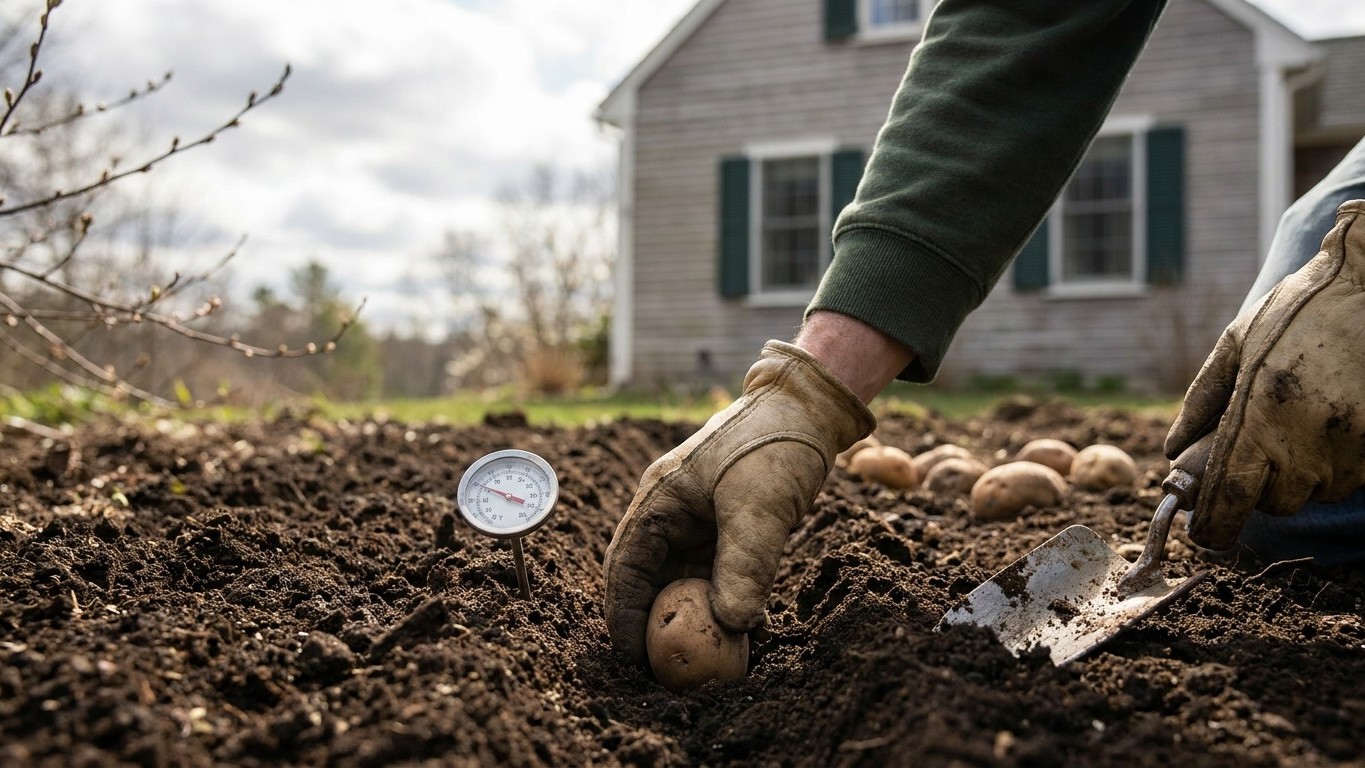

Rhode Island gardeners generally aim for the back half of March, roughly two to three weeks before the last spring frost, because potatoes go into the ground as soon as soil temperature hits 50 F rather than waiting for frost-free air. Around Providence, that last frost falls between April 7 and April 17, according to NOAA NCEI’s 1991-2020 U.S. Climate Normals. Count backward from that window and planting lands in mid-to-late March for most of the state’s warmer valleys and coastal ground.
The short answer
The reference figure for this whole calculation comes from a single weather station, the NOAA NCEI climate site in Providence, which puts the last spring freeze somewhere between April 7 and April 17. That’s not a guess dressed up as science; it’s a 30-year normal built from actual freeze probabilities at that airport location. Potatoes don’t care about that frost date directly, though. What they respond to is soil temperature, and University of Maine Cooperative Extension along with Utah State University Extension both point to the same trigger: get tubers in once soil reaches 50 F, which typically happens 14 to 21 days before the last frost.
Run that math against the Providence window and the planting date settles somewhere between mid-March and the first days of April for much of the state. Twenty-one days before April 7 lands in mid-March. Fourteen days before April 17 lands right around the start of April. So the honest answer isn’t a single date circled on a calendar; it’s a stretch of roughly three weeks where soil warmth, not air temperature, makes the call.
That Providence figure is a reference point, not a statewide promise. Suburban yards and rural gardens away from the airport typically see their own last frost land later in spring and their first fall frost arrive earlier, often by one to two weeks, and more than that at higher elevation. A garden in the Blackstone Valley or up toward the Connecticut border shouldn’t assume the same March window as a yard closer to Narragansett Bay. Anyone planting seriously should check their own county’s frost history rather than borrowing the airport’s number wholesale.
The takeaway worth holding onto: the date on the seed packet or the extension calendar is really a soil-temperature question wearing a calendar’s clothing. Once that’s clear, the rest of the planning follows from two mechanisms, not one.
What actually decides it
The 50 F floor and the 14-to-21-day count
Seed potatoes rot in cold, wet soil before they ever sprout. That’s the entire reason for the 50 F threshold that both Utah State University Extension and University of Maine Cooperative Extension use as the planting trigger. Air temperature can feel like spring while soil four inches down is still cold and slow to warm, especially in heavier clay or shaded ground. The 14-to-21-day window before the last frost isn’t arbitrary either; it reflects how long it typically takes soil to climb from winter cold to that 50 F mark once the frost date approaches. A gardener working from a different county’s frost date just needs to slide this same 14-to-21-day count against their own local last frost, then confirm with an actual soil reading before trusting the math.
The 90 F ceiling on the other end of the season
The date at the start of the season matters, but so does what happens in July and August. Utah State University Extension and University of Maine Cooperative Extension both flag the same upper limit: once soil temperature climbs above 90 F, tuber set and fill shut down. Watering more doesn’t reverse that; the plant simply stops sizing tubers in soil that hot. This is the mechanism that should really decide how a gardener plans the whole season, not just the planting date. In a spot where soil regularly pushes past 90 F for stretches of summer, the smart move is planting early and harvesting a spring crop before that heat window opens, rather than trying to nurse a summer crop through conditions the plant can’t use productively. Where summers stay cooler and soil rarely nears that ceiling, the planting window has more flexibility on the back end.
Put those two mechanisms together and the entire planting decision comes down to bracketing: how soon can the soil clear 50 F, and how soon will it likely cross 90 F. Everything else, calendar dates included, is downstream of those two numbers.
How to do it
- Look up your own county’s typical last frost date rather than defaulting to the Providence figure, since inland and higher-elevation gardens tend to run later.
- Check actual soil temperature with a soil thermometer instead of trusting a date on a calendar, and wait for a steady 50 F reading before doing anything else.
- Order certified seed potatoes from a reputable source rather than using grocery-store potatoes, since certified stock is inspected for virus that uncertified seed can carry without showing symptoms.
- Set whole small seed potatoes, or cut pieces that each carry at least one eye, in a bright, cool spot so they green up and start sprouting before they go in the ground.
- Let any cut surfaces heal over for a few days so they don’t rot once they’re sitting in still-cool spring soil.
- Plant once the soil itself reads 50 F, which generally falls 14 to 21 days ahead of your area’s expected last frost.
- Choose an early-season variety if soil in your yard regularly climbs past 90 F in summer, since early types finish sizing tubers before that heat sets in.
- Hill soil up around the stems as the plants grow, keeping developing tubers covered.
- Track soil temperature again through mid-summer, and where it holds above 90 F for extended stretches, plan to dig the crop rather than wait on vines that have stopped filling.
What goes wrong
- Planting strictly by the calendar frost date, ignoring soil temperature: air can feel warm while soil is still cold enough to rot seed potatoes; check with an actual soil thermometer before planting instead of trusting the date alone.
- Borrowing Providence’s April 7-April 17 window for an inland or elevated county: that figure comes from a single airport station, and gardens away from it typically see a later last frost by a week or two, sometimes more at elevation; adjust the count for your own location.
- Using uncertified seed potatoes from the grocery store: uncertified stock frequently carries virus with no visible symptoms, which quietly weakens the whole crop; buying certified seed avoids that risk entirely.
- Growing a late-season variety through a soil that regularly tops 90 F in midsummer: tuber set and fill stall out above that threshold and extra watering won’t restart it; an early-season type planted as soon as soil hits 50 F sidesteps the problem by finishing before the heat arrives.
- Cutting seed potatoes and planting them immediately without letting the cut surfaces heal: fresh cuts sitting in cool, damp soil are prone to rot before they ever sprout; give them a few days to cure first.
Common questions
Can I use Providence’s frost date if I garden inland in Rhode Island?
Use it only as a starting reference. The April 7-April 17 window comes from a single NOAA NCEI station in Providence. Gardens further inland or at higher elevation typically see their last frost land later, often by one to two weeks, so check your own local history before counting backward from that figure.
What happens if I plant potatoes before the soil reaches 50 F?
Seed potatoes sitting in soil colder than that tend to rot rather than sprout, since the tuber can’t get moving in cold, damp conditions. Waiting for a steady 50 F soil reading, generally 14 to 21 days before the last frost, gives the seed piece a better chance of sprouting cleanly.
Should I choose an early, mid-season, or late variety for Rhode Island?
That depends on how hot your particular soil runs in midsummer. Where soil regularly climbs above 90 F, an early-season variety planted as soon as soil hits 50 F lets you dig a spring crop before tuber set and fill shut down from heat. Neither Utah State University Extension nor University of Maine Cooperative Extension publishes a specific days-to-maturity figure for any variety; they classify by season length instead, and matching that class to your yard’s heat pattern matters more than the variety’s name.
Does certified seed really matter for a home garden?
Yes. Certified seed potatoes are inspected for virus that uncertified stock, including potatoes bought at a grocery store, can carry without any visible sign. That hidden virus load can quietly reduce yield and vigor all season, so starting with certified seed is one of the simplest ways to protect the whole crop before it’s even in the ground.
If you follow the almanac, here is when to plant potatoes by the moon. It is a tradition, not a proven method.