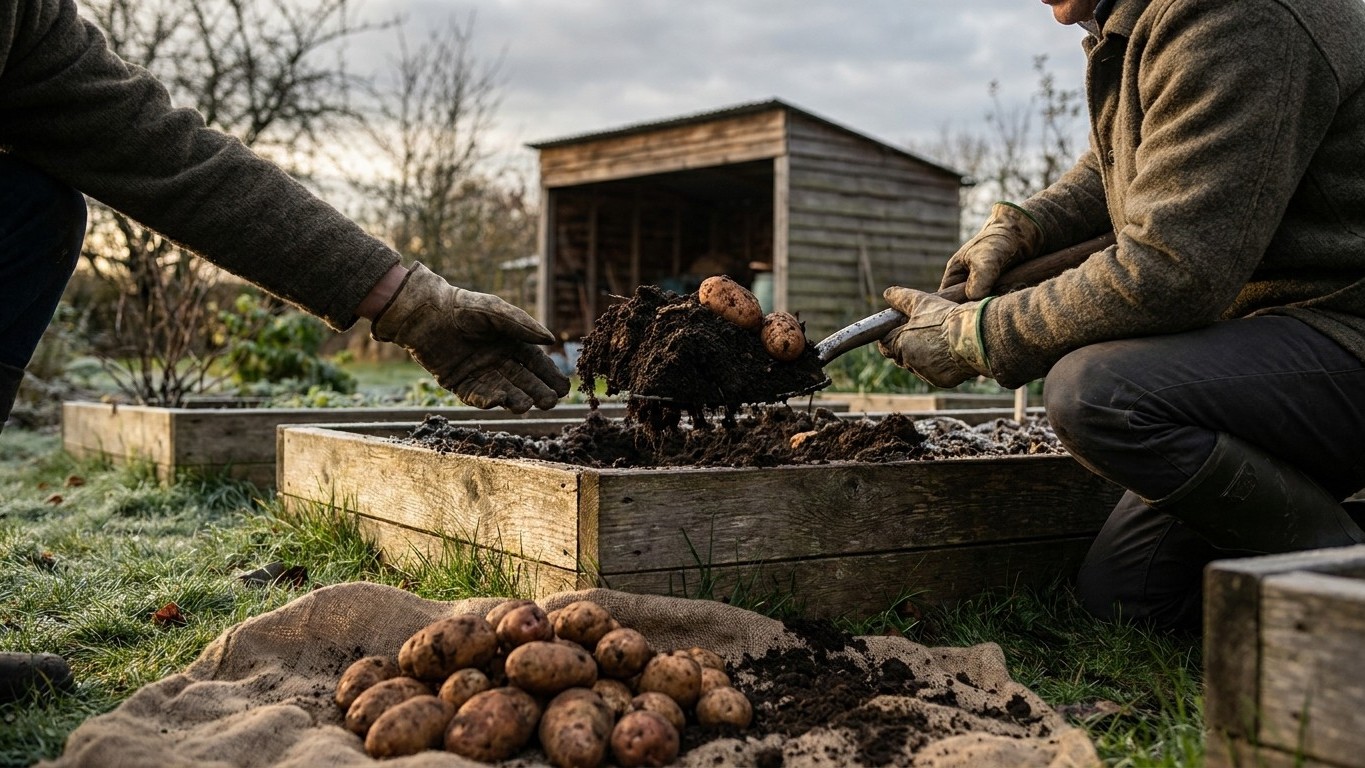

In Rhode Island, potatoes need to come out of the ground before the first fall frost window hits between October 24 and November 3, then cure for two to three weeks at 55-60°F before moving to a dark space that holds 40-45°F all winter. That last part is the hard one here: an unheated shed or garage won’t do it once the coldest month’s average low drops to 22.1°F.
The short answer
Two numbers frame everything about growing and keeping potatoes in this state. The first fall frost, on average, lands somewhere between October 24 and November 3, according to NOAA’s 1991-2020 Climate Normals for the Providence reference station. The second is the mean daily minimum temperature during the coldest month: 22.1°F, from that same NOAA dataset. Neither of those is a record low or a scary outlier. They’re averages, which makes them more useful, not less. They describe a normal year, not a bad one.
What that means for a potato grower is straightforward. The frost window tells you the outer edge of the digging season. Most Rhode Island gardeners pull their crop before that window arrives, because a hard freeze that reaches the soil can damage tubers sitting an inch or two under the surface, especially in raised beds or sandy ground that cools faster than heavier soil. Once the vines have died back and the window is approaching, it’s time to dig, not wait.
The second number, that 22.1°F average low, is the one that decides whether storage will actually work. Potato storage needs a steady 40-45°F according to Utah State University Extension, or 38°F at high humidity according to the University of Maine Cooperative Extension. An unheated garage or an uninsulated shed in a Rhode Island winter will spend weeks below freezing, not hovering in the 40s. That space will freeze the crop solid at some point during the season, and frozen potatoes don’t recover, they turn soft and sweet and start breaking down almost immediately after thawing.
So the short version: dig ahead of the frost window that arrives in late October to early November, and plan on a space that’s insulated, buffered by earth, or otherwise protected from the swings that push Rhode Island’s coldest month into the low 20s at night. A fully unheated outbuilding is not that space, most winters. A basement, an insulated root cellar, or a buffered crawl space usually is. Check your own county rather than assuming the reference-station dates apply exactly. Inland and higher-elevation spots in Rhode Island often see frost a week or two earlier than a coastal or urban station would suggest.
Curing, and where
Curing is the step that toughens potato skins and heals over any nicks from the fork or shovel, and skipping it is one of the fastest ways to lose stored potatoes to rot. Utah State University Extension puts the target at 55-60°F with high humidity, held for two to three weeks. Rhode Island’s harvest window, right around that late-October frost date, often delivers daytime temperatures in that range, but nighttime lows are already sliding toward the 30s and 40s by then, which narrows where curing can actually happen.
- Dig on a dry day and let the potatoes sit on top of the soil for an hour or two so surface moisture evaporates before you move them.
- Brush off loose soil without washing the tubers. Water at this stage invites the rot that curing is supposed to prevent.
- Move them to a shaded, ventilated space that can hold 55-60°F. Early in the harvest window, a covered porch or a breezy garage bay often gets close, since Rhode Island afternoons are still mild. Once nights are consistently near or below 50°F, that same porch no longer works and the potatoes need to move indoors, to a basement corner or an unheated but insulated room.
- Keep the pile shallow, a single layer or two at most, spread on newspaper, cardboard, or slatted crates so air moves around each tuber rather than trapping moisture against the skin.
- Hold that spot for two to three weeks, checking periodically for any tuber that’s gone soft or started weeping. Pull those out before they spread trouble to the rest of the batch.
The practical reality in this state is that curing almost always has to shift indoors partway through the two-to-three-week stretch. A basement that stays a bit warm from the house above it, or a mudroom that isn’t directly heated but isn’t exposed to outdoor swings either, tends to land closer to that 55-60°F target than anywhere fully outdoors once late October arrives. A detached, uninsulated garage is usually too cold by the back half of the curing period, even if it worked fine for the first few days.
Storing through this winter
Once curing wraps up, the target temperature drops. Utah State University Extension calls for 40-45°F in a dark space, while the University of Maine Cooperative Extension gives a tighter figure of 38°F combined with 95% humidity. Either way, the goal is cold enough to slow sprouting but nowhere near freezing, and dark enough that the tubers don’t green up and produce solanine, the compound that makes green-skinned potatoes bitter and mildly toxic.
This is where Rhode Island’s coldest month becomes the deciding factor. A mean daily minimum of 22.1°F means that during the coldest stretch of winter, most nights are dropping well below the storage target, not just brushing up against it. A garage with no insulation, a detached shed, or an unheated barn will track close to outdoor air on the coldest nights, which puts them at or below freezing for hours at a stretch. That’s not a marginal risk, it’s close to guaranteed at some point across a full Rhode Island winter.
A basement is usually the more reliable option, particularly one built at least partly below grade, since the surrounding earth buffers temperature swings far better than a wood-framed structure sitting above ground. Interior basements that share a wall with a heated part of the house sometimes run warmer than the 40-45°F target, which isn’t ideal either, since it can encourage early sprouting. In that case, the coolest corner, often the one nearest an exterior wall or farthest from the furnace, tends to run closer to the mark. A root cellar dug into a hillside or built with earth berming on the exterior walls will hold steadier numbers than either a garage or a warm basement corner, but not every Rhode Island property has one.
Wherever the crop ends up, darkness matters as much as temperature. A cardboard box with the flaps loosely closed, or a bin covered with a towel, keeps light out without sealing off the air movement that potatoes need to avoid trapping moisture and rotting.
What goes wrong here
- Digging after the ground has already frozen once. Rhode Island’s frost window arrives in late October to early November, and gardeners who wait past it risk a soil freeze that damages tubers before they’re even out of the ground. Dig ahead of that window, not after it.
- Curing on a porch too late in the season. A shaded porch works fine for curing early in the harvest window, but once nighttime temperatures fall toward the 30s and 40s, that same porch stops holding the 55-60°F curing range. Move the batch indoors as soon as evening temperatures drop.
- Storing in an unheated garage or shed through winter. With the coldest month averaging a 22.1°F nightly low, an uninsulated outbuilding will freeze potatoes at some point in the season. Move storage to a basement or an insulated, buffered space instead.
- Storing too close to a furnace or heated wall. A basement corner that runs warm encourages early sprouting well before spring. Pick the coolest interior spot that still stays above freezing, typically along an exterior wall away from heating equipment.
- Skipping humidity control. Both Utah State University Extension and the University of Maine Cooperative Extension point to humidity as part of the storage equation, not just temperature. A bone-dry basement will shrivel tubers over the winter even if the temperature is right; a loosely covered bin or a damp burlap layer helps hold moisture in without inviting rot.
- Ignoring pest or disease pressure before storage. Any tuber showing damage from insects or fungal spotting should be set aside and used first rather than stored long-term. Treating the growing crop with appropriate insecticides or an appropriate fungicide during the season reduces how much of the harvest carries problems into storage.
Common questions
How early should I plan to dig potatoes in Rhode Island?
Plan around the first fall frost window for your area, which for the Providence reference station runs October 24 to November 3 based on NOAA’s 1991-2020 Climate Normals. Inland or elevated parts of the state often see frost a week or two earlier, so check local conditions rather than relying on that single station.
Can I cure potatoes outdoors in Rhode Island?
Early in the harvest window, yes, a shaded and ventilated outdoor spot like a covered porch can hold close to the 55-60°F curing range set by Utah State University Extension. Once nights turn cooler, which happens quickly as the frost window approaches, curing needs to move indoors to a basement or similarly buffered space.
Is a garage cold enough for winter potato storage?
An unheated, uninsulated garage tends to be too cold, not too warm. With Rhode Island’s coldest month averaging a 22.1°F nightly low, an unbuffered garage will likely drop below freezing repeatedly, which ruins stored tubers. A basement or insulated cellar space that holds 40-45°F, per Utah State University Extension, is the safer choice.
What temperature and humidity does the University of Maine recommend for storage?
The University of Maine Cooperative Extension gives 38°F combined with 95% humidity as its storage benchmark, a slightly tighter range than the 40-45°F figure from Utah State University Extension. Either target is workable, but both require a space well below what most unheated Rhode Island outbuildings hold through the coldest months.