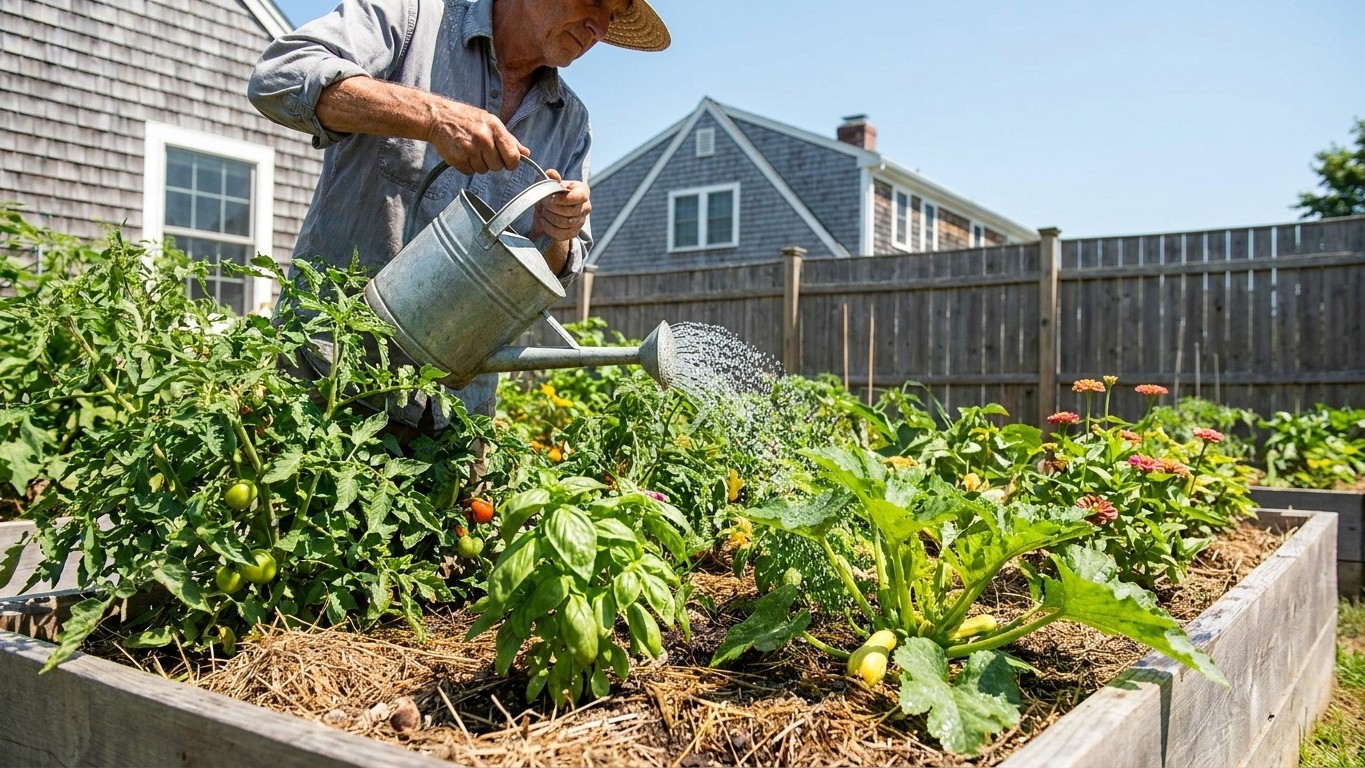

Rhode Island’s growing season runs roughly six and a half months, but the state also logs 9.4 days a year at 90F or hotter, hot enough to dry out a bed fast between rains. That combination, a long window with real heat spikes, is why “just water when it looks dry” fails here more often than gardeners expect. The rules below cover how much, how often, what’s restricted, and how to use less.
What the climate asks of you

Two numbers matter more than any calendar date. The first is 9.4, the average number of days per year the Providence reference station hits 90F or above, according to NOAA’s 1991-2020 Climate Normals. That’s not a heat wave state, but it’s enough hot days scattered through July and August to push a shallow-rooted bed into stress within 48 hours of the last rain. The second is the frost-free window itself: a last spring frost falling between April 7 and April 17, and a first fall frost between October 24 and November 3, at the same Providence station. Stretch those dates and you get a growing season of roughly six and a half months, which sounds generous until you remember that every one of those weeks needs consistent moisture, not just the hot ones.
Here’s the honest gap: published, site-specific weekly rainfall totals for June, July, and August aren’t part of the verified data behind this guide, and Rhode Island’s coastal exposure means totals can swing noticeably between a garden in Newport County and one twenty miles inland. Rather than guess at a number, the practical move is to pull your own week’s rainfall from a $10 rain gauge or from NOAA’s local station data, then compare it to the standard horticultural target of about an inch of water a week for most vegetable and perennial beds. Some weeks the sky covers most of that. Other weeks, especially around those 90F stretches, it covers none of it, and the gardener carries the whole inch.
Why soil type still decides the outcome
Two gardens getting identical rainfall can need completely different watering schedules if their soil differs. Sandy, fast-draining ground loses that inch of water in a day or two. Heavier, clay-rich soil holds it for most of a week. Since a state-wide soil texture figure isn’t part of the verified data here, the reliable step is a simple squeeze test: grab a handful of moist soil from six inches down. If it crumbles apart, you’re leaning sandy and watering more often. If it holds a ribbon shape, you’re leaning clay and watering less often but more deeply. Your local University of Rhode Island Cooperative Extension office can also run or point you to soil texture information for your specific county.
How much, how often
Deep and infrequent beats shallow and daily, every time, a principle at the heart of Watering Through a Dry Spell in Rhode Island. A quick daily sprinkle wets the top inch of soil and trains roots to stay near the surface, right where summer heat bakes them hardest. A deep soak sends water down further, though the calculus shifts for Watering Pots and Containers in Rhode Island, where limited soil volume dries out much faster than an in-ground bed down six to eight inches, where roots stay cooler and the plant can ride out a couple of dry days without wilting. The test for whether it’s time to water isn’t the calendar, it’s the soil: push a finger or a trowel two inches down. Dry and crumbly means water now. Cool and slightly damp means wait another day.
Morning watering, aimed at the base of the plant rather than the leaves, does two things a midday or evening soak doesn’t. It gives foliage time to dry before nightfall, which cuts down on the fungal issues that thrive in humid New England evenings, and it loses far less water to daytime evaporation than a noon watering does. On sandy ground, that morning soak needs to happen more often, since the water simply isn’t staying in the root zone. On heavy clay, resist the urge to water again just because the surface looks dusty. Watering clay before it has actually dried at root depth is one of the fastest ways to suffocate roots and encourage rot, and working or digging clay soil while it’s still wet compacts it for the rest of the season.
Here’s a sequence that works across most Rhode Island garden soils:
- Check moisture two inches down with a finger or trowel before turning on any hose or system.
- Water early morning, delivering roughly one inch total per week, split across one or two deep sessions rather than several light ones.
- Aim water at the soil around the base of the plant, keeping the foliage dry.
- On sandy soil, shorten the interval to every two to three days with a smaller volume each time, since the ground can’t hold a full week’s worth.
- On clay soil, stretch the interval toward once a week and confirm the surface has actually dried before the next soak.
- During any run of 90F days, which average 9.4 annually at the reference station, check soil moisture daily even if the calendar says it isn’t a watering day.
Restrictions and rules
Watering restrictions in Rhode Island are set locally, by individual water districts and municipalities, not by a single statewide rule, and they change from year to year depending on reservoir levels and drought conditions. Some districts run routine odd/even day schedules through the summer months regardless of rainfall; others only impose limits once a drought advisory is declared. Because that verified, current detail isn’t something a general guide can responsibly pin down, the only reliable step is checking directly with your local water supplier or municipal public works department before setting a sprinkler timer for the season.
Given that Rhode Island’s driest summer weeks can leave a garden getting little to no rain during a run of those 90F days, it’s worth checking restrictions earlier in the season rather than waiting for a drought announcement to find out your hose is on an odd/even schedule you didn’t know about. Many districts post current status and any active restrictions online, and URI Cooperative Extension can point you to your specific water district if you’re not sure which one covers your address.
Using less
The gap between a garden that struggles through a dry stretch and one that shrugs it off usually comes down to a handful of low-effort habits, not a bigger hose. Each of these does a specific, measurable job:
- Mulch, two to three inches deep: cuts surface evaporation dramatically and keeps soil temperature more stable, which matters most during those 90F-day stretches when unmulched soil can dry out within hours of watering.
- Drip irrigation or soaker hoses: deliver water directly to the root zone instead of the air and the pathway between plants, wasting far less to evaporation and wind drift than an overhead sprinkler.
- Grouping plants by water need: keeps thirsty vegetables like tomatoes and squash on one zone or one section of hose, and drought-tolerant natives or established perennials on another, so you’re not over-watering the tough plants just to satisfy the thirsty ones.
- Organic matter worked into the soil: compost improves both ends of the problem, helping sandy soil hold water longer and helping clay soil drain a little better, narrowing the gap between the two extremes described above.
- Rain barrels, where locally permitted: a roof catching an inch of rain over 1,000 square feet sheds roughly 600 gallons, so even a modest storm can fill a standard barrel several times over. The catch in Rhode Island is timing: barrels fill fast during a wet spring stretch but can sit empty for days during a dry summer week with a run of 90F heat, so they supplement a watering routine rather than replace one.
None of these techniques requires replacing an existing garden layout. Mulch and grouping plants by need can both happen this weekend with tools most gardeners already own, and they’re the two changes most likely to shrink your water bill and your watering time before the next hot stretch arrives.
Common questions
How often should I water a vegetable garden in Rhode Island during summer?
Check soil moisture two inches down every day or two, and water deeply, aiming for about an inch total per week, more often on sandy soil, less often on heavy clay, and daily checks recommended during any run of 90F-plus days.
Does Rhode Island have statewide watering restrictions?
No single statewide rule applies. Restrictions are set by individual water districts and municipalities and vary by year and by drought status, so check with your local water supplier before setting a summer watering schedule.
What’s the growing season length for a Rhode Island garden?
At the Providence reference station, the last spring frost typically falls between April 7 and April 17, and the first fall frost between October 24 and November 3, giving roughly six and a half months frost-free. Suburban and rural gardens often see frost arrive a week or two earlier in fall and linger a week or two later in spring, so check your own county’s typical dates.
Are rain barrels legal in Rhode Island?
Rules on rain barrels are set locally rather than statewide, so confirm with your municipality or water district before installing one. Where allowed, a barrel catching runoff from a 1,000-square-foot roof section can collect around 600 gallons per inch of rainfall, though it can run dry quickly during extended hot, low-rain stretches.