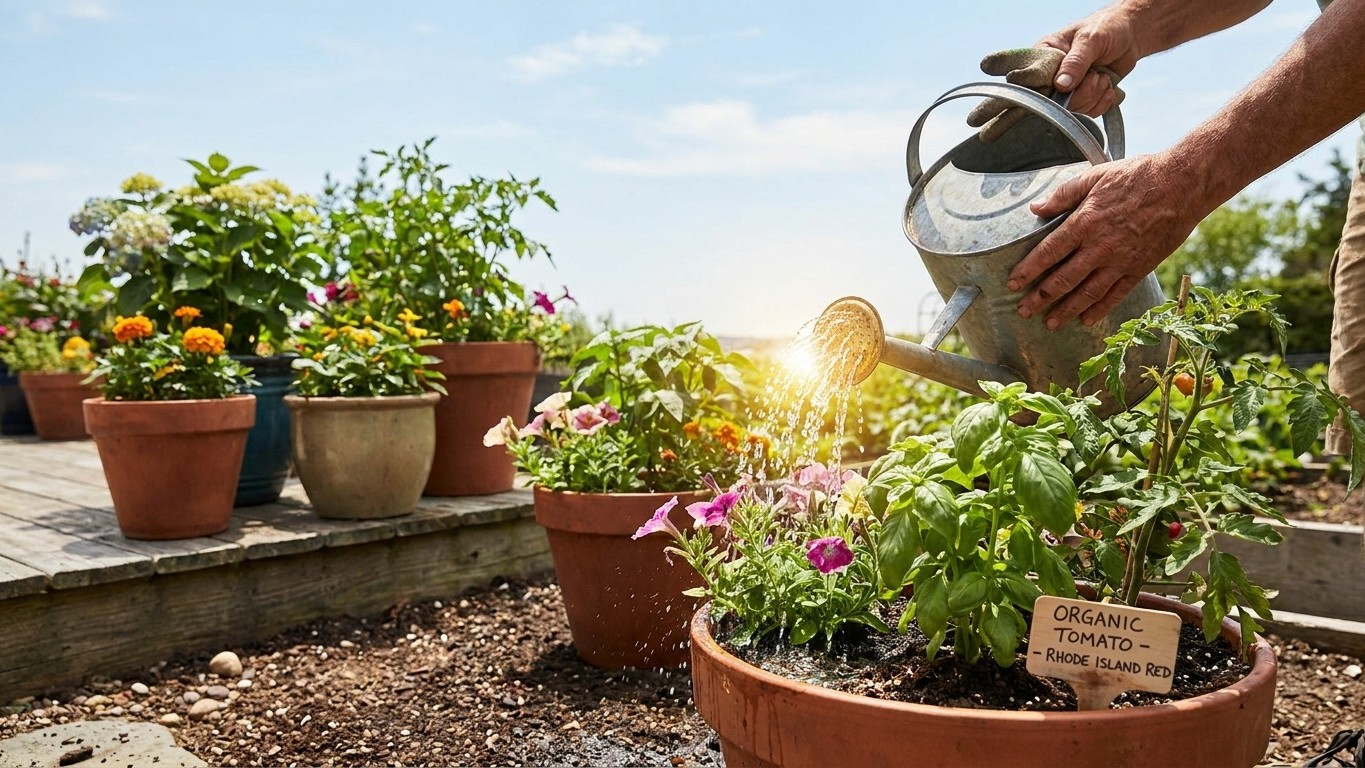

Rhode Island gardens face a paradox: the state gets plenty of rain over the year, but July, the peak of the growing season, is also its driest month. Combine that with nearly ten days of 90-degree heat each summer, and watering becomes a matter of timing, not just quantity.
What changes here

Two numbers set the terms for every Rhode Island vegetable bed and flower border. July, the region’s driest summer month, averages 2.91 inches of rain. And the state sees 9.4 days a year at or above 90 degrees. Together, they mean the month when plants need water most is also the month the sky provides the least of it, while heat is pulling moisture out of the soil faster than in June or August.
Do the arithmetic and the gap gets concrete. A vegetable or flower bed generally wants about an inch of water a week. July’s month-long total, spread across roughly 4.4 weeks, works out to about 0.66 inch a week falling from the sky. That leaves a shortfall of roughly 0.34 inch a week that has to come from a hose or a sprinkler if the bed is going to keep pace with what it actually needs during the hottest stretch of summer.
That shortfall isn’t evenly distributed across the season either. June brings 3.81 inches and August 3.59 inches, both comfortably closer to the weekly-inch target than July’s 2.91. So a Rhode Island gardener who waters lightly in June and August, then keeps the same habit into July, is the one who ends up with stressed plants in late summer. The month that looks the same on the calendar behaves differently underground.
Soil texture changes how far that supplemental water actually reaches. An inch of water applied to sandy, fast-draining ground moves through the root zone quickly and dries out again within a day or two. The same inch on heavy clay sits closer to the surface and takes much longer to drain, which means the frequency of watering, not just the total volume, has to match what’s actually under the mulch. Since soil varies block by block in Rhode Island’s mix of glacial till, coastal sand and reclaimed farmland, a simple hand test tells you more than any statewide average can.
How to water when it matters
The method that works in Rhode Island’s climate is the same one that works almost everywhere gardeners deal with a hot, drying month: water deeply, water infrequently, water at the base, and water in the morning. Each piece of that has a reason behind it rooted in what the plant is actually doing underground and above it.
A deep soak pushes moisture several inches down, which encourages roots to grow downward chasing it. A shallow daily sprinkle does the opposite: it wets only the top inch of soil, so roots stay shallow and exposed right where July’s heat bakes the surface hardest. Watering at the base rather than overhead keeps water where roots can use it instead of evaporating off leaves in the day’s heat, and it keeps foliage dry, which matters because wet leaves overnight are an open invitation to fungal disease. Morning watering gives plants a full day to take up moisture before the evening cools and any residual dampness lingers into the night.
Knowing when to water beats watering on a schedule. The surface of the soil can look bone dry while the root zone underneath is still moist, or look fine while roots two inches down are parched. Push a finger, or a garden trowel, about two inches into the bed near the plant’s base. If it’s dry at that depth, it’s time to water. If it’s still cool and damp, wait.
- Start with about 1 inch of water a week as a baseline, split into one or two deep sessions rather than daily sprinkles, then adjust once you’ve checked your own soil.
- Check soil moisture two inches down with a finger or trowel before each scheduled watering, not on a fixed calendar.
- On sandy, fast-draining soil, shorten the interval between waterings and expect to check more often, since moisture moves through quickly.
- On heavy clay, lengthen the interval and confirm the top few inches have actually dried before adding more, since clay holds water far longer and drowns roots that never get an oxygen break.
- Water early in the morning, directed at the base of the plant, so foliage dries in daylight and moisture has time to reach the roots before peak afternoon heat.
Treat that one-inch figure as a starting point, not a rule. Rhode Island’s mix of sandy coastal soils and heavier inland clay means two gardens ten miles apart can need noticeably different rhythms, and the only way to know for certain is to check.
What goes wrong
“I water a little every day, just to be safe”
This is the mistake that costs the most during a Rhode Island July. Frequent light watering keeps moisture in only the top inch of soil, so roots never have a reason to grow deeper. When a 90-degree stretch hits and the surface dries out fast, those shallow roots have nowhere else to draw from, and the plant wilts even though water was applied just yesterday.
“I water in the evening so it can soak in overnight”
Evening watering, especially overhead, leaves foliage wet through the cool overnight hours. That damp window is exactly when fungal diseases like powdery mildew and blight get their foothold. Morning watering lets the sun dry leaves within a few hours instead of letting moisture sit all night.
“It rained yesterday, so I don’t need to water”
A passing summer thunderstorm can look like a downpour and still only wet the top half-inch of soil, especially on drier ground where the surface has crusted. Rhode Island’s rainfall is real on the calendar, but it doesn’t always translate into moisture at root depth. Check with a finger before skipping a scheduled watering, rather than trusting how hard it sounded on the roof.
“I never bothered with mulch”
Bare soil loses moisture to evaporation far faster than mulched soil, particularly on the hot days that push toward 90 degrees. A two- to three-inch layer of mulch around plants (not against stems) slows that evaporation and keeps the deep watering from being undone by the next afternoon’s sun.
Local help
The University of Rhode Island Cooperative Extension offers soil testing, plant diagnostics and region-specific gardening guidance for conditions across the state. Find their programs at web.uri.edu/coopext. Watering restrictions during dry stretches vary by municipal and district water supplier, so check with your local water provider before setting an irrigation schedule, especially in mid-to-late summer.
Common questions
How often should I water my garden in Rhode Island during summer?
Aim for roughly an inch of water a week, split into one or two deep sessions, then adjust based on a finger check two inches into the soil rather than a fixed calendar.
Why is July the hardest month to keep a garden watered in Rhode Island?
July averages just 2.91 inches of rain, the lowest of the summer months, while the state also logs most of its 9.4 annual days at or above 90 degrees, so demand peaks right when rainfall dips.
Does sandy or clay soil change how much I should water?
Yes. Sandy soil drains fast and needs shorter, more frequent watering, while clay holds moisture much longer and can drown roots if watered again before the top few inches have dried.
Are there watering restrictions in Rhode Island?
Restrictions are set locally by water districts and municipalities and change with drought conditions, so check current rules with your own water provider rather than assuming a statewide standard.