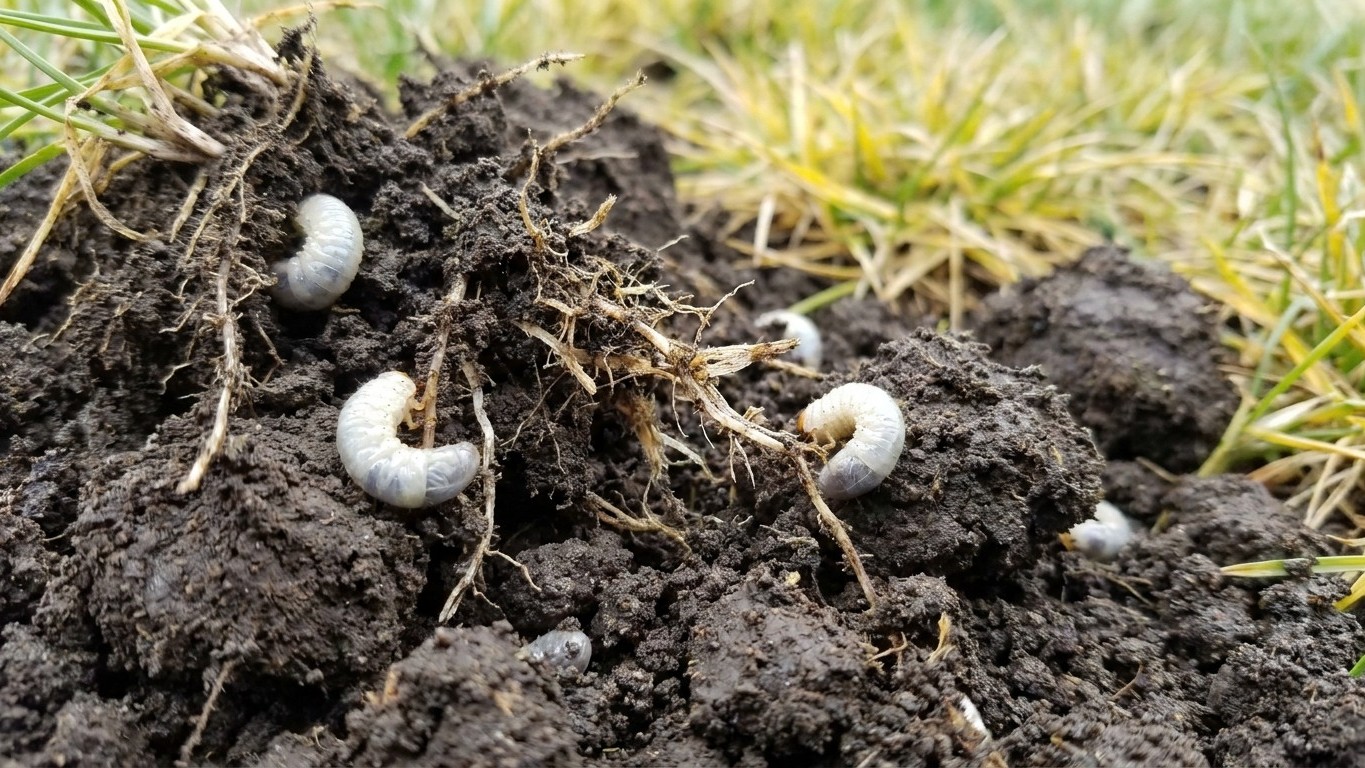

White grubs show up in Rhode Island lawns and garden beds from April through May, with late May marking the point when treatment does the most good. That window comes from University of Rhode Island Cooperative Extension guidance, and it lines up with the weeks right after the ground finally shakes off winter.
The weeks to watch

White grubs feed on plant roots in Rhode Island during April and May, and the University of Rhode Island Cooperative Extension names late May as the best window for treatment. That’s the period when grubs sit close to the soil surface, chewing on root systems before they move deeper to pupate into adult beetles.
Spring feeding: April to May
This is the documented window for Rhode Island. Grubs that overwintered deeper in the soil move back up as the ground warms, resuming root feeding through April and into May. This is also when lawn damage from the previous fall becomes visible again, since roots weakened over winter can’t support new spring growth.
Fall feeding: not documented locally
Most white grub species (Japanese beetle, European chafer, and similar scarab beetle larvae) also feed on roots in late summer and early fall, after eggs laid in June and July hatch. URI’s published composite doesn’t name a fall window specifically for Rhode Island, so treat the general late-summer-into-fall pattern as a rule of thumb rather than a confirmed local date. If you’re watching for a second round of damage, September is the general period entomologists point to across the Northeast, but that’s not a Rhode Island-specific figure.
Reading the calendar from your last frost

Grubs respond to soil temperature, not to a date on a wall calendar. A cold, slow spring pushes their feeding activity later; a warm one pulls it earlier. That’s why the last spring frost for the Providence area, which NOAA’s 1991-2020 climate normals place between April 7 and April 17, is a useful anchor even though it doesn’t predict grub behavior directly.
- Start with your last frost date. For the Providence reference station, that falls somewhere between April 7 and April 17. Rural and suburban yards outside the city often see frost end one to two weeks later, so check your own county’s typical date before planning around this.
- Add roughly five to seven weeks. That lands in the late-May window URI names as the best time to check for grub activity and treat if needed. This is not a single calculated day, it’s a range built from a range, and it should be treated that way.
A gardener who transplants seedlings right around the frost date should expect any grub-related root stress to become visible by late May, right when the recommended treatment window opens.
What it attacks, and what the damage looks like

The first sign is rarely the insect itself. It’s a patch of lawn that goes brown and spongy despite regular watering, or turf that lifts away from the soil like a loose carpet because the roots underneath have been eaten through. In garden beds, seedlings with shallow root systems wilt suddenly and topple even though the soil looks moist. Skunks, raccoons, and crows digging up patches of lawn overnight are often the clearest field sign, since they’re hunting the grubs themselves.
The damage is done by the larval stage, the grub itself, not the adult beetle. Adult beetles feed on foliage above ground, a separate kind of damage entirely. That distinction matters for treatment: anything aimed at adult beetles on leaves does nothing for grubs already chewing roots below the surface.
Plants and areas commonly affected include:
- Lawn turf, especially Kentucky bluegrass and fine fescue
- Newly laid sod, which has a shallow, still-developing root system
- Vegetable garden seedlings with shallow roots
- Strawberry beds
- Ornamental grasses
How Rhode Island sits in this pest’s range

White grubs aren’t a Rhode Island problem specifically, they’re a Northeast-wide one. The beetle species behind them (Japanese beetle, European chafer, and related scarabs) are established across nearly every state in the region, which means presence isn’t really the question. Timing is. A lawn in coastal Rhode Island warms up differently than one in a colder inland pocket of Connecticut or Massachusetts, and that shifts when the spring feeding window opens by a week or two in either direction.
URI’s own guidance on this pest comes from a composite of several extension pages rather than one dedicated vegetable-garden bulletin, and it leans toward ornamental and lawn care rather than food crops. That’s worth knowing if you’re searching for grub advice specific to a vegetable plot, since the most detailed local guidance was built with lawns and landscape beds in mind first.
What actually works against it

- Ease up on summer watering. Adult beetles seek out moist, well-watered lawns to lay eggs. A lawn allowed to go slightly dry in July is less attractive to egg-laying females, which cuts down next spring’s grub population before it starts.
- Raise your mowing height. Taller grass grows deeper roots, and deeper roots tolerate some grub feeding without turning brown. This doesn’t kill grubs, it just buys the lawn more resilience.
- Check by tugging turf in late May. Pull back a patch of grass in the treatment window URI names. If you find several grubs per square foot, you know the population is active while it’s still shallow enough to matter. This step becomes useless once grubs have moved deeper for winter dormancy.
- Encourage natural predators. Ground beetles and birds both eat grubs. Avoiding broad-spectrum treatments that also kill these predators keeps that natural pressure working in your favor.
- Apply beneficial nematodes to the soil. Many home gardeners use this as a late-summer treatment, timed to when young grubs are near the surface. Results are inconsistent and depend heavily on soil moisture and application timing, university trials don’t show it as a reliable stand-alone fix.
- Milky spore, for Japanese beetle grubs specifically. It’s a long-standing home remedy, slow to establish over multiple seasons, and it doesn’t work against other grub species. Treat it as a partial, patient measure rather than a quick answer.
Once grubs have already fed heavily and roots are dead, none of these measures bring the turf back. At that point, the practical step is reseeding or resodding the damaged patch and starting the prevention cycle over for next year.
Common questions
Can I see white grubs without digging up my lawn?
Not usually. They stay a few inches below the surface, so the reliable check is pulling back a patch of turf during the late-May window and looking directly at the root zone.
Do white grubs come back every year in the same spot?
They can, especially in lawns that stay consistently moist through summer, since that’s what draws egg-laying beetles back to the same ground.
Is grub damage the same as drought stress?
They look similar at first, brown, thinning turf, but drought-stressed grass usually greens back up after rain. Grub-damaged turf stays brown and lifts easily because the roots underneath are gone.