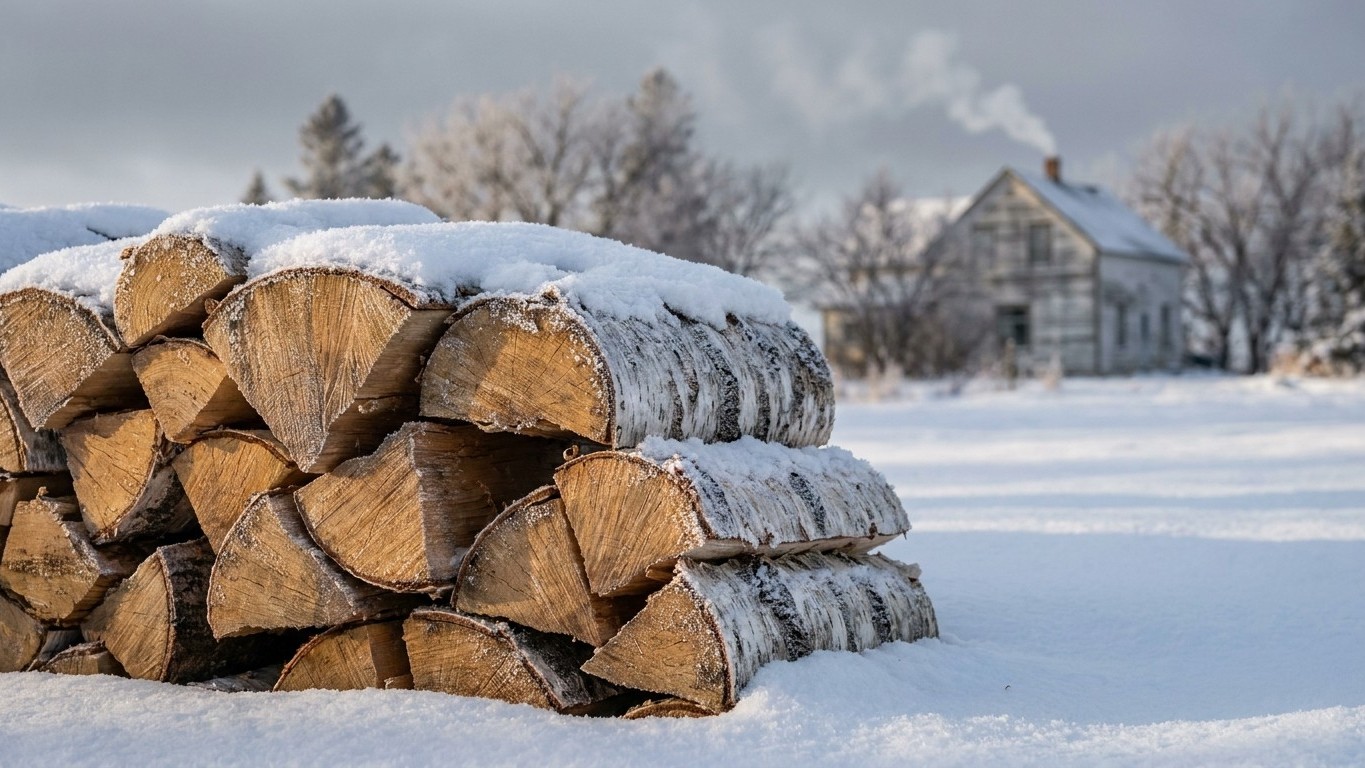

Saskatchewan winters don’t leave much room for guessing. The coldest month here averages a low of -5.3°F, and that single number should shape every decision you make about firewood: what species to burn, how many cords to stack, and how early you need to start drying wood for the season ahead. This guide walks through all three, using verified figures instead of rules of thumb.
How cold it actually gets here

Saskatoon’s climate normals put the average daily minimum for the coldest month at -5.3°F. That’s not a record low, and it’s not some worst-case anecdote from an old-timer. It’s the average low, meaning half the nights in that stretch dip below it. For a heating system, wood or otherwise, that’s the number that matters most, because it tells you what the appliance has to sustain, night after night, for weeks at a time.
A figure like that removes any ambiguity about what firewood means in this province. This isn’t a climate where a wood stove is a weekend accessory or a nice glow for the patio. At -5.3°F average lows, wood heat, when it’s the primary source, is infrastructure. A furnace or stove that can’t keep pace isn’t a comfort problem, it’s a pipes-freezing, pet-shivering, real problem. Even homes that use wood as a supplement to gas or electric heat are leaning on it hardest exactly when the grid or the furnace is under the most strain, during the same cold snaps this number describes.
What this means for the reader
Practically, this changes two things right away. First, the margin for error on wood quality shrinks. Poorly seasoned or low-density wood might get you through a mild fall evening, but it will not carry a household through a January cold snap when outdoor temperatures sit well below zero for days. Second, the volume of wood needed stops being a rough guess and becomes a planning problem, because running out mid-February in Saskatchewan is not the same inconvenience as running out in a climate where winter means occasional frost.
None of this means every household here heats exclusively with wood. Plenty use it as backup, or for a wood stove that takes the edge off in one room while a furnace handles the rest of the house. But even in that supplemental role, the -5.3°F figure sets the baseline. It tells you the stove will be asked to perform on the coldest nights of the year, not just the pleasant ones, and that reality should inform which wood you buy and how much of it you keep on hand.
Which woods are worth the effort here
Once you accept that winter here regularly drops well below zero, the density of your firewood stops being a minor preference and becomes the main variable. A cord is a fixed volume, 4 feet by 4 feet by 8 feet, or 128 cubic feet, whether you fill it with dense hardwood or light softwood. Since heat output scales with the wood packed into that volume, the denser species carry more energy for the same amount of stacking, hauling, and stove-loading. Michigan State University Extension puts a well-seasoned hardwood cord at roughly 20 million BTU, comparable to about 145 gallons of #2 fuel oil or 215 gallons of LP gas. That figure is an average, and it moves depending on species and moisture, but it’s the benchmark worth keeping in mind when you’re deciding what’s worth the extra effort to source and split.
Denser hardwoods, the kind that approach or exceed that 20-million-BTU benchmark once properly seasoned, are what you want loaded into the stove before bed on the coldest nights, because they burn slower and hold coals longer, which matters when you need heat to last eight hours without a reload. Lighter, less dense woods burn hot and fast, which makes them useful for getting a fire started or for shoulder-season evenings in October or April when you want some heat without loading the stove to capacity. They’re not built to carry an overnight burn through a night at -5°F, though, and treating them as a primary fuel in the depths of winter usually means waking up to a cold stove.
Local availability matters as much as the table
A dense species you can’t buy seasoned, or can only find green with no time left before the snow flies, is worse than a lighter wood you can actually get dried and stacked in time. Seasoning status trumps species rank almost every time. Ask any seller directly how long the wood has been split and stacked, not just cut, before assuming it’s ready to burn.
| Wood category | Heat output per cord | Smoke | Sparks |
|---|---|---|---|
| Dense hardwood (well-seasoned) | Near the ~20 million BTU benchmark | Low, clean burn when dry | Low |
| Medium-density hardwood | Moderate, below the hardwood benchmark | Low to moderate | Low to moderate |
| Light/softwood | Lower, burns fast rather than long | Higher, especially if resinous | Higher, more prone to popping |
How much wood a winter takes
Any number you see published for “cords per winter” in Saskatchewan is close to meaningless without knowing your own house. The honest answer is that you build the estimate yourself, using three variables that move the total up or down by a wide margin. The starting point is the cold figure covered above, -5.3°F average lows, which sets the floor for how much heat your home needs to generate just to stay livable. From there, everything depends on the house itself and on how wood fits into your heating setup.
The mechanism that makes estimates swing so much is insulation. A poorly insulated, drafty house in a hard winter can burn through roughly double what a tight, well-sealed home uses in that same climate, because so much of the heat you produce leaks straight back outside. That’s not a small rounding error, it’s the difference between three cords and six for two houses sitting on the same street.
- Local winter severity: use the coldest-month average low for your area as the baseline for how hard your heat source will be worked.
- Home insulation and airtightness: older, drafty construction can roughly double wood consumption compared to a well-sealed, well-insulated home in the same climate.
- Role of wood heat: whether wood is your primary heat source or a supplement to furnace or electric heat changes the total dramatically, since a supplement only needs to cover part of the load.
Run those three down the list for your own situation before you commit to buying, splitting, or seasoning any particular volume. A household heating primarily with wood in a drafty older farmhouse should plan very differently than one running a modern, tightly insulated home with wood as an occasional backup, even if both sit under the same -5.3°F winter low. Buy in stages if you can, and track how fast your stack actually disappears in the first cold snap. That real-world burn rate is a better predictor for the rest of the season than any generic number.
Drying wood in this climate
Seasoning matters more than species almost everywhere, and Saskatchewan is no exception. The target, regardless of climate, is wood at 20 percent moisture or less. Green wood can sit above 60 percent moisture when it’s first cut, and every bit of that water has to boil off inside the firewood before the wood can actually produce usable heat, which is exactly why unseasoned wood hisses, smokes, and struggles to sustain a flame instead of burning clean.
What dries wood isn’t sunlight, it’s air movement and time. Wood needs to be split first, then stacked loosely enough that air can pass through the pile, ideally off the ground and away from moisture. Split and stacked correctly, most wood reaches that 20 percent target after one full summer of drying. Red oak is a documented exception: its cell structure slows moisture loss, so it needs longer than a single season to reach the same target, even when split and stacked the same way as everything else in the pile.
The cold figure ties directly into timing. Wood cut in spring for that same winter is, in most cases, not going to be ready by the time the cold arrives in Saskatchewan, and this is the single most common mistake local burners make. A spring cut gives you maybe five or six months of drying time before the first hard frost, which isn’t enough for a lot of wood to reach 20 percent moisture, especially in a summer with normal or above-normal rainfall. The wood that goes into the stove this winter should, ideally, have been split and stacked at least a year earlier, giving it a full summer or more of airflow before it’s ever asked to produce heat on a night that drops toward -5°F.