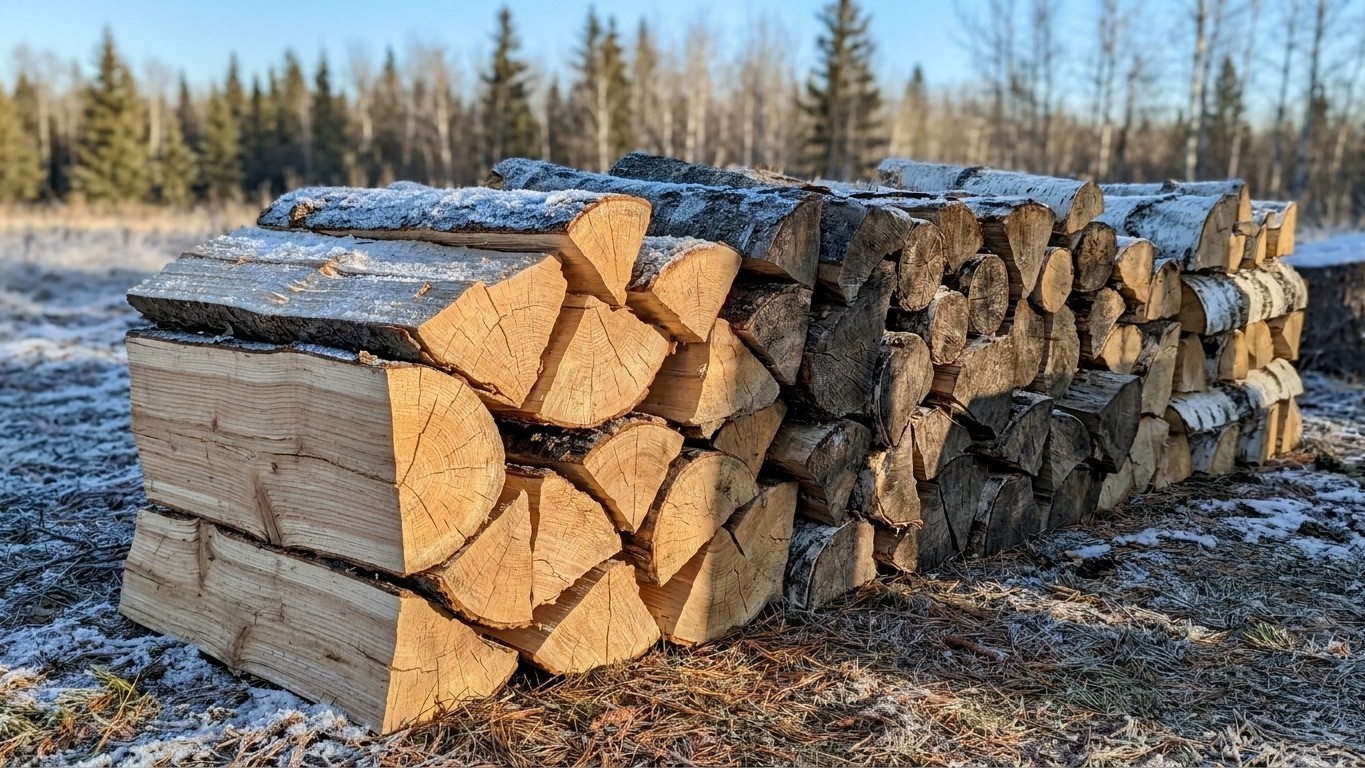

For most of Alberta, the winter answer comes down to two woods working together: lodgepole pine for quick, hot fires and shoulder-season heat, and trembling aspen or white birch for the long, steady burns that get you through a January cold snap. Spruce fills in as a third option where pine and aspen aren’t easy to find, but it burns fast and throws more creosote, so it works best mixed in rather than relied on alone.
That combination isn’t arbitrary. It reflects what actually grows in Alberta’s boreal and foothill forests, what’s legal to cut or transport, and what survives the province’s brutally dry cold without falling apart in the wood shed.
Why Alberta’s Climate Changes the Firewood Equation

Alberta winters don’t behave like winters in Ontario or the Maritimes. Chinook winds can push temperatures from minus 20°F to above freezing in a matter of hours, then slam back down just as fast. That swing matters for firewood in a way people don’t expect: wood that’s properly seasoned holds up fine, but wood with any hidden moisture pockets can crack, pop, and burn unevenly when it’s yanked through repeated freeze-thaw cycles.
The upside is humidity, or the lack of it. Alberta’s air is dry almost everywhere outside the far north, and that dryness is a gift for seasoning. Wood split and stacked properly in Calgary, Red Deer, or Lethbridge can reach burnable moisture content in four to six months during summer, compared to the year-plus some eastern hardwoods need in damper climates. The catch is you still have to split it early. Standing dead pine looks dry on the outside but often holds moisture in the core, and skipping the split-and-stack step just because the air feels arid is the single most common mistake first-time buyers make here.
The Species That Actually Grow (and Burn) Here
Alberta doesn’t have the oak, hickory, and sugar maple stands that dominate firewood conversations east of Manitoba. The province sits almost entirely in boreal and montane forest zones, which means the available species list is shorter, but each one has a defined job.
Lodgepole Pine
This is the workhorse. Lodgepole pine covers huge stretches of the foothills and eastern slopes, and it’s the wood most Albertans burn without even thinking about alternatives. It splits easily, seasons fast (often in three to four months if cut in spring), and lights without much coaxing. The tradeoff is a lower heat output than hardwood and a resin content that demands a clean, hot-running chimney to avoid creosote buildup. Pine is the right call for fall and spring fires, camp stoves, and getting a cold firebox going before you add something denser.
White and Black Spruce
Spruce is everywhere in the boreal belt and often shows up mixed into pine loads sold by roadside sellers. It burns hot but quick, throws sparks more than pine does, and isn’t the wood you want for an overnight burn. Where it earns its keep is as kindling and quick-heat supplemental wood on mild days when you don’t need a fire to hold for six hours.
Trembling Aspen (Poplar)
Aspen is the closest thing Alberta has to a reliable “hardwood” option for everyday heating, even though botanically it’s a softer hardwood than oak or maple. It’s dense enough to burn slower than pine, produces a decent coal bed, and is abundant across the parkland and boreal regions, meaning it’s usually cheaper per cord than birch. Alberta households burning aspen as their primary wood typically report needing less frequent reloading than with straight pine, which matters at 2 a.m. in February.
White Birch
Birch is the premium option in most of Alberta, prized for a hotter, longer burn and a pleasant smell, but it’s less widely distributed than pine or aspen and commands a higher price where it’s sold commercially. Its bark, which stays flammable even when slightly damp, makes it a favorite for fire-starting in addition to sustained heat.
Tamarack (Larch)
Less common in firewood conversations but present in wetter boreal pockets, tamarack is unusual because it’s a conifer that drops its needles every fall. It burns hotter and denser than pine or spruce, closer to birch in output, though it’s harder to find in commercial quantities and mostly shows up when people cut their own on Crown land permits.
Rules You Need to Know Before You Cut or Haul
Alberta treats firewood as a regulated resource, not just a backyard commodity, and two issues drive most of the rules.
Cutting on public land requires a personal use forest products permit through Alberta Environment and Protected Areas. These permits set volume limits, specify which forest management unit you’re allowed to cut in, and usually require the wood to stay within a defined distance of where it was harvested. Showing up with a chainsaw and a truck without one isn’t a technicality violation, it’s an offense that can carry real fines.
The bigger issue is mountain pine beetle. Alberta has active quarantine and monitoring zones, particularly through the foothills and parts of the boreal forest, where moving untreated pine firewood out of a control area is restricted specifically to slow the beetle’s spread eastward into Saskatchewan and further into the province’s pine stands. If you’re buying pine locally and burning it locally, this rarely affects you. If you’re hauling wood a long distance, especially east or north out of infested zones, check current provincial restrictions before you load the truck.
A second, separate concern shows up mainly in cities: Dutch elm disease. Edmonton, Calgary, and several other municipalities restrict storing or transporting elm wood, especially during the beetle-active season from April through September, because elm bark beetles that spread the disease can live in cut elm and jump to healthy trees. Elm isn’t a major heating wood in Alberta anyway, but anyone pruning a yard elm should know that stacking it in a woodpile isn’t the default disposal option it would be for a fallen aspen.
Where Albertans Actually Get Their Wood
Three sources cover almost everyone. Retail and roadside sellers, common along highways near Rocky Mountain House, Hinton, and the foothills corridor, typically sell mixed pine and spruce loads by the cord or half-ton pickup load, with birch and aspen priced separately as an upgrade. Private woodlots and farm operations, especially in the Peace Country and central Alberta, often sell aspen and birch directly, sometimes at a discount if you’re willing to pick up unsplit rounds. And Crown land permits remain the cheapest option by far for anyone willing to do the cutting, splitting, and hauling themselves, provided they stay inside their permitted unit and volume.
One detail that catches new residents off guard: Alberta firewood is commonly sold by the “face cord” rather than the full bush cord, and a face cord’s actual wood volume depends entirely on how long the pieces are cut. A face cord of 16-inch pieces holds roughly a third of a full cord’s wood. Asking the seller for the piece length before agreeing on a price avoids the disappointment of a truckload that looks full but heats a lot less than expected.