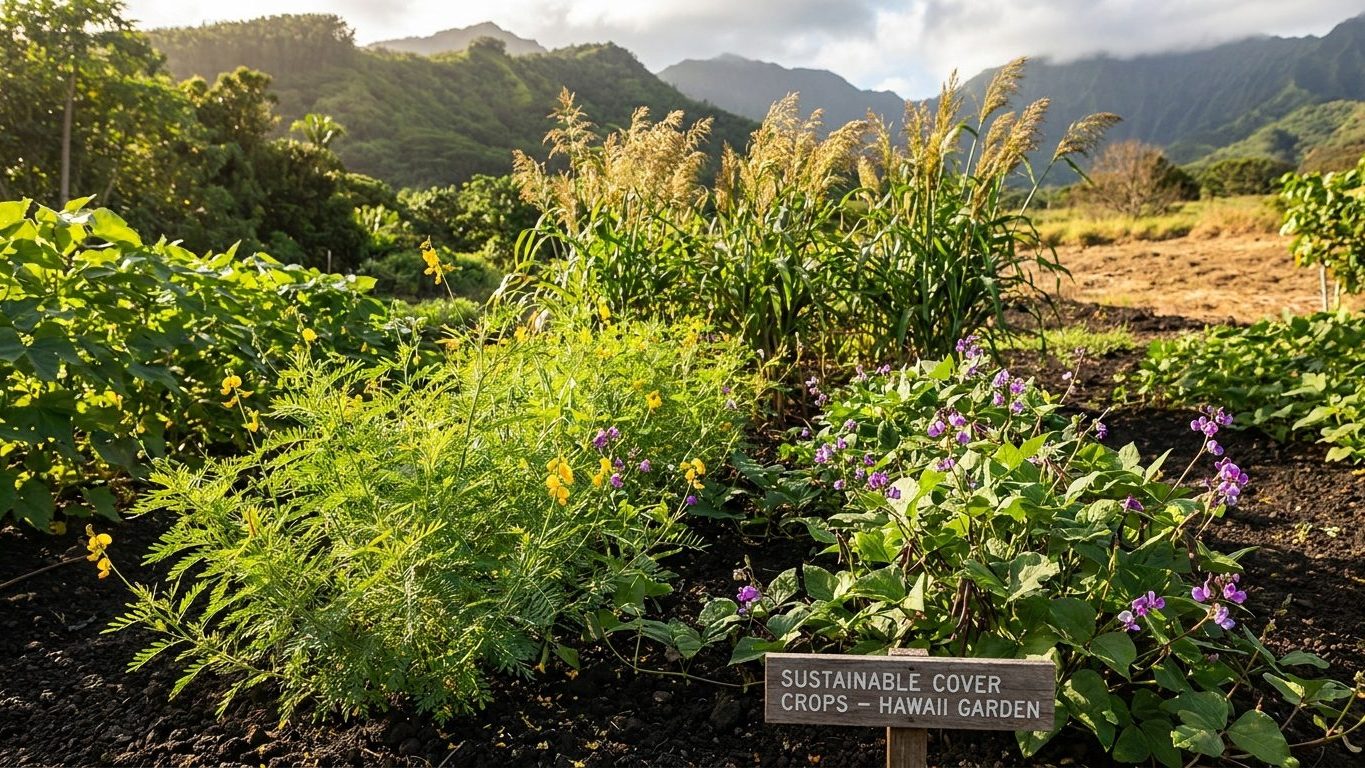

Fall rye is the cover crop that actually survives a Saskatchewan winter, and it’s the one most growers lean on for overwinter ground cover. Oats, field peas, and tillage radish fill the shoulder-season gaps when the calendar is too short for anything slower to establish. What doesn’t work here is just as telling as what does, and that’s the part worth understanding before seed goes in the ground.
The short answer for Saskatchewan
Saskatchewan’s frost-free window, measured at the Saskatoon SRC station, runs from a mean last spring frost on May 18 to a mean first fall frost on September 18. That gives a working season of roughly 123 frost-free days in an average year, and that number is a midpoint, not a guarantee. In one year out of two, frost arrives later in spring or earlier in fall than these dates suggest, so any cover crop plan built on a 123-day season needs slack on both ends, not a tight fit.
That short, cold-bookended window is why the winter cereals carry so much weight in prairie cover cropping. Fall rye and winter wheat are bred to sit dormant under snow and resume growth the moment soil thaws, which matters when the reference hardiness zone for this region is 3a and the coldest month brings a mean daily minimum of -20.7°C (-5.3°F is the figure on this site’s US pages, but that comparison only matters if you’re checking against an American county). A plant that can’t shrug off that kind of cold has no business going in a Saskatchewan field as a season-long cover.
For the parts of the rotation that don’t call for overwintering, the fast movers matter more than the hardy ones. Oats germinate quickly in cool soil, put on bulk fast, and winterkill cleanly, which makes them a low-risk choice between a harvested crop and next spring’s seeding. Field peas do the same job while fixing nitrogen, and tillage radish adds a taproot that breaks up compaction in the weeks it has before frost shuts it down. None of these three need to survive winter, which is exactly the point: they’re built for the gap, not the whole year.
The practical shortlist, then, sorts by purpose rather than by a single “best” plant. Fall rye or winter wheat for genuine overwinter cover and spring biomass. Oats or field peas for a quick post-harvest cover that dies on its own. Tillage radish where compaction is the actual problem. Anything promising a season-long, frost-tender cover crop in this climate is selling a Zone 5 solution to a Zone 3a field.
What will not work here
Buckwheat is the clearest example of a plant that looks perfect on paper and fails on the prairie calendar. It grows fast, suppresses weeds, and flowers within weeks, but it has zero frost tolerance. A single light frost, and the stand is done. With a mean first fall frost landing on September 18, and real years running earlier, buckwheat planted with anything less than a wide margin before that date turns into a wasted seed bag rather than a cover crop.
Hairy vetch and crimson clover have the opposite problem: they’re marketed as winter cover legumes, and in milder zones they are, but their winter survival gets unreliable once the coldest month’s mean daily minimum drops toward -20.7°C. That’s the kind of cold that sits below the comfort range most seed catalogs quote for these two species, which is why growers who trial them at zone 3a routinely report thin, patchy spring stands rather than the thick mat sold on the label.
Biennial sweet clover asks for a full season to get established before it can handle winter, and a 123-day frost-free window doesn’t always leave room for that plus a harvested cash crop ahead of it. Seed it too late in the shoulder season and it goes into winter as a weak seedling instead of a hardened plant, and a weak seedling is exactly what a -20.7°C month is built to finish off.
Brassicas planted too late
Fast brassicas like tillage radish work well when they’re seeded right after an early-harvested crop, but push that seeding date too close to September 18 and they simply run out of daylight and warmth to build the root mass they’re grown for. A radish that never gets past a few true leaves before frost isn’t breaking up compaction, it’s just an expensive cover for bare dirt.
The pattern across all of these failures is the same: species bred for a longer, milder season get sold into a short, cold one, and the mismatch shows up as thin stands, winterkill, or crops that never mature. Matching the plant to the 123-day window and the 3a cold, not to the seed tag’s optimistic range, is the entire game.
What changes across Saskatchewan
Saskatoon’s reference hardiness zone of 3a describes one station, not the whole province, and Saskatchewan is not one climate wearing a single label. Natural Resources Canada’s plant hardiness mapping, built from seven climate variables rather than the single-variable USDA approach, shows conditions shifting noticeably as you move from the southern grain belt toward the northern forest fringe, with growers in the far north working a shorter, colder season than the Saskatoon numbers on this page describe.
That spread matters for cover crop timing more than for cover crop choice. The same species, fall rye, field peas, oats, tend to show up across most of the settled agricultural belt, but the calendar for seeding and terminating them shifts by region. A grower working land north of the Saskatoon reference point should expect the safe seeding window to close earlier in fall and open later in spring than the May 18 to September 18 dates quoted here, simply because the growing season itself is shorter the farther north you go.
There’s no single zone number that covers the province, and this page won’t invent one just to sound complete. What it can say is that the difference between the milder south and the colder north is large enough to change a planting date by weeks, not days, which is enough to turn a comfortable margin into a tight one, or a tight one into a failure.
Rather than guess which side of that spread applies to a given farm or garden, check the actual mapped zone for the specific location. Natural Resources Canada’s Plant Hardiness Site lets you enter a location and get the zone that applies there, and that single lookup does more for planning purposes than any provincial average on this page ever will.
Where to check this for your own county
Saskatchewan’s Ministry of Agriculture publishes provincial guidance through the Government of Saskatchewan’s agribusiness portal at saskatchewan.ca’s agribusiness, farmers and ranchers section, and that’s the right first stop for anything more specific than the province-wide figures used here. This page works from the Saskatoon SRC station’s frost dates and the 3a reference zone; a regional agrologist or a rural municipality’s extension contact works from what actually grows in that specific district.
What’s worth looking for on that provincial page is twofold. First, any regional planting calendar that breaks the province down by soil zone (brown, dark brown, black, and grey wooded soil zones behave differently even at the same latitude) rather than treating Saskatchewan as one block. Second, any list of cover crop varieties that have actually been trialled in the reader’s part of the province, since a fall rye variety that performs well near Saskatoon isn’t automatically the one recommended for the Peace River block or the southwest corner near the Alberta border.
A county-level, or in Saskatchewan’s case a rural-municipality-level, recommendation beats a provincial one every time, because it accounts for local soil zone, local frost pattern, and local field trial results that a province-wide page can’t capture. This page gives the provincial baseline: 123 frost-free days around Saskatoon, zone 3a at the reference station, a coldest month averaging -20.7°C. Local extension contacts refine that baseline into an actual planting date for an actual field, and that refinement is worth the phone call or the site visit.
Checking this against your own garden
No frost date on this page beats what the ground itself is telling you in a given year, and three simple checks reveal more about a specific plot’s microclimate than any provincial average.
Soil warmth by feel is the first and most reliable one. Push a hand a few inches into the seedbed on a spring morning; if it feels cool and slightly damp rather than cold and wet, most cover crop seed will germinate reliably, regardless of what the calendar says the date should be. Ground that still feels genuinely cold, even weeks after the average last frost, is signaling a slower microclimate than the Saskatoon reference station describes, and seeding should wait for it.
The first true leaves on an already-seeded cover crop are the second signal. A fast species like oats or radish should show true leaves, not just the initial seedling leaves, within roughly a week or two of emergence in reasonable conditions; a stand that’s stalled at the seedling stage for much longer than that is struggling with either cold soil or moisture stress, and that’s worth noting for next year’s timing.
Third, watch how a fall-seeded cereal like rye behaves right before the ground freezes hard. A stand that’s tillered and has decent green leaf going into winter has banked enough growth to come back strong in spring; a thin, barely-emerged stand seeded too close to the season’s end is a sign the seeding date needs to move earlier next year, whatever the provincial average frost date says. That single observation, made once, tells a grower more about their own patch of ground than September 18 ever will on its own.