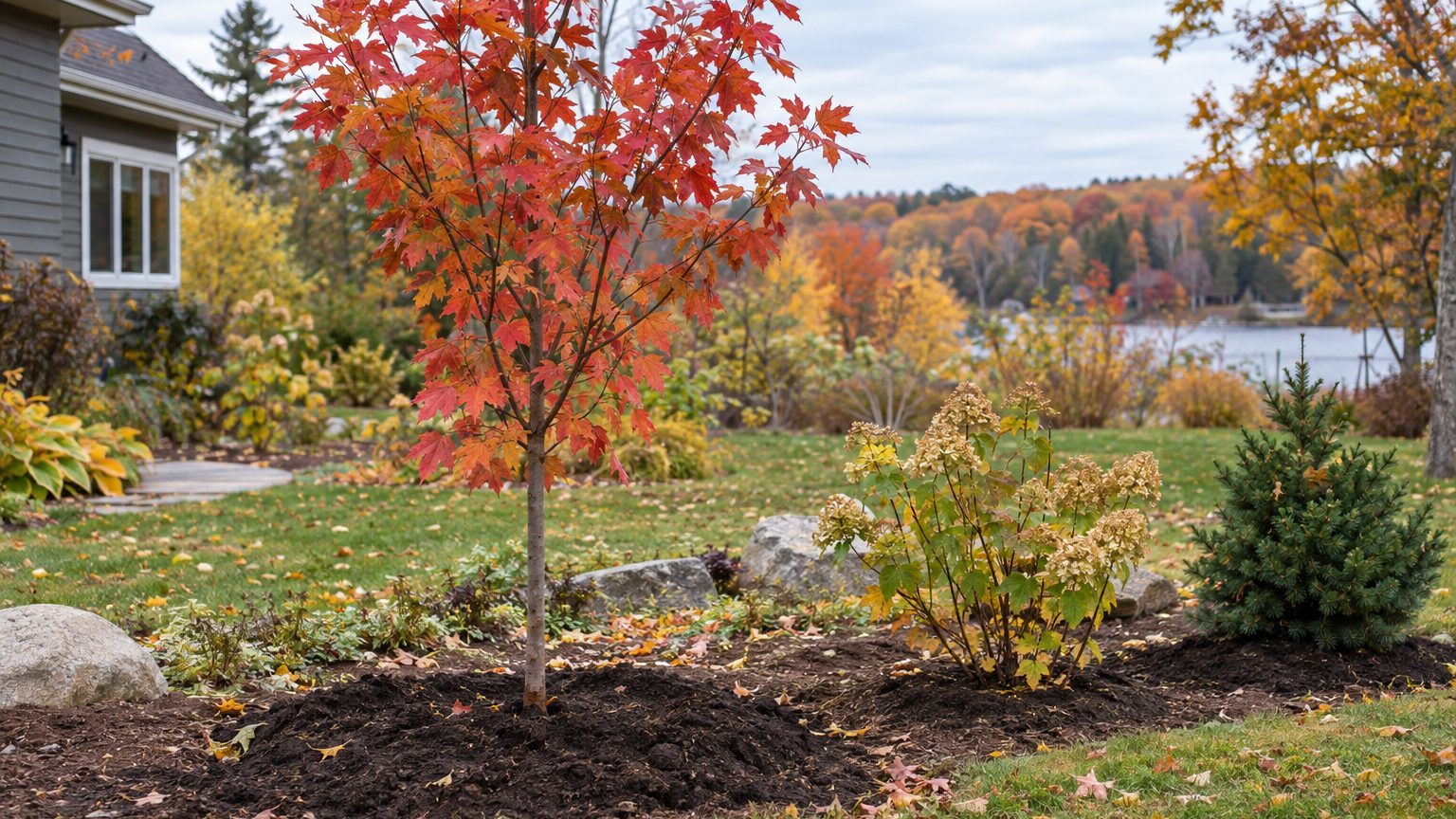

The conservative answer for Alberta is to have trees and shrubs in the ground by August 5, six weeks before the first fall frost, which averages September 16 at Calgary. That is the safe target, not the hard stop. Hardy container and balled stock planted after that date often make it, and the margin shrinks with every week you wait. The true limit is the day the soil freezes solid, and that date changes from year to year.
The deadline in Alberta
Roots keep growing as long as the soil is workable and above freezing, and that lasts well after the air has turned cold. A tree drops its leaves and looks finished for the year, but underground it is still reaching into cool soil. That is why Cornell Cooperative Extension (Orleans County) puts the rule in terms of the ground rather than the air: “Fall is an excellent time for transplanting, provided you get them to their new home at least 6 weeks before the ground freezes, allowing them time to establish roots before winter dormancy.”
Working back from the first fall frost
Nobody knows in August when the ground will freeze, so the practical move is to count back from the first fall frost, which is easier to look up. Environment and Climate Change Canada’s 1981-2010 climate normals for the Calgary International station put the first fall frost on average at September 16. Six weeks earlier is August 5, the conservative planting deadline. Treat early August as your target for getting trees and shrubs into the ground, with August 5 as the safe mark at Calgary.
That September 16 figure is a mean, not a promise. In one year out of two the frost arrives later, and in the other half it arrives earlier. Think of it as the midpoint of a window running through mid-September, not a safe date. Ground freezing usually comes later than the first frost of the air, so the real limit sits past the August 5 mark. That gap is the buffer you use up when you plant in September or October.
Calgary is one station in a big province. Northern and upland districts get their first fall frost earlier, so their deadline moves earlier too, and a garden in the foothills or well north of Calgary should count back from a date well ahead of mid-September. The First and Last Frost Dates in Alberta page has more on how those dates shift across the province. One more caveat: Canadian normals cover 1981-2010, while US figures cover 1991-2020, so numbers from a US site are not on the same footing.
Winter is the other half of the picture. The mean daily minimum of the coldest month at Calgary is -13.2 °C (Canadian Climate Normals 1981-2010). Natural Resources Canada places Calgary in Canadian plant hardiness zone 4a, based on 1991-2020 normals. That is the Canadian system, built on seven climate variables, and it is not a USDA zone. NRCan says there are no simple conversions between the two systems, and that Canadian zone 4a overlaps nine USDA zones, from 3a to 7a. When a tag lists a USDA zone, do not assume it matches what you see on a Canadian map. More local guidance is collected in the Alberta guides.
What to plant late, and what to wait on
After the safe date, what matters most is how well the plant is suited to your winter. Container-grown and balled-and-burlapped stock that is fully hardy for Canadian zone 4a establishes well in cool fall soil. It arrives with a root system mostly intact, and it does not have to compete with summer heat while it settles in. Deciduous trees and shrubs are the easiest, because they lose their leaves and stop demanding water from roots that are still finding their footing.
Risk climbs with anything borderline. A shrub rated for zone 5 or warmer will get through many Alberta winters, but a -13.2 °C average coldest-month minimum, with colder snaps on top of that, is a lot to ask of a plant that has not yet rooted in. Evergreens have a different weakness: they keep their needles and keep losing water all winter, including on dry, windy days when the soil is frozen and roots cannot replace it. A juniper planted in early August has time to settle in, while one planted in mid-October may not.
| Type of plant | Late fall planting | Why |
|---|---|---|
| Hardy deciduous tree or shrub, container or balled | Good, if soil is workable | Leafless plants lose little water and roots keep growing in cool soil |
| Hardy perennial in a container | Good, earlier is better | Roots need time to anchor before the ground freezes |
| Evergreen tree or shrub | Risky after the safe date | Foliage loses water all winter while roots cannot replace it |
| Borderline-hardy plant (marginal for Canadian zone 4a) | Wait for spring | An unrooted plant has little margin against cold |
If you are unsure which category a plant falls in, check its hardiness rating against Canadian zone 4a, not a USDA number. For the basics of setting a plant in the ground, from hole width to how deep the root flare sits, see Planting and Caring for Trees, Shrubs and Perennials. Anything borderline or evergreen that misses the early August target is better held until spring. A nursery can usually keep the plant, or you can heel it in somewhere sheltered, and a few months of waiting costs much less than replacing a dead tree.
Watering and mulch until the ground freezes
A newly planted tree has a small root system that sits in a small volume of soil, and that soil dries out faster than the surrounding ground. Alberta falls are often sunny and dry, and chinook winds can pull moisture out of soil in a hurry. Water deeply, enough to soak the root ball and the soil just beyond it, and keep doing it through fall until the ground freezes. A light sprinkle that wets only the top inch does more harm than good, because it encourages roots to stay shallow.
Skipping that last soak is a common mistake. Gardeners put the hose away after the leaves fall, but roots in unfrozen soil are still drinking, and the plant will lean on that stored water all winter. Give one more deep watering when the soil is still workable and the weather has turned cold.
Mulch does two jobs here: it holds moisture and it evens out soil temperature. The NC State Extension Gardener Handbook (chapter 11, Woody Ornamentals) gives the depth for trees: “Provide a 3-inch layer of mulch to reduce water loss and maintain uniform soil moisture and temperature around roots.” On the weed side it says: “A 2-inch to 3-inch layer of mulch suppresses most annual weed seeds and makes it easy to hand-pull any that do germinate.” Both sentences point to the same depth. Aim for a 2-inch to 3-inch layer, spread in a ring and pulled back from the trunk. More is not better.
Shape matters as much as depth. A ring is a flat, wide donut of mulch with the trunk flare left visible in the middle. A volcano is mulch heaped up against the bark, which holds moisture on the trunk and gives rodents a warm place to nest. If the mulch touches the trunk, you have built the second one. The Mulching Without Killing the Plant page covers this in more detail.
The first winter is about roots, not growth. A tree planted in fall will not put on noticeable new top growth until the following season. What it is doing underground, before the soil locks up, is spreading roots out from the original root ball into native soil. A plant that goes into winter with roots that have reached out will wake up in spring and grow. One that has not may leaf out weakly, or not at all. Judge success by how the plant looks in June, not October.
What goes wrong
The most common failure is planting too late for the climate. If the ground is already freezing when a tree goes in, the roots never get the weeks they need. The plant survives on stored energy until spring, and many run out. That is why the six-week rule exists, and why a tree that misses the conservative target should be hardy stock planted well and watered until freeze-up, or it should wait for spring. Digging into frozen ground is a sign you are past the point of no return.
Winter burn is the second problem, and it hits evergreens hardest. Sun and wind pull moisture out of needles, and frozen roots cannot send more up. Needles turn brown, usually on the windward or sunny side, and the damage often shows in late winter or spring. Chinook conditions make this worse, because a warm, dry wind can dry needles out mid-winter while the soil beneath is still frozen. Good fall watering and a planting spot sheltered from the prevailing wind help. So does choosing evergreens for planting earlier in the season.
Heaving is the third. Shallow root balls sit in the soil layer that freezes and thaws repeatedly, and each cycle can push the plant up a little. By spring the root ball may be sitting partly out of the ground, with roots exposed. Mulch in a ring moderates those swings, and planting at the right depth in the first place matters most. If you see a tree lifted in spring, gently firm it back down and water it.
Last, a dry fall can undo everything. Soil that never gets rain and never gets watered leaves roots dry going into winter. Gardeners east of Alberta face the same timing question, and the same rule plays out a bit differently there. How Late Can You Plant Trees and Shrubs in Fall in Saskatchewan? shows how the count changes with a different frost date.
Common questions
Is it too late to plant a tree in Alberta in October?
It is past the conservative deadline, but not automatically too late. If the soil is still workable and the tree is a hardy deciduous container or balled plant, it can still establish. Water it deeply and mulch it. If the ground is frozen or nearly so, wait for spring.
Does the first fall frost mean I should stop planting?
No. Frost is an air temperature, and the ground freezes later. The first fall frost at Calgary averages September 16, and it comes later in about half of years. It works as a marker for counting back, not as a stop sign. The conservative deadline is six weeks before that frost.
What hardiness zone should I use for Alberta?
Use the Canadian system. Natural Resources Canada lists Calgary in zone 4a, and that is not a USDA zone. NRCan says the two systems do not convert simply, and that Canadian 4a overlaps nine USDA zones, from 3a to 7a. Colder districts will differ from Calgary, so check your own location on the NRCan map at planthardiness.gc.ca.
Should I keep watering after the leaves drop?
Yes. Roots are active until the ground freezes, and the tree will draw on that moisture all winter. Keep giving deep waterings through fall and finish with one more just before freeze-up.