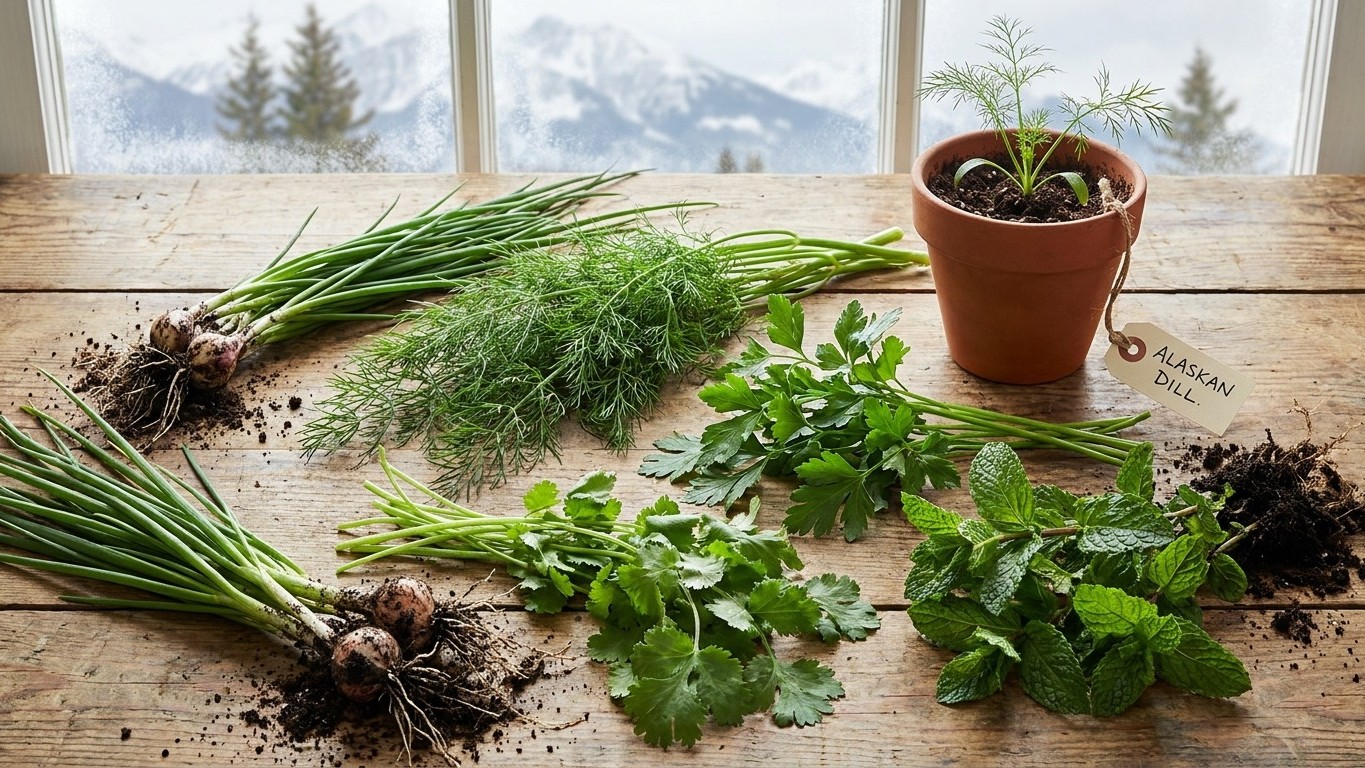

Saskatchewan‘s short, intense growing season rewards fast annual herbs like dill, cilantro, chives, and parsley over slow Mediterranean perennials. With a mean frost-free window of roughly 123 days and winters that test even hardy perennials to their limit, the safest bets are herbs that either finish quickly or are rated for Canadian zone 3a.
The short answer for Saskatchewan
Saskatoon’s climate normals put the mean last spring frost at May 18 and the mean first fall frost at September 18. That’s a 123-day gap between two averages, not two guarantees, and in about half of all years frost arrives later in spring or earlier in fall than these dates suggest. Any herb decision in this province starts from that squeeze.
For fast annual herbs, the math works in your favor. Dill, cilantro, chervil, and summer savory can go from seed to harvest in six to eight weeks, which means even a shortened version of that 123-day window still gives you two, sometimes three, successive plantings. Chives, technically a perennial but essentially indestructible, sail through the cold with no fuss and regrow reliably each spring once established.
Basil is the trickier case. It’s a fast grower once warm, but it hates cool soil and will simply sit and sulk if direct-seeded outdoors near that mean May 18 frost date, when soil is still cold. The workaround gardeners across the prairies use is starting basil indoors four to six weeks before the last frost and transplanting it out only once nights are reliably above 50°F, not on the calendar date itself. That shifts the effective outdoor season closer to 90-100 days for basil, still workable, but with less margin for error than dill or parsley.
Parsley and cilantro do well seeded directly once soil has warmed, and both tolerate the cooler shoulder seasons better than basil. Oregano and thyme, treated as perennials, need to be chosen specifically for zone 3a hardiness rather than assumed hardy just because they’re often sold as perennial herbs in warmer catalogs. Tarragon splits into two: French tarragon is only marginally hardy here and often needs winter protection, while Russian tarragon shrugs off the cold but has a milder, less prized flavor.
The single number that should guide every choice on this list is Canadian hardiness zone 3a, assigned to the Saskatoon reference station. That zone rating, built from seven climate variables rather than the single minimum-temperature figure the US system uses, is the filter every perennial herb needs to pass before you commit garden space to it for more than one season.
What will not work here
Rosemary is the herb most gardeners want to grow and the one Saskatchewan’s climate refuses outright. Rosemary needs winter lows that stay well above what this province delivers even in a mild year. The mean daily minimum temperature in Saskatoon’s coldest month sits at -5.3°F, and that’s an average, not the floor. Actual winter events routinely dip far colder across the province. Rosemary planted in open ground here doesn’t struggle through winter; it dies in it, every time, unless it’s grown in a container and moved indoors before the first hard frost.
Bay laurel fails for the identical reason. It’s a Mediterranean shrub with no meaningful cold tolerance, and no amount of mulch or wind protection changes that math when winter minimums run this low. Lemongrass belongs in the same category: it’s a tropical grass that dies at the first light frost, and Saskatchewan’s 123-day mean season isn’t long enough to make growing it as an annual from seed worthwhile even where climate allowed it.
French tarragon sits in a gray zone rather than a flat no. It survives some winters here with heavy mulch and good snow cover, and winterkills in others when snow cover is thin or a cold snap arrives before insulating snow builds up. Gardeners who want tarragon reliably tend to choose Russian tarragon instead, trading some flavor intensity for a plant that doesn’t need to be replaced every second or third year.
Long-season basil varieties bred for hot climates elsewhere in North America run into a different problem: not winter cold, but a summer that simply isn’t long or hot enough to bring them to full flavor and yield before the mean September 18 fall frost closes things down. Shorter-season, compact basil varieties handle the compressed window far better than the large-leaf types bred for six-month growing seasons.
Thyme deserves a specific caution. It’s often marketed as a hardy perennial, and in many climates it is, but exposed crowns in windswept, low-snow sites can die back even where the species is rated for zone 3a. The failure here isn’t the plant’s cold tolerance on paper; it’s wind desiccation and inconsistent snow insulation at a specific site, which no hardiness rating fully accounts for.
What changes across Saskatchewan
Saskatoon’s zone 3a rating describes one reference point in a province that stretches from open prairie in the south to boreal forest near the Northwest Territories border. A province this size does not have one climate, and it does not have one hardiness zone. The Saskatoon figure is a useful anchor for the southern-central belt where most of the province’s population and farmland sit, but it is not a stand-in for conditions farther north or in low-lying frost pockets anywhere in the province.
Gardeners farther north should expect a shorter frost-free window than the Saskatoon mean, colder winter minimums than the -5.3°F figure recorded there, and less reliable snow cover to insulate perennial herb roots through winter. That combination pushes marginal perennials like French tarragon and some thyme varieties from “difficult” to “not worth attempting outdoors” the farther north a garden sits.
South of Saskatoon, particularly in sheltered river valleys, conditions can run slightly milder, occasionally supporting perennial herbs that struggle at the reference station. But “slightly milder” in a zone 3a province still means genuinely cold winters by the standards of most of the continental United States, and it does not open the door to Mediterranean herbs like rosemary or bay.
Because this page can only report the figure verified for the Saskatoon reference station, it cannot tell an individual reader which zone applies to their own yard. That’s a job for the map, not for a provincial article. Natural Resources Canada’s Plant Hardiness Zone tool lets you check the rating for your specific location rather than assuming Saskatoon’s number applies uniformly across a province this large.
Where to check this for your own county
Saskatchewan at the provincial level is described by one reference station’s frost dates and one reference city’s hardiness zone. That’s useful for a first pass, but it is not a substitute for information specific to your rural municipality, and a local recommendation will always outrank a provincial one when the two disagree.
Saskatchewan’s agriculture ministry maintains a resource hub for agribusiness, farmers, and ranchers at saskatchewan.ca. That’s the right starting point for anyone who wants a recommendation grounded in their own part of the province rather than in Saskatoon’s climate normals alone.
When you get there, look specifically for two things. First, any regional or crop-specific planting guidance that reflects local frost data rather than the province-wide averages used here; frost dates can shift by a week or more between the Saskatoon station and a location fifty or a hundred miles away. Second, look for variety information tied to trials or growing conditions relevant to your area, since a cultivar that performs well in a milder river valley may not be the best pick for an exposed upland site or a spot much farther north.
This kind of local detail matters more for herbs than it might seem. A perennial herb rated borderline-hardy at the provincial level can be a safe long-term planting in a sheltered county with reliable snow cover, and a real gamble in an exposed one just a short drive away. The provincial page you’re reading now gives you the general shape of the season; a county-level source, where one exists, gives you the specifics that actually decide whether a perennial herb survives its first winter.
Checking this against your own garden
No frost date, mean or otherwise, replaces what your own garden is telling you in a given year. Three simple observations will tell you more about your specific site than any provincial average.
Start with soil warmth, checked by hand rather than by calendar. Push a finger a couple of inches into the bed where you plan to direct-seed dill, cilantro, or parsley. If the soil still feels cold and damp rather than merely cool, seeds will sit and rot before they germinate, regardless of what the mean frost date suggests about timing. Warm, slightly dry-feeling soil is the real green light, not the date on a chart.
Second, watch how transplanted basil responds in its first week outdoors. If it stalls, yellows slightly, or simply stops growing after transplant, the air and soil are still too cold for it even if the calendar says the mean frost has passed. Vigorous new growth within days is the sign that your particular yard has genuinely warmed up, which matters more than the provincial average ever will.
Third, for anyone trying perennial herbs like thyme or tarragon through their first winter, watch how much snow actually accumulates and stays on your planting site compared with more open or more sheltered spots nearby. A thin, wind-scoured snow cover exposes roots to cold air far below the -5.3°F mean minimum for the coldest month, while a spot that reliably holds snow acts like insulation. That single difference, observed over one winter in your own yard, will tell you more about whether a marginal perennial herb belongs in your garden than any provincial hardiness zone can.