
The short answer: don’t plant herbs outdoors before the last week of May, and count on being done by mid-September. Saskatchewan runs on Canadian hardiness zone 3a, with a growing window that barely covers four months. That reality shapes almost every decision a home gardener makes here, from which species to try to whether a plant lives in the ground or in a pot that comes indoors for winter.
When the soil is warm enough in Saskatchewan

Environment and Climate Change Canada puts the average last spring frost at the Saskatoon SRC station at May 18, based on the 1981-2010 Canadian Climate Normals. That’s the number most Saskatchewan gardeners reach for, and it’s a reasonable starting point. But it’s a mean date, not a guarantee. Half the years on record saw frost arrive after May 18, sometimes well after. Treat it as the middle of a window, not a green light.
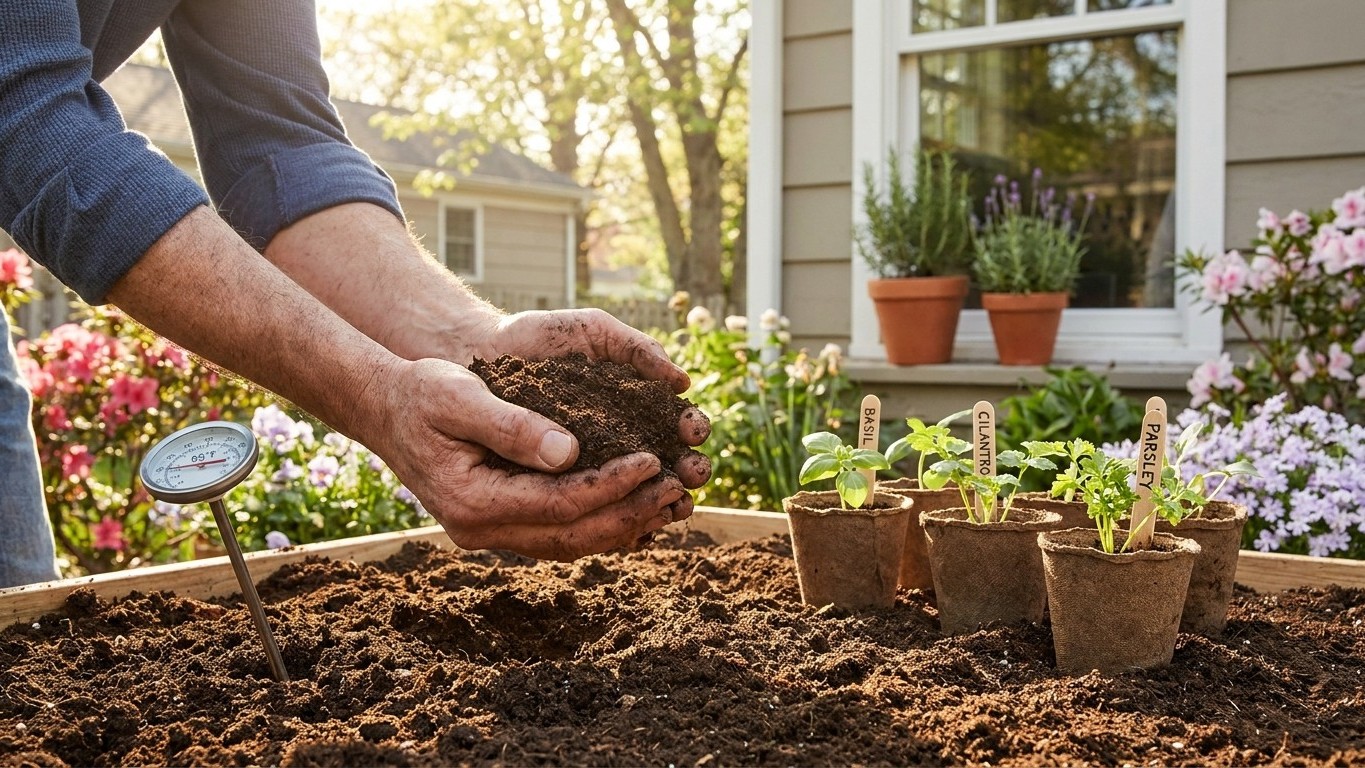
Frost date and soil temperature are two different things, and herbs care about the second one far more than the first. Air can warm up on a sunny afternoon while the ground six inches down is still cold from a long prairie winter. Most culinary herbs, especially the tender annual types, want soil that’s held steady warmth for several days running, which usually means waiting one to two weeks past that average frost mark before direct-seeding or setting out transplants. Rushing it doesn’t kill the plant outright most of the time, but it stalls growth so thoroughly that a later-planted, properly timed herb often catches up and passes it.
Saskatchewan is also not one climate. The Saskatoon SRC station sits in the central part of the province, and gardeners farther north, or at higher elevation, are routinely two to three weeks behind that date. If you garden near La Ronge or up toward the forest fringe, treat May 18 as optimistic and watch your own soil, not the calendar.
A practical way to judge readiness without lab equipment: push a bare finger into the top few inches of garden bed. If it feels only faintly cool rather than genuinely cold, and this holds true across several consecutive mornings, that’s a better signal than any printed date. Raised beds and containers warm faster than open ground, which is one reason many Saskatchewan gardeners start tender herbs in pots on a warm deck or south-facing step before the main bed is ready at all.
This page sticks to species and general types rather than named cultivars, since variety performance depends heavily on local trials this page doesn’t have access to. It also doesn’t cover medicinal use, herbal remedies, essential oil extraction, or wild plant identification. Some herbs carry long-standing reputations for health uses; this page simply doesn’t evaluate those claims, and readers foraging for wild look-alikes should know that several dangerous plants closely resemble common garden herbs. None of that is in scope here.
How long the season lasts here
Between the average last spring frost of May 18 and the average first fall frost of September 18, Saskatchewan’s frost-free window runs about 123 days. Both figures come from the same Saskatoon SRC station and the same 1981-2010 Canadian Climate Normals dataset, which is the only way this kind of subtraction is worth doing. Mixing a station’s spring date with another location’s fall date would produce a number that means nothing.
123 days is a middling window, not a generous one and not a punishingly short one either. It’s enough time for most fast-maturing annual herbs to go from seed or transplant to a full harvest, but it doesn’t leave much slack for mistakes, replanting after a cutworm attack, or a cold snap that lingers past the average date. In warmer regions with a five- or six-month window, gardeners often get a second sowing in after the first crop bolts or gets pulled. In Saskatchewan, that second round is a gamble unless it’s started very early indoors or chosen from the quickest-maturing types available, because anything planted in July has to finish its growth before the September frost risk climbs back up.
That timing pressure changes how transplanting gets handled too. With a longer season, a gardener can afford to baby a slow-establishing transplant, checking root development and potting up as needed before it ever goes in the ground. With roughly four months to work with, most Saskatchewan growers skip that extra step for anything meant to produce a real harvest, and instead choose transplants that are already root-ready, or they direct-seed the hardier types straight into the bed once soil temperature allows.
Anyone weighing a second planting, or trying to squeeze more out of this window through staggered sowing dates, will get more precise guidance from this site’s succession sowing guide, which walks through timing herbs and vegetables for exactly this kind of short-season math.
Heat and water in Saskatchewan

Here’s where Saskatchewan’s herb story takes a different shape than it does in the southern half of this content series. There’s no meaningful count of days above 90°F driving decisions in this territory, and no summer rainfall figure worth building a watering strategy around from the available data. The heat-stress questions that dominate herb growing in hotter regions, shade cloth, midday wilting, bolting from sustained high temperatures, simply don’t apply the same way on the Canadian prairie. Summers here run warm but rarely brutal, and the growing season is short enough that heat stress is a minor concern next to the two things that actually decide what survives: winter cold and season length.
The number that matters most is the coldest month’s average daily minimum, which sits at -5.3°F at the Saskatoon reference station. That’s a mean minimum, not a record low, but it’s still cold enough to kill the root systems of almost every herb commonly grown as a perennial farther south. Combined with a Canadian hardiness zone rating of 3a, it draws a hard line: very little in the herb world is genuinely winter-hardy outdoors here without protection, and gardeners who want a plant to persist year after year are usually looking at either a cold frame, a heavily mulched microclimate, or bringing the pot indoors before the ground freezes.
Where summers run cool and occasionally damp rather than scorching, the practical risk shifts from heat stress to fungal trouble. Dense, leafy herb plantings that don’t get airflow can develop mildew or slower, mushier ripening in a wet stretch, especially where beds sit close together or against a fence that blocks wind. Spacing plants generously and watering at the base rather than overhead does more for herb health in this climate than any amount of sun protection would.
Which herbs suit Saskatchewan
Given a roughly 123-day window and a winter that rules out most perennials outdoors, the herbs that do well here tend to fall into a few practical categories rather than specific named varieties.
- Fast-maturing annual herbs that complete their life cycle well within the frost-free window, since anything slow risks running into the September frost before it’s fully productive.
- Herbs treated as annuals regardless of their natural habit, including types that are technically perennial in milder climates but simply won’t survive a Saskatchewan winter outdoors, so they’re grown fresh from seed or transplant each year.
- Herbs grown in containers specifically so they can be moved indoors, or into an unheated but frost-protected space, before the first fall frost, letting a gardener keep a plant alive across winter that couldn’t survive the open ground.
- Types tolerant of cool, occasionally damp conditions, since disease resistance matters more here than heat tolerance, and a plant prone to mildew in humid stretches will struggle regardless of how well it handles the cold.
What this page won’t do is name a specific cultivar and call it the right choice for Saskatchewan. Variety trials run by provincial and university programs test dozens of strains of the same herb species under local soil, daylight, and disease pressure, and their results shift from year to year as new options come through. A page like this one, built on climate normals rather than field trials, has no business pointing to one packet over another. The Government of Saskatchewan’s agriculture and agribusiness resources are the place to find that kind of locally tested recommendation, since they draw on trials actually run in this province rather than general species-level reasoning. Refusing to name a variety here isn’t a gap in this page, it’s the honest answer: the climate data explains why a type of herb might work, but only a local trial can say which specific one performs best in this soil, this season, this year.