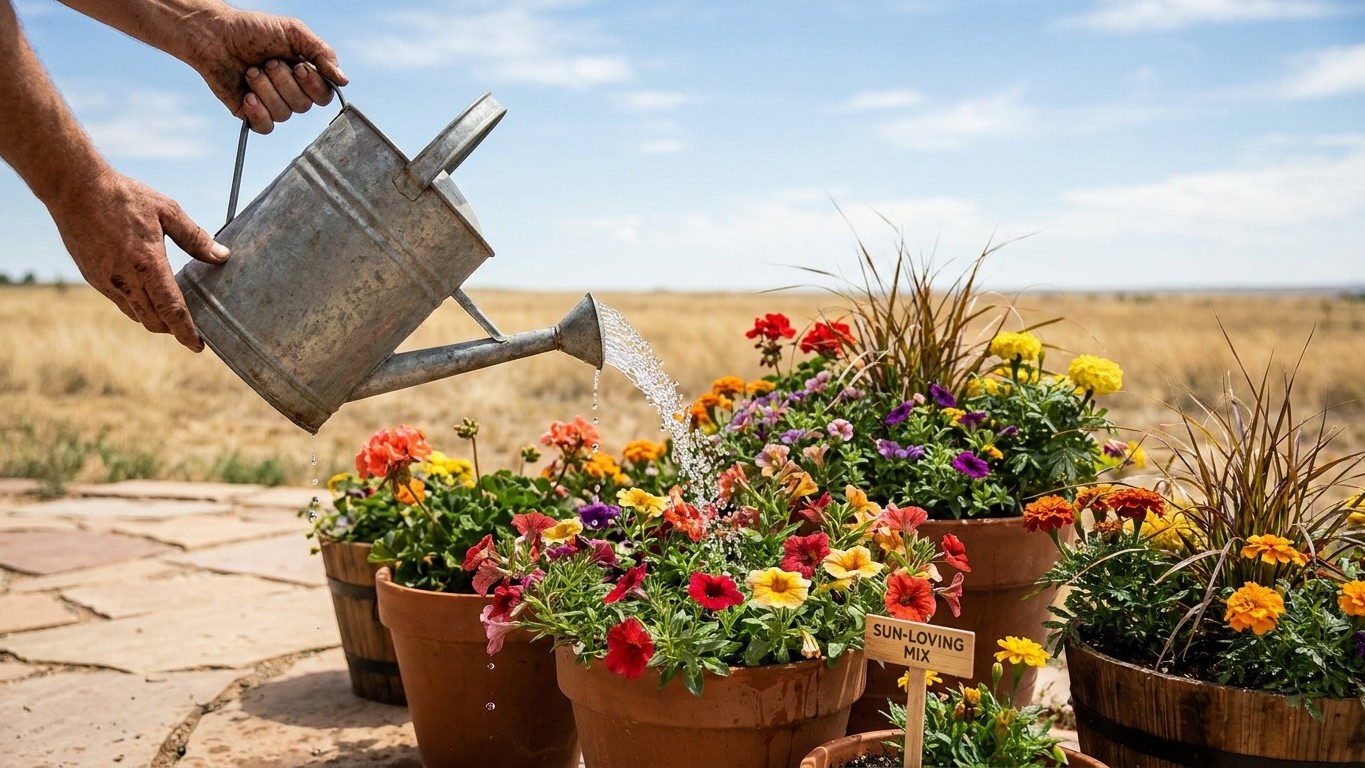

Saskatchewan pots and containers lose moisture more from wind and light, sporadic rain than from raw heat. The province logs almost no days above 90F, but its driest summer month, August, brings only 1.68 inches of rain. That combination means containers need a steady watering habit through summer, not a reaction to hot spells.
What changes here

Two numbers set the terms for anyone watering pots on the prairie. August, the driest month of the Saskatchewan summer, delivers just 1.68 inches of rain. The reference station near Saskatoon logs 0.0 days a year at or above 90F. Put together, that means containers here rarely bake in the kind of heat that flash-dries a pot by mid-afternoon, but they also can’t count on the sky to keep pace with what a growing plant pulls out of the mix week after week.
Run the arithmetic on that August figure. A healthy container in active growth wants somewhere close to an inch of water a week. August’s 1.68 inches, spread over roughly 4.3 weeks in the month, works out to about 0.39 inch arriving from the sky in an average week. That leaves close to 0.6 inch the gardener has to carry themselves, week after week, just to hold a container steady at that baseline, and more than that on a hot, breezy stretch, since Saskatchewan’s summer rain often falls as one heavy burst rather than a steady drizzle spread evenly across the days.
Why containers feel it faster than the ground
None of this touches the actual mix inside the pot. Potting soil is nothing like native garden ground: it’s built to drain fast, which means it also dries fast. A patch of open ground might take a week to dry out after a soaking; a container with the same inch of water can lose it in two or three days once roots fill the pot and its small surface area to volume works against it. Low regional heat slows that clock down some, since Saskatchewan almost never sees the 90-plus-degree days that pull moisture out of a pot by early afternoon elsewhere. But it doesn’t stop the clock. Wind across open prairie does a lot of the drying that heat does in other regions, and it works on calm-looking, mild days almost as well as it works on warm ones.
How to water when it matters
The method that works on this ground is deep, infrequent watering at the base of the plant, done in the morning. Each part earns its place. Watering deeply pushes moisture past the top inch of mix and down to where the roots actually live, which trains them to grow down and out instead of staying shallow and vulnerable near the surface. Infrequent watering lets the top layer dry between soakings, which starves fungus and rot of the damp they need to spread. Watering at the base instead of overhead keeps the leaves dry, and morning watering gives any splashed foliage hours of daylight to dry off before evening, when cool prairie nights would otherwise let moisture sit on the leaf surface for hours.
Checking the mix by eye isn’t reliable. The surface can look dry an hour after a soak while the roots below are still plenty wet, and it can look dark and damp right after a passing shower even when the water never got past the top half-inch. Push a finger two inches down along the inside edge of the pot, or use a thin trowel or a wooden stake for larger containers. If it comes out dry at that depth, it’s time to water. If it’s still cool and damp, wait another day and check again.
A starting point, not a rule
For a typical container in a Saskatchewan summer, start by checking every two days and watering when that two-inch depth reads dry. That’s a starting point built around the province’s low heat load and its light, uneven rainfall; it isn’t a fixed schedule to set and forget. A small terracotta pot in full sun and open wind will dry faster than that. A large glazed container tucked into part shade will hold moisture longer. The finger test, run against your own containers over a full week, is what actually settles the rhythm.
- Check the mix two inches down with a finger or trowel before assuming a container needs water.
- Water slowly at the base until it runs from the drainage holes, not just until the surface looks wet.
- Water in the early morning, before the day’s wind and light pick up.
- Let the top inch or two dry out between waterings rather than topping up every day.
- Adjust the two-day starting rhythm up or down based on what the finger test actually shows on your porch or patio.
What goes wrong
“I water a little every day, just to be safe”
This is the single most common habit that backfires. A light daily splash wets only the top inch of mix, which is exactly where it stays. Roots follow the moisture, so they cluster near the surface instead of growing down toward the reservoir near the bottom of the pot. Those shallow roots are the first to fry the moment a container goes even a single day without attention, which makes the plant more dependent on daily watering, not less. It’s a loop that gets harder to break the longer it runs.
“I water in the evening so it doesn’t stress the plant in the heat”
Given that Saskatchewan logs essentially no days above 90F, heat stress isn’t really the risk evening watering is solving here. What evening watering does instead, especially when it hits the leaves, is leave foliage wet through the cool prairie night, when temperatures drop and nothing is around to dry them off. That damp, dark window is exactly what fungal disease uses to get started.
“It rained, so I skipped watering”
A summer downpour on the prairie often arrives fast and heavy, and a lot of that water runs straight across the surface of a container’s mix and out the drainage holes before it ever soaks in. A shower that looks generous from a kitchen window can leave the root zone just as dry as it was the day before. Check with a finger two inches down before crossing watering off the list for the day.
“I didn’t bother with mulch on the containers”
An inch of mulch, straw, or even fine gravel on top of the mix slows evaporation from the surface, and that matters more than it sounds like it should in a windy, low-humidity province. Skip it, and a chunk of every watering session goes straight back into the air within a day, especially on the breezy afternoons that show up even when the thermometer never gets close to hot.
Local help
For guidance on soil, crops, and growing conditions specific to the province, the Saskatchewan Ministry of Agriculture publishes resources for farmers, ranchers, and home growers alike. Watering restrictions, where they exist, come from individual municipalities and water providers rather than the province as a whole, and they shift with the season and the year’s rainfall. Check with your local water utility or municipal office before setting a fixed outdoor watering schedule for containers or beds.
Common questions
How often should I water container plants in Saskatchewan?
Start by checking the mix two inches down every two days during summer, and water when it’s dry at that depth. Wind and low humidity dry containers faster than the thermometer suggests, since the province rarely sees days above 90F.
Does Saskatchewan get enough summer rain for outdoor pots?
Not reliably. August, the driest summer month, brings only 1.68 inches of rain across the entire month, which works out to well under half an inch in an average week, far short of what an actively growing container needs. Containers need supplemental watering through summer regardless of how wet the season looks overall.
What’s the biggest watering mistake for pots in this climate?
Watering a little every day. It keeps roots shallow and dependent on constant attention, and it’s an easy habit to fall into precisely because the region’s mild heat can make deep, less frequent watering feel unnecessary.
Are there watering restrictions I should know about?
They vary by municipality and utility, and they aren’t set at the provincial level. Check with your local water provider for current rules before assuming any watering schedule applies everywhere in Saskatchewan.