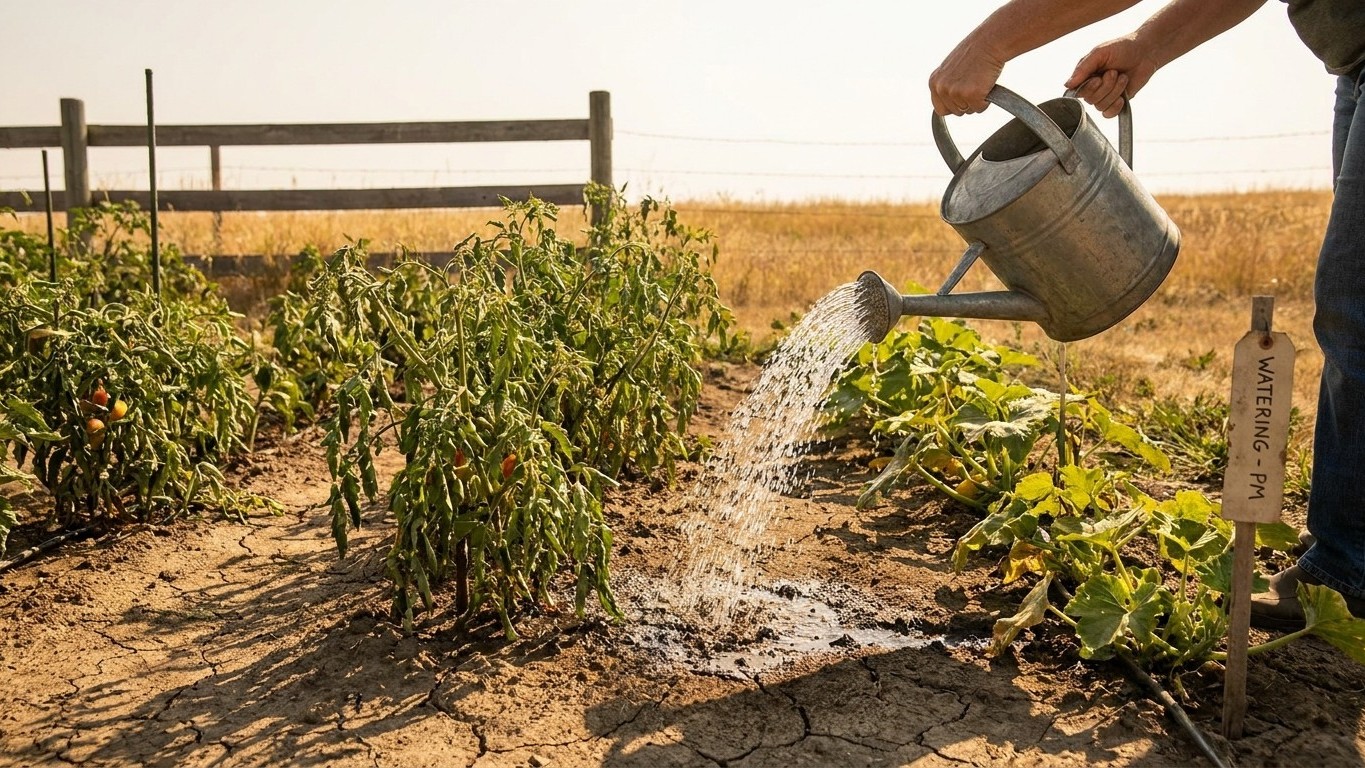

Saskatchewan summers give a garden less than an inch and a half of rain in the driest stretch, yet almost never push the thermometer past 90°F. That combination means the danger isn’t scorching heat, it’s a slow rainfall deficit that adds up week after week. The fix is deep, infrequent watering at the base of the plant, timed to the driest month rather than to a heat wave that, on average, never arrives here.
What changes here

August is the driest month of the Saskatchewan summer, delivering about 1.68 inches of rain on average, according to Environment and Climate Change Canada’s 1981-2010 climate normals for the Saskatoon Diefenbaker International Airport station. The same station records 0.0 days a year that reach 90°F. Put those two numbers side by side and the message for a gardener is straightforward: this isn’t a territory where plants wilt from a heat blast, it’s one where they slowly run short of water because the sky simply doesn’t deliver enough, even though the air rarely gets punishingly hot.
A vegetable bed or a perennial border wants roughly an inch of water a week to keep growing without stress. Spread August’s 1.68 inches evenly across the month’s four and a bit weeks and the sky is providing something like 0.38 inches a week, well under half of what the bed is asking for. The rest, something like 0.6 inches, has to come from a hose or a sprinkler, every single week the whole month runs dry. June and July aren’t quite as tight, at 2.59 inches and 2.38 inches respectively for the month, but even those totals only cover a portion of a full growing season’s demand once several dry days string together.
None of this arrives evenly. Prairie rain tends to fall as a handful of thunderstorms rather than a steady drizzle, so a month’s total can hide a run of two or three completely dry weeks bracketed by one heavy downpour. A downpour that drops half an inch in twenty minutes mostly runs off a hard, sun-baked surface instead of soaking down to the root zone, which is exactly where sandy ground and heavy clay start behaving differently. Water passes through a sandy plot quickly and needs topping up sooner; the same inch sits in clay for the better part of a week, holding moisture longer but also drowning roots if it’s applied before the ground has had a chance to dry out. Neither soil type changes the monthly rainfall total. Both change how often a gardener needs to step in with a hose to make up the difference.
How to water when it matters
Deep, infrequent watering at the base of the plant, done in the morning, beats a daily sprinkle every time in a territory where the sky is only covering about a third of what a bed needs through August. Each of those three choices does a specific job. Deep watering pushes moisture down to where roots actually live, six to eight inches under the surface for most vegetables and perennials, training the plant to reach down rather than stay shallow. Infrequent watering lets the top inch of soil dry out between sessions, which is what pushes roots downward in the first place. Morning watering gives the leaves time to dry before nightfall, since a plant that goes into a cool prairie evening with wet foliage is an open invitation to fungal disease.
Checking the soil before turning on the hose matters more than checking the calendar. A finger pushed two inches into the ground, or a trowel pulled up for a quick look, tells the real story: dry, crumbly soil at that depth means it’s time to water regardless of what the surface looks like, and cool, moist soil at that depth means the plant can wait even if the top feels dusty. Heavy clay can hold close to a week’s worth of moisture once it’s properly soaked, so watering it again too soon risks waterlogging and starving roots of oxygen. Lighter, sandier patches drain fast and need shorter, more frequent soakings to avoid a dry snap between waterings.
A reasonable starting point for most Saskatchewan garden beds through the driest weeks of summer is one deep soaking of about an inch, delivered in a single session, roughly every five to seven days, adjusted up or down once the finger test says otherwise.
- Push a finger or trowel two inches into the soil near the root zone; if it comes up dry and crumbly, water now.
- Water early in the morning, before the heat of the day builds and while the leaves have hours to dry.
- Apply water at the base of the plant, not overhead, using a soaker hose, drip line or the spout of a watering can aimed at the soil.
- Deliver about one inch of water in a single session rather than splitting it into several short bursts.
- Wait five to seven days before repeating, checking the two-inch depth again rather than watering on a fixed schedule.
- Shorten that interval on sandy ground that drains quickly, and lengthen it on heavy clay that stays wet for days after a proper soak.
What goes wrong
A little water every day
A quick daily sprinkle feels responsible, but it only ever wets the top inch or two of soil. Roots have no reason to grow deep when moisture always shows up right at the surface, so they stay shallow and vulnerable the moment a watering gets skipped or a warm, dry stretch runs a day longer than expected. In a month like August, when the sky is only handing over about a third of what a bed actually needs, shallow roots are the difference between a plant that shrugs off a missed watering and one that wilts by afternoon.
Watering the leaves at night
Running a sprinkler in the evening, after the day’s heat has passed, seems like a reasonable time to catch up on watering. The problem is what happens to wet foliage once the sun goes down: leaves that stay damp through a cool prairie night give fungal spores exactly the conditions they need to take hold, and diseases like powdery mildew and various leaf blights spread fastest on plants that never get a chance to dry out before dark.
Trusting the rain that just fell
A ten-minute downpour looks like it solved the watering problem for the week, but a summer thunderstorm often wets only the top half-inch of soil before running off a dry, compacted surface. The sky can look like it delivered plenty and still leave the root zone bone dry. A finger pushed two inches down after the storm settles the question faster than guessing from how wet the ground looks on top.
Skipping the mulch
Saskatchewan’s driest month arrives without the extreme heat that punishes gardens further south, since the region averages 0.0 days a year at or above 90°F. That doesn’t make evaporation harmless. Prairie summers bring steady wind and low humidity, and bare soil left uncovered loses moisture to that wind almost as fast as a hose can replace it. A two to three inch layer of mulch around the base of a plant slows that loss dramatically, which matters most here precisely because the rain isn’t coming to make up the difference on its own.
Local help
Saskatchewan’s Ministry of Agriculture publishes guidance for growers dealing with dry conditions, soil moisture and irrigation planning across the province. Municipal watering restrictions, when they’re in place, are set by individual water providers and RM or city offices rather than by the province as a whole, and they can change from one summer to the next depending on reservoir levels and demand. Checking directly with a local water utility or municipal office before setting an irrigation schedule is the only way to know the current rules for a specific address.
Common questions
How often should I water a garden in Saskatchewan during summer?
A deep soaking of about an inch every five to seven days is a reasonable starting point through the driest weeks, adjusted by checking soil moisture two inches down rather than sticking to a fixed calendar.
Does Saskatchewan get hot enough to need extra watering for heat stress?
Not by the temperature record alone. The reference station at Saskatoon averages 0.0 days a year at or above 90°F, so the pressure on a garden comes from low rainfall during August rather than from extreme heat.
Is Saskatchewan considered a drought-prone province for gardening?
Summer rainfall runs light, with August normally bringing only about 1.68 inches, well under what most beds need for the month, which makes supplemental watering a routine part of gardening here rather than an occasional emergency measure.
Are there watering restrictions in Saskatchewan during dry spells?
Restrictions exist in some municipalities and change with local water supply conditions, so the current rules for a specific address should be confirmed with the local water provider or municipal office rather than assumed from provincial averages.