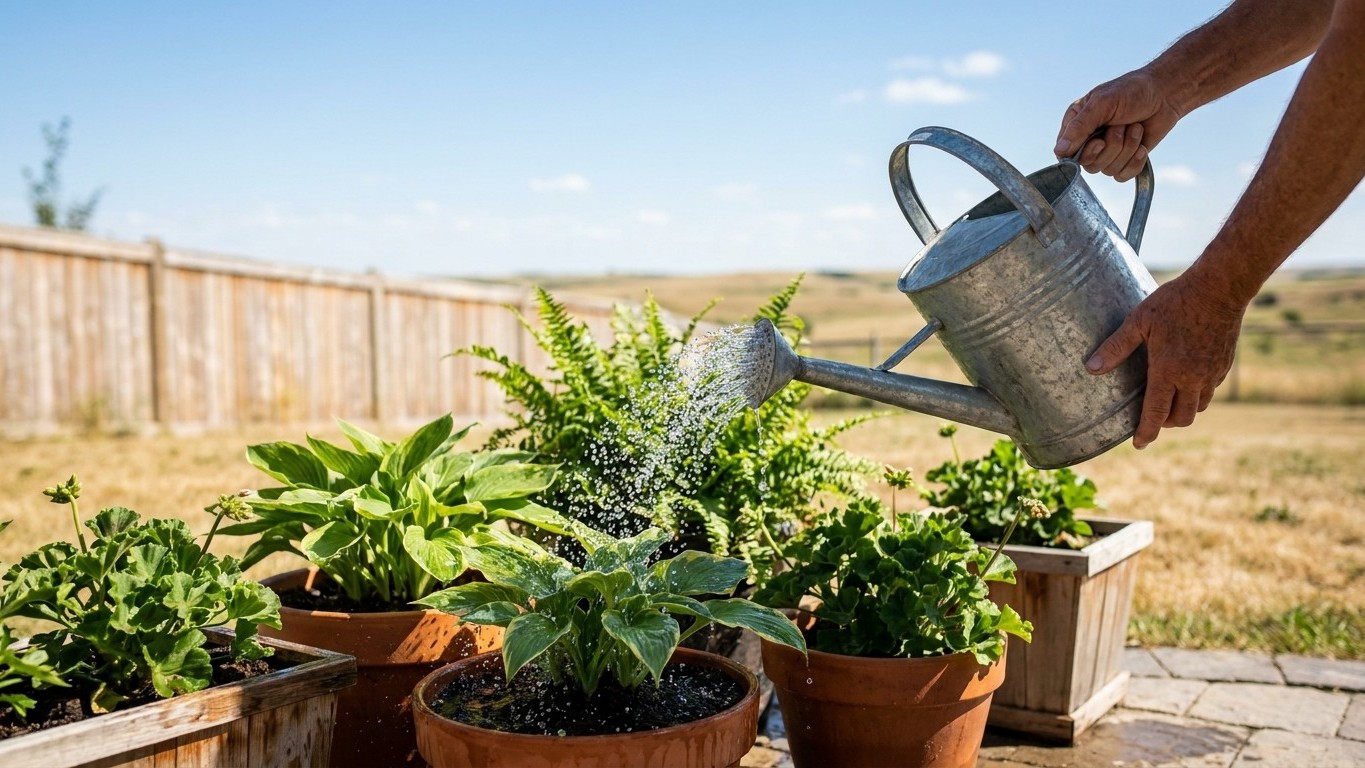

Alberta’s driest summer month delivers just 2.24 inches of rain, and the reference station records 0.0 days a year at or above 90F. Put those two numbers together and the message is simple: heat stress rarely forces the issue here, but the sky alone won’t carry a garden through August. Watering has to be planned, not assumed.
What changes here

Two figures set the frame for every Alberta garden. The driest summer month, August, brings 2.24 inches of rain. And the reference station logs 0.0 days a year reaching 90F. Together they describe a summer that is short on heat stress but also short on rainfall in its driest stretch, which means a garden here doesn’t fail from scorching afternoons so much as from quiet, cumulative drought.
The weekly math
A typical garden bed wants roughly an inch of water a week to keep root growth steady. August has about 4.4 weeks in it, so that 2.24 inches works out to roughly half an inch a week arriving from the sky, about 0.5 inch. That leaves the other half inch, or thereabouts, for the gardener to carry by hand or hose. It isn’t a dramatic shortfall, but it’s a real one, and it repeats every week of the driest month.
How that half inch behaves once it lands depends on what’s underneath it. On sandy ground, water drains through within hours, so the same rainfall or watering session leaves less moisture at root depth by the next day. On heavy clay, the same amount can sit in the top few inches for the better part of a week, which changes the timing of the next watering far more than it changes the total volume needed. The zero-day count for 90F heat matters here too: without repeated heat spikes pulling moisture out of the topsoil, that stored water in clay has time to actually reach the roots instead of evaporating first.
How to water when it matters
Deep, infrequent watering at the base of the plant, done in the morning, is the method that fits Alberta’s rainfall pattern rather than fighting it. Deep watering pushes moisture down to where roots actually grow, training them to follow the water downward instead of clustering near a surface that dries out in a day. Watering at the base, rather than overhead, means the water goes where it’s used instead of sitting on foliage. Morning watering gives the day’s mild heat, remember, no 90F days on average, a chance to dry any incidental leaf moisture before evening, when damp leaves overnight become an invitation for fungal disease.
Reading the soil, not the surface
Surface soil can look dry while root depth is still damp, or the reverse. The only reliable check is physical: push a finger about two inches down, or slice in with a trowel, before deciding to water. If it’s cool and slightly moist at that depth, the bed can wait. If it’s dry and crumbly, it’s time.
Soil texture changes the rhythm more than the total amount. Sandy soil holds little moisture, so it needs shorter, more frequent soakings to keep root depth from drying out between waterings. Heavy clay holds a week’s worth of water, but watering it again before it’s had a chance to dry pushes out the air roots need and invites rot. Neither texture changes the plant’s actual need for water, only how often that need should be met.
The sequence
- Check soil moisture two inches down with a finger or trowel before watering, not by looking at the surface.
- If dry at that depth, water slowly at the base until the top six inches of soil are moist, roughly one inch of water for an average bed as a starting point to test against your own soil.
- Water in the morning, so any splashed foliage dries before evening.
- On sandy soil, check again in two to three days; on clay, wait closer to a week before checking.
- Adjust the interval up or down based on what the finger test actually finds, not on a fixed calendar.
That one-inch figure is a starting point, not a rule. A garden on fast-draining sand or in a sheltered, shaded spot will need its own adjustment once the finger test has been run a few times.
What goes wrong
“I water it a little every day”
Daily light watering keeps moisture in the top inch of soil and never sends it deeper. Roots follow the water, so they stay shallow, and a shallow root system is the first thing to fail the moment a watering is missed or a warm, dry stretch stretches longer than usual.
“I water in the evening so it’s cooler”
Evening watering feels considerate, but wet foliage overnight, with no sun or breeze to dry it, gives fungal disease hours to establish itself. Morning watering avoids that window entirely.
“It rained yesterday, so I’ll skip it”
A summer shower can look generous while wetting only the top half inch of soil, especially the kind of short thunderstorm that runs off fast rather than soaking in. The finger test, two inches down, settles it faster than trusting the sky. Because Alberta’s driest month arrives with no help from extreme heat, a light rain here can feel like more relief than it actually delivers underground.
“I don’t bother with mulch”
Bare soil around a plant loses moisture straight back to the air, undoing a chunk of whatever was just watered in. A two-to-three-inch layer of mulch slows that loss and stretches the interval between waterings, which matters most in a territory where the driest month’s rainfall barely covers half of what a bed wants.
Given the 0.0 figure for 90F days, the costliest mistake locally isn’t heat-driven scorching, it’s complacency: assuming that because the air never gets brutally hot, the soil doesn’t need attention either. The driest month’s rainfall says otherwise.
Local help
For soil-specific guidance, plant lists and current growing conditions, Alberta’s provincial agriculture office is the primary resource: Alberta Agriculture and Irrigation. Watering restrictions vary by municipality and change with drought conditions, so check with a local water provider or municipal water utility before setting a fixed watering schedule for the season.
Common questions
Does Alberta really get no 90F days?
The reference station’s normal is 0.0 days a year at or above 90F, based on the 1981-2010 climate normals. Individual years and specific locations, especially in a rain shadow or an urban heat pocket, can still see hotter spells.
Which month needs the closest watering attention?
August, the driest summer month at 2.24 inches of rain, is when supplemental watering carries the largest share of a garden’s weekly needs.
Does clay soil mean I can water less often?
Less often, not less overall. Clay holds water for close to a week, but it still needs that water to arrive; the risk is watering again too soon and drowning roots before the soil has dried.
Is one inch of water a week always enough?
It’s a starting point. Sandy soil, full sun exposure and container plants often need more frequent watering than a single weekly figure accounts for; check soil moisture directly rather than watering on a fixed schedule alone.