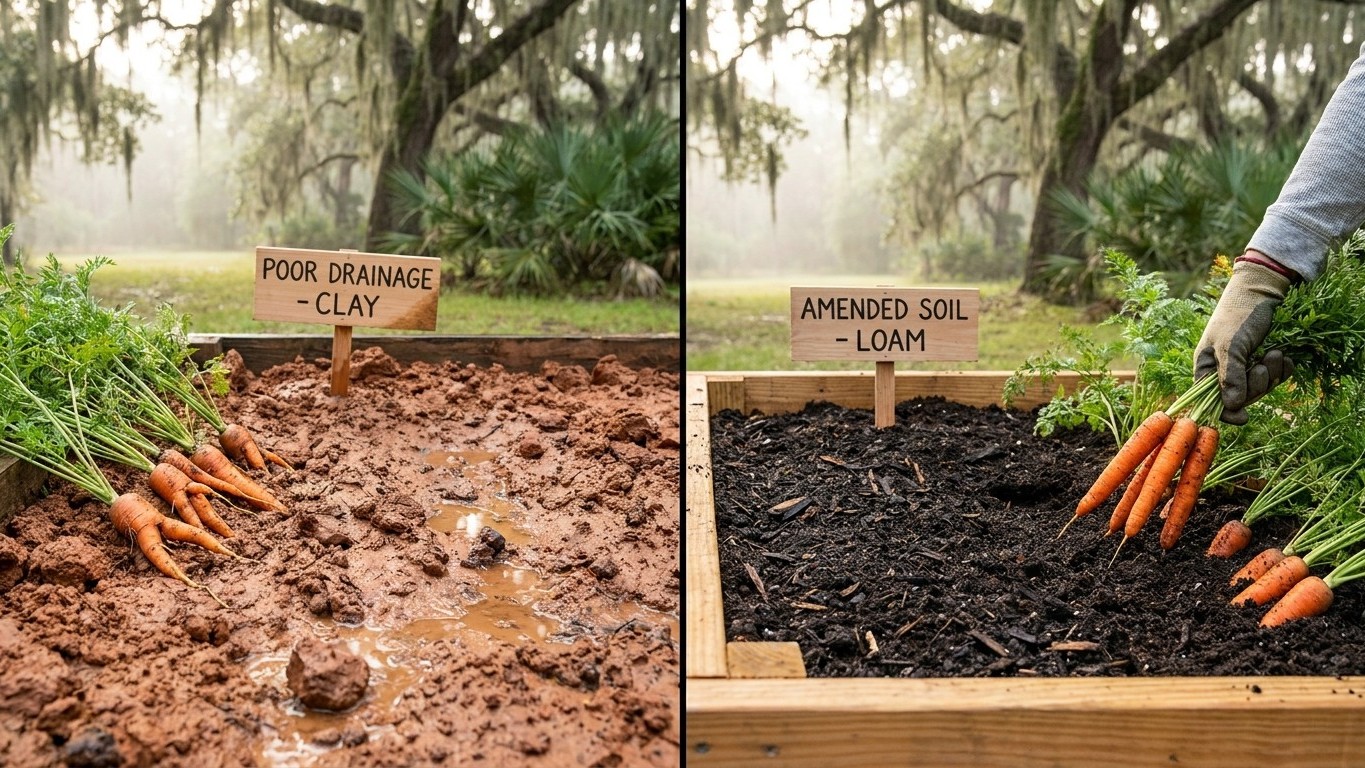

South Carolina’s official state soil, the Bohicket series, runs 35 percent clay and only 17 percent sand, sitting in the very poorly drained class. That’s close to the worst possible starting point for a carrot, which wants loose, sandy ground to grow straight. If your garden matches that profile, expect forked, stubby roots unless you build up the bed with compost or switch to a raised frame filled with lighter soil. The fix is almost never a different variety; it’s the ground itself.
The short answer
The soil USDA lists as representative for South Carolina is the Bohicket series, an Entisol, meaning it’s young ground with almost no layered profile to speak of. Sampled surface horizons run 17 percent sand, 35 percent clay and 48 percent silt, with organic matter around 15.0 percent and a surface pH near 7.3, essentially neutral. Drainage class: very poorly drained. That’s the signature of tidal marsh and low-lying flats rather than a tilled backyard bed, but it points at something real about the direction a lot of South Carolina’s coastal and low-country ground leans: heavy, wet, slow to dry out between rains.
For a carrot, that combination is close to a worst case. Utah State University Extension is blunt about it: carrots want deep, sandy, well-drained soil rich in organic matter, and heavy or rocky ground makes the root fork instead of growing straight down. A texture running one-third clay, paired with drainage that stays soggy for days, checks both boxes for trouble, raising the real question of Will Carrots Fork in South Carolina Soil? Roots hit resistance, split around dense clods, or stop elongating and swell sideways instead, producing the short, forked carrots gardeners on heavy clay recognize immediately when they pull the first bunch.
Utah State University Extension’s answer to heavy ground is not a different carrot variety, it’s changing the soil itself: work in plenty of compost and double dig the bed to break up compaction well below the depth a carrot root will reach. Where clay runs deep or the water table sits high, which describes much of the ground the Bohicket series represents, a raised bed filled with a lighter, sand-amended mix sidesteps the problem instead of fighting it every single season.
None of this is a diagnosis of your particular yard. South Carolina spans hundreds of mapped soil series, from sandy Coastal Plain ridges to red Piedmont clay to the low, wet ground the Bohicket series describes. The state soil is a flag planted for the whole state, not a soil test for your backyard bed. Treat it as a starting assumption, then check it against the dirt actually under your feet, which is worth doing before you spend a season fighting forked roots you could have avoided from the start.
The test that settles it in your own garden
The Bohicket series numbers describe a soil USDA mapped as representative for the state, not the loam, sand or clay sitting under your own plot. Before deciding whether your ground needs a full raised-bed rebuild or just a season of compost, run through these checks yourself.
- Dig a hole at least a foot down, further if you can manage it. Carrots push straight roots to real depth, so look at what the soil does as you go deeper, not just at the loose surface inch you’d rake for a lawn.
- Check for rocks, buried construction debris and any hardpan layer. A band of stones or a compacted layer that resists the shovel is a fork point waiting to happen; a carrot root deflects around anything solid instead of pushing through it.
- Feel the texture between your fingers at a few depths. Sandy soil feels loose and falls apart when you squeeze it; clay feels sticky and holds a ribbon shape when wet; silt feels smooth, almost soapy. Most garden soil is a blend, and knowing which one dominates tells you whether you’re closer to the Bohicket end of the spectrum or the sandy end that carrots actually prefer.
- Watch how water drains after a hard rain. Standing water still visible an hour or more after a downpour points toward poor drainage; water that disappears within minutes points toward sandy, fast-draining ground. Carrots tolerate the fast end of that range far better than the slow one.
None of these checks require a lab, and none will hand you an exact number the way a real soil test does. If you want an actual pH or nutrient reading, your local Extension office can point you toward proper testing rather than a guess made with a garden trowel. What the four checks above will tell you, reliably, is which direction your ground leans: toward the loose, sandy profile that rewards carrots with long straight roots, or toward the heavy, slow-draining profile that produces the short, forked ones. That’s the only decision that matters before you sow.
When to sow here
Carrots go into the ground as seed, exactly where they’ll grow to harvest. There’s no transplanting to shift the calendar around, so every date below counts from the day seed touches soil, not from a later planting-out date.
- Start from your last spring frost. NOAA’s climate normals put South Carolina’s 32-degree freeze probability window at February 28 to March 17, based on the long-term record at station USW00013880. That’s roughly a three-week spread depending on where in the state you garden, with the coast running milder and the Upstate running colder at both ends of that window.
- Count backward two to three weeks from whichever end of that window applies to you. Carrot seed can go in that early because it germinates in cool soil the same way lettuce and spinach do. Working from the February 28 end, two to three weeks earlier lands sowing in the second half of February for the mildest gardens; working from the March 17 end pushes that same backward count into late February or early March for colder spots.
- Check the soil itself, not just the date on a chart. Carrot seed needs soil at 40 degrees Fahrenheit minimum before it does anything useful. A thermometer pushed a couple of inches into the bed on a clear morning tells you more than any calendar math.
- Aim for the germination sweet spot of 55 to 65 degrees Fahrenheit. Seed sown once soil has only just cleared the 40-degree minimum will still sprout, just slowly and unevenly, while a sowing timed closer to that 55-to-65 range gets a faster, more uniform stand within days rather than weeks.
- Count 70 to 100 days from that sowing date to harvest. Because carrots are never transplanted, that window runs entirely from the day seed goes into the ground. A sowing timed to the mild end of the frost window can be ready to pull well before one timed to the cold end even reaches maturity.
What goes wrong here
- Forking in heavy, clay-leaning ground. Where garden soil runs closer to the Bohicket series’ 35 percent clay than to loose sand, carrot roots meet resistance and split instead of growing straight. Utah State University Extension’s fix is working in compost and double digging the bed, or building a raised bed filled with a lighter mix where underlying clay runs too deep to amend by hand.
- Poor germination during a hot spell. Carrot seed germinates best between 55 and 65 degrees Fahrenheit; a sowing that lands during an early warm stretch, which happens easily once the frost window closes, can push soil well past that range and leave gaps in the row where seed simply never sprouted. Sowing at the early end of the recommended window and watering to keep the seedbed cool limits the damage.
- Roots splitting from uneven watering. A carrot root swells fastest right after a dry stretch gets followed by a heavy soaking, and the outer layer can’t stretch fast enough to keep up, so it cracks. Even, regular watering rather than a feast-or-famine schedule keeps the root growing at one steady pace.
- Slow, patchy stands in poorly drained beds. The very poorly drained class describing the Bohicket series also describes plenty of low-lying garden ground across the state; seed sitting in soil that stays soggy for days after rain rots before it ever sprouts. Raising the bed a few inches above grade, or working in enough organic matter to open the soil structure, gets water moving through instead of sitting in it.
Checking this against your own county
Everything above is built from statewide figures: one representative soil series, one set of climate normals from a single weather station. Neither is a substitute for what’s actually happening in your county this season. South Carolina’s counties span the sandy Coastal Plain, the wet river-bottom ground the Bohicket series represents, and the red clay hills of the Piedmont, and frost timing alone can shift by weeks between the coast and the Upstate.
Clemson Cooperative Extension is the land-grant Extension service for South Carolina, and it’s the right place to check local frost timing, soil testing options and planting guidance specific to your county rather than the state as a whole. Their office can also point you toward a proper soil test, the kind that gives an actual pH and nutrient reading instead of the statewide estimate this page works from.
Find your local office through Clemson Extension before you commit a season’s carrot bed to a guess.
Common questions
Do I need to test my soil before planting carrots in South Carolina?
Not strictly, but it saves guessing. The state’s representative soil, the Bohicket series, runs heavy clay and very poorly drained, exactly the conditions that cause forked carrots. A simple dig-and-feel check, or a proper test through Clemson Extension, tells you whether your bed matches that profile before you sow a whole row.
Can I fix forked carrots by choosing a different variety?
The forking comes from the soil, not the seed. Utah State University Extension points to heavy or rocky ground as the cause, and the fix is amending the soil with compost and double digging, or growing in a raised bed with lighter soil, rather than switching what’s planted.
How early can I sow carrot seed in South Carolina?
NOAA’s climate normals put the state’s last spring frost probability window at February 28 to March 17 at station USW00013880. Counting two to three weeks before that window, and confirming soil temperature has reached at least 40 degrees Fahrenheit, gives a workable early sowing date, though the coast and the Upstate land on different ends of that range.
Why did my carrot seed germinate unevenly?
Carrot seed germinates best between 55 and 65 degrees Fahrenheit. Soil colder than that, or soil that swings hot during an early warm spell, produces slow or patchy sprouting. Checking soil temperature directly, rather than sowing by the calendar alone, catches this before it turns into a gappy row.