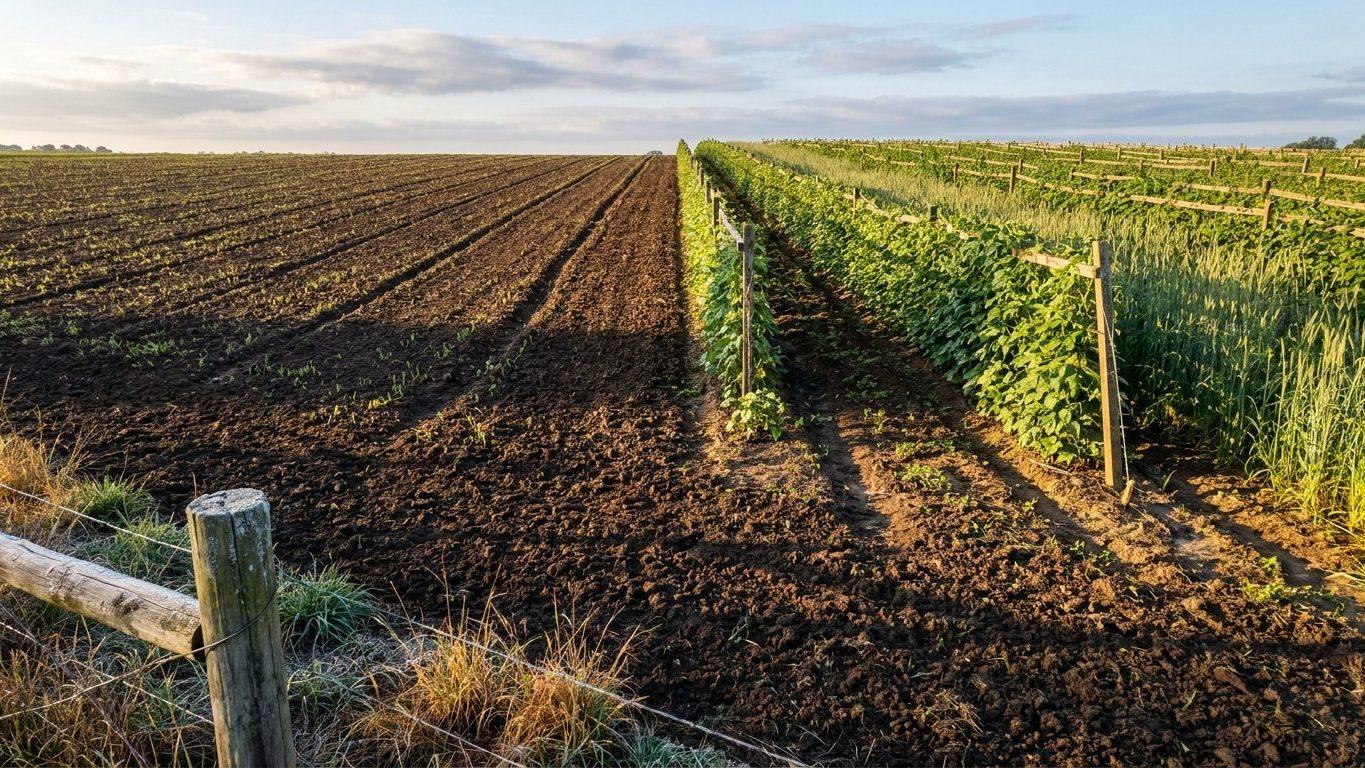

South Carolina gardeners work two sowing windows, not one: cool-season cover crops go in during fall, ahead of the season’s first freeze, and warm-season covers wait until the spring frost risk has passed. Both windows come straight from the state’s frost dates, and both shift depending on where in South Carolina you’re standing.
The short answer for South Carolina
Cool-season cover crops (cereal rye, crimson clover, hairy vetch, winter wheat, oats) need to be in the ground with enough leaf area to survive winter before the first hard freeze arrives. In South Carolina, that first fall frost lands somewhere between November 20 and December 5, according to NOAA’s 1991-2020 climate normals for the Charleston-area reference station. Working backward from that window, the sowing target for fall cover crops is six to eight weeks before the first fall frost, which puts most of the state’s fall sowing into the stretch from mid-September through mid-October.
Warm-season cover crops behave the opposite way. Buckwheat, cowpeas, sunn hemp, and sorghum-sudangrass are frost-tender from the seedling stage on, so they can’t go in until the last spring frost has genuinely passed. NOAA’s same dataset puts that last spring frost date anywhere from February 28 to March 17 for the reference station, a nineteen-day spread that reflects real year-to-year variability, not a rounding error. Treat that whole window as the probability zone for a killing freeze, not a guarantee that frost stops on any single date. A gardener aiming for reliability, rather than a gamble, waits until the tail end of that window, into late March or early April, before committing buckwheat or cowpea seed to open ground.
Neither of those windows is a state-wide fact you can apply blind. They come from one reference station, and the caution attached to that station matters: peninsular Charleston runs milder than the airport station the data is drawn from, while the Upstate runs the frost calendar several weeks tighter on both ends. This page gives the mechanism and the source dates. It doesn’t have a county-level frost calendar, and it shouldn’t pretend to.
What will not work here
The number that trips up the most gardeners in South Carolina isn’t a frost date at all. It’s the coldest month’s mean daily minimum temperature, which sits at 38.9°F. That’s not a record low and not an average across the whole month, it’s the typical overnight low during the coldest stretch of winter, and it tells you something specific: South Carolina winters rarely deliver the hard, sustained freeze that reliably kills off a cover crop stand. Gardeners who plant oats or certain brassica mixes expecting winterkill to handle termination for them are often surprised in February to find the stand still green and growing. Instead of dying back on schedule, the cover crop turns into a spring weed problem that now needs mowing, crimping, or herbicide to clear before the next planting.
Frost-tender warm-season covers fail for the opposite reason: impatience with that nineteen-day spring frost spread. Sowing buckwheat or cowpea seed in the first week of March, right after a warm spell, is a common mistake, because the state’s last frost date can run as late as March 17 in a given year. A single overnight freeze at the seedling stage wipes out the stand entirely, and there’s no recovering a frost-killed buckwheat crop the way there is with an established perennial.
Humidity does its own damage, separate from temperature. South Carolina’s summer air stays heavy and wet for months, and cover crop stands sown too thick, especially clovers and vetches, trap moisture at the crown and invite fungal disease before they ever get tall enough to matter. Wider spacing than a seed packet’s northern-climate instructions suggest is usually the fix, along with sowing early enough in the fall window that plants have some airflow-building growth before the humid stretch returns the following summer.
What changes across South Carolina
USDA’s hardiness zone map places South Carolina across 7a to 9a, a two-zone spread that runs from the Upstate mountains down to the coastal Lowcountry. That’s built on average annual extreme minimum temperature alone, a different measure than the frost dates or the coldest-month figure above, but it’s a useful shorthand for how much the state actually varies within its own borders. A gap that size means there is no single fall sowing date that works from Greenville to Hilton Head, and any calendar that gives you one number for the whole state is smoothing over real differences.
The practical shift runs in a predictable direction. Upstate gardens, sitting in the cooler end of that zone range, see their first fall frost arrive earlier and their last spring frost linger later, which means the whole cover crop calendar compresses. Fall cover crops need to go in earlier to get established before an earlier freeze, and spring-sown warm-season covers need to wait longer before the frost risk clears. The caution attached to the state’s frost data backs this up directly: the Upstate runs several weeks tighter at both ends of the calendar compared to the coastal reference station this page’s dates are built from.
Coastal and peninsular areas run the opposite way. Charleston’s peninsula, specifically, stays milder than the airport station used for these normals, which means fall sowing can stretch a little later into October and spring sowing can start a little earlier without the same frost exposure. None of this tells you which zone your own yard sits in, though. A yard at higher elevation just fifteen miles from a warmer valley can sit in a different zone entirely. The map, not this page, is where that gets settled.
Where to check this for your own county
Clemson Cooperative Extension is South Carolina’s land-grant extension service, and it’s the source that carries county-specific cover crop guidance this page doesn’t have. The Clemson Extension website is the starting point, and it’s worth knowing what to look for once you’re there rather than browsing blind.
Clemson’s Home & Garden Information Center publishes detailed, species-specific maintenance calendars rather than one generic state calendar. The pattern is consistent across their lawn grass fact sheets, for example, HGIC 1216 covers Bermudagrass on its own schedule, HGIC 1217 covers Zoysiagrass, HGIC 1215 covers Centipedegrass, and HGIC 1218 covers St. Augustinegrass, each with its own timing because a cool-season species and a warm-season species get worked in opposite halves of the year. Cover crops follow the same logic. Search HGIC’s fact sheet library for the specific cover crop species you’re planting, whether that’s crimson clover, cereal rye, or buckwheat, rather than relying on a generic “cover crop calendar” that treats every species the same way.
The other thing to look for is variety trial data. County extension agents track which cultivars have actually performed well in local trial plots, information that a state-wide page like this one simply doesn’t carry. A county-level recommendation from your local Clemson extension office outranks this page every time, because it’s built on soil, rainfall, and frost data specific to where you garden, not a single reference station averaged across the whole state.
Checking this against your own garden
Every date on this page is a probability built from thirty years of averages. Your own garden, checked directly, tells you what’s actually happening this particular year, and it outranks the calendar every time there’s a conflict.
Soil warmth by feel is the first check, and it needs no equipment beyond your hand. Dig down two or three inches in the spot you plan to sow. Soil that feels cold and damp, almost clammy, is still too cold for warm-season cover crop seed to germinate reliably, regardless of what the spring frost window says. Soil that feels cool but crumbly and workable is a better sign that the ground itself, not just the air, has caught up to spring.
The second check is watching for frost damage on whatever tender plants are still in the ground, whether that’s a tomato left too long or a stray pepper seedling. Blackened, wilted leaves on a frost-tender plant confirm a freeze actually happened at your specific location, which matters more than a calendar date when you’re deciding whether it’s finally safe to sow buckwheat or cowpeas.
Third, watch the volunteer weeds. Henbit and chickweed germinating in bare soil are a reliable signal that soil temperatures have climbed into the range where small-seeded fall cover crops will germinate too. If those weeds are up and growing in your beds, your soil has likely reached the same threshold your cover crop seed needs, whatever the calendar happens to say that week.