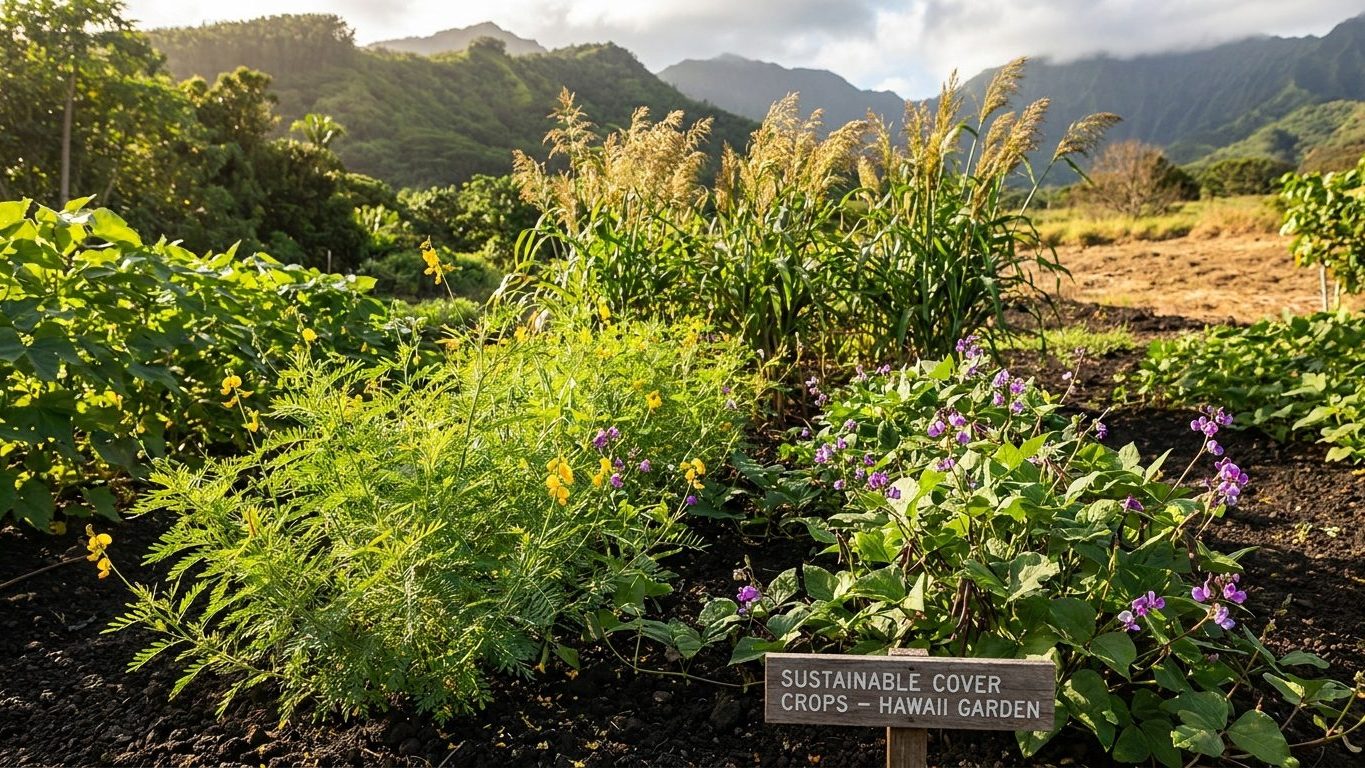

South Carolina’s long, mild growing season makes it prime cover crop territory for both cool-season legumes and warm-season smother crops. Crimson clover, cereal rye, and hairy vetch handle the state’s winters with ease, while cowpea and buckwheat fill the summer gap. The right pick depends on which season you’re covering and where in the state you garden.
The short answer for South Carolina
Pick your cover crop by season, not by brand loyalty to whatever grew well up north. South Carolina’s frost window runs late, with the first fall freeze arriving between November 20 and December 5 and the last spring freeze wrapping up between February 28 and March 17. That gap gives cool-season covers a genuinely long runway, which is why this state rewards a different strategy than a shorter-season territory would.
For the fall-to-spring slot, cereal rye is the workhorse. It germinates fast in cooling soil, tolerates the state’s mild winters without blinking, and produces enough biomass by spring to matter for weed suppression. Crimson clover pairs well alongside it, fixing nitrogen while rye holds the soil. Austrian winter peas and hairy vetch also do fine here, though vetch needs a trellis-mate or a mowing plan because it will sprawl in a winter this mild.
Summer is a different game entirely. Once soil warms past planting temperature in late spring, buckwheat, cowpea, and sorghum-sudangrass take over. Buckwheat is the quick option, ready to bloom and get turned under in about six weeks, which makes it useful for filling a bed between a spring harvest and a fall planting. Cowpea does more for nitrogen and tolerates the state’s summer heat and humidity better than most legumes.
The mean daily minimum of South Carolina’s coldest month sits at 38.9°F, measured at the Charleston reference station. That number is the one that actually decides winter survival, not the record low from some ice storm a decade back. It tells you cereal rye, crimson clover, and winter peas are working with winters that rarely threaten them outright. The decision here is straightforward: cool-season legumes and cereals for the long fall-to-spring window, and fast summer annuals for the hot months, with the November 20 to December 5 fall frost window marking the point where you want your summer cover already terminated or well on its way out.
None of this replaces a county-level check, which comes later in this piece. But as a state-wide starting point, this is the split that holds up across South Carolina’s growing conditions.
What will not work here
Oats are the classic disappointment in this state, and the reason is written right into the frost data. Oats winterkill reliably once temperatures drop into the low 20s for a sustained stretch, and while coastal South Carolina rarely sees that, the Upstate does. Plant oats expecting a clean overwinter cover the way a gardener might in Georgia’s coastal plain, and in Spartanburg or Greenville you can lose the whole stand to a January cold snap. If winterkill is actually your goal, that is fine. If you wanted living cover through spring, oats are the wrong pick outside the mildest coastal counties.
Buckwheat fails a different way. It is not built for South Carolina’s long season, it is built for exactly six weeks and then it is done. Sow it in early October hoping it will still be contributing biomass by Thanksgiving, and you will find it flowered, set seed, and turned into a weed problem well before the November 20 fall frost date arrives. Buckwheat belongs in the summer gap between plantings, not stretched into a season it was never designed to fill.
The state’s humid summers punish anything planted too densely. Cowpea and sorghum-sudangrass both do well here, but crowd the rows the way a drier-climate guide might suggest and you invite fungal pressure that a Southwestern garden would never see. South Carolina’s combination of heat and humidity through June, July, and August means cover crops need airflow between rows more than they need maximum density. A grower who copies a spacing chart written for Arizona or inland California is setting up a mildew problem, not a cover crop.
Cold-climate legumes struggle for a different reason
Vetch varieties bred for hard winters up north can actually grow too aggressively in South Carolina‘s mild cold season, since nothing knocks them back the way a real freeze would. Left unchecked, hairy vetch here turns into a tangled mat that is harder to terminate in spring than the biomass gain is worth. It is not a failure of survival, it is a failure of restraint, and it means an unmanaged vetch planting in this state needs an earlier mowing or crimping date than a Midwest guide would tell you.
What changes across South Carolina
South Carolina is not one garden, and the hardiness zone range makes that plain: the state spans USDA zones 7a to 9a. That is a real spread, not a rounding error, and it means a cover crop plan built around Charleston’s mild winters will not automatically hold up three hours inland or up toward the mountains.
The caution in the climate data matters here too. Peninsular Charleston runs milder than even the airport station used for the official frost normals, while the Upstate runs several weeks tighter at both ends of the season. Practically, that means a cover crop that overwinters cleanly with weeks to spare near the coast might get caught by an early freeze in the Upstate before it has built the biomass a coastal grower would expect. Winter peas and crimson clover, both reasonably cold-hardy, still benefit from an earlier sowing date the farther inland and upland you go, simply to bank more growth before the season’s first hard freeze shows up.
There is no single sowing date that works for all of South Carolina, and a guide claiming otherwise is glossing over a genuinely wide zone spread. A grower near the coast working within zone 9a territory has meaningfully more slack for late plantings and tender covers than a grower in the colder pockets of the Upstate. The 7a to 9a zone range is the number that should make any reader pause before copying a neighbor’s timing from across the state, because that neighbor may be gardening in a genuinely different climate.
None of this tells an individual reader which zone applies to their own yard, and it shouldn’t try to. The USDA’s plant hardiness zone map is built for exactly that lookup, using the average annual extreme minimum temperature as its one variable, and it is worth checking directly rather than guessing from a state-wide range.
Where to check this for your own county
Everything above is a state-level answer, and a county-level answer beats it every time. South Carolina’s land-grant extension system exists specifically to close that gap, and Clemson Cooperative Extension is the address to bookmark.
What to actually look for once there is narrower than the homepage suggests. Extension offices publish planting calendars broken out by crop and by region within the state, and those calendars reflect real trial data from county agents rather than a generalized frost-date average. Clemson’s Home & Garden Information Center, for instance, publishes maintenance calendars organized by species rather than by state, the same way it handles turfgrass with separate calendars for Bermudagrass, Zoysiagrass, Centipedegrass, and St. Augustinegrass rather than one blanket lawn-care guide. That per-species structure is the model to expect for cover crops too: look for the specific crop you are planting, not a generic “South Carolina cover crop calendar,” because that document does not reflect how the state’s own extension service organizes its guidance.
A county agent can also tell you which varieties have actually been trialled nearby, which matters more than it sounds. A cereal rye variety that performs well in trial plots near Clemson’s home base in the Upstate is not guaranteed to be the same variety recommended for the Lowcountry, and local trial data catches that difference in a way a state-wide guide cannot.
Treat this article as the starting framework, useful for understanding why cool-season and warm-season covers split the way they do in South Carolina. Treat your county extension office’s specific recommendation as the number that overrides everything here when the two disagree.
Checking this against your own garden
Every date on this page is a regional average, and your own soil will tell you something more precise than any calendar can. Three signs are worth learning to read before you trust a planting date over your own eyes.
Soil warmth by feel comes first. Push a bare hand a couple inches into the bed in early spring; if it still feels cold and slightly damp in a way that makes you want to pull your hand back, summer covers like buckwheat and cowpea are not ready yet no matter what the frost date says. Cool-season covers like crimson clover germinate in noticeably cooler soil than that, which is part of why they suit South Carolina’s long fall window.
The first true leaves on whatever you planted last are the second signal. Cover crop seedlings show a first set of rounded seed leaves, then a second set that actually looks like the mature plant, cereal rye’s characteristic blade shape or clover’s trio of leaflets. That second set showing up on schedule tells you your particular bed is tracking close to the regional average. A long delay past what you’d expect suggests your yard runs cooler than the reference station data, maybe from shade, low ground, or heavier clay that holds cold longer.
Third, watch how fast winter cover crops resume visible growth once days lengthen in late winter. A bed that greens up and starts putting on height a couple weeks ahead of a neighbor’s, even within the same town, is sitting in a warmer microclimate, likely near a south-facing wall or a paved area holding heat. That is worth noting for next year’s sowing date, since your own bed’s green-up timing will tell you more about your actual microclimate than any state-wide frost average ever will.