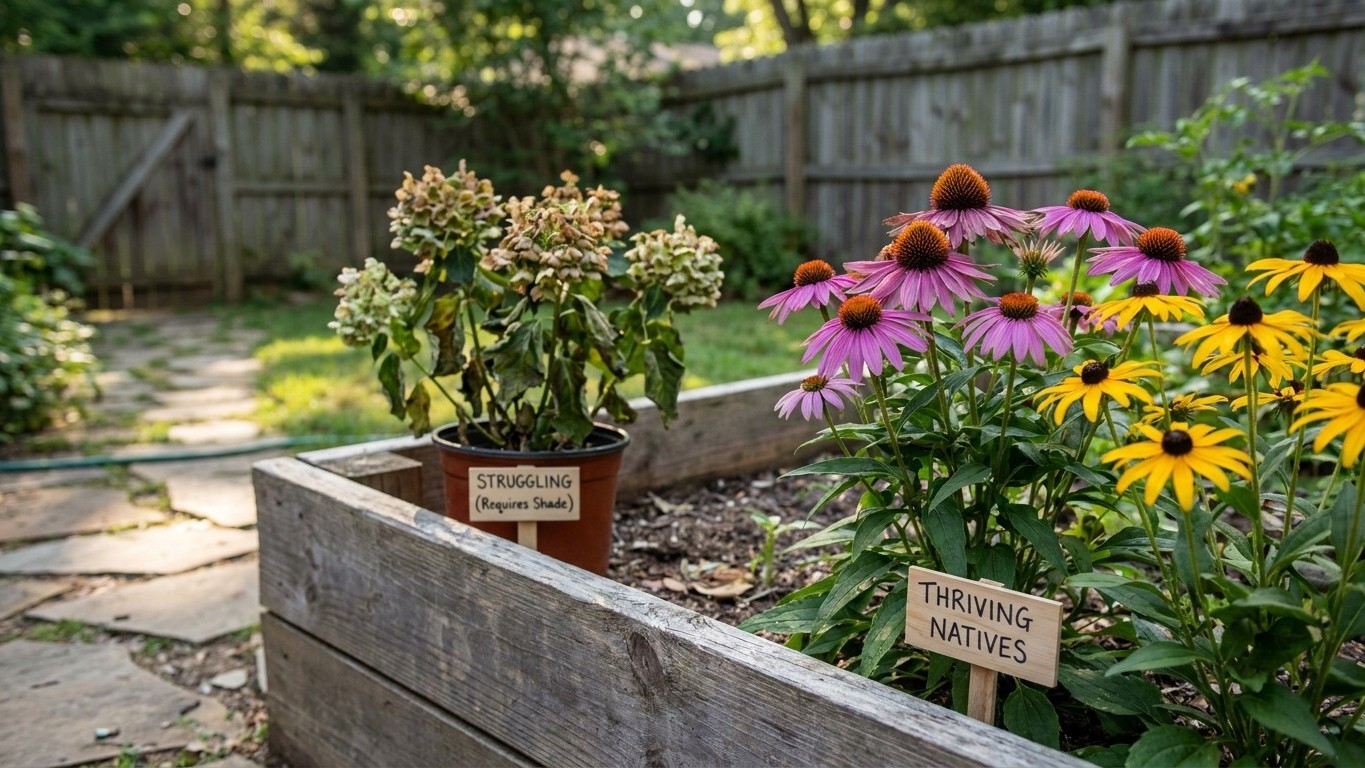

Thirty-point-one degrees Fahrenheit is the number that quietly decides which flowers make it through a Tennessee winter, and forty days above 90°F each summer decide the rest. Catalogs written for the upper Midwest or the dry West don’t account for either one, so their picks either freeze back in January or mildew into mush by August. What actually holds up here isn’t the plant everyone else recommends — it’s the one bred to shrug off both a Nashville frost and a Memphis heat wave without blinking.
What thrives in Tennessee

The state’s growing conditions are set by two numbers, and both come from NOAA’s 1991-2020 climate normals at the Nashville reference station. The coldest month’s average nightly low sits at 30.1°F, which is the figure that decides whether a plant’s roots survive winter here at all. Nashville also averages 40 days a year at 90°F or above, a heat load that drives fungal disease and wilts anything bred for a cooler, drier summer. USDA’s 2023 hardiness map splits the state across zones 5b to 8a, with the coldest pockets on the high ground of the Cumberland Plateau and the Smokies, and the mildest winters down toward Memphis and Chattanooga.
A flower that does well across most of Tennessee needs three things working together: enough cold tolerance to sit through a Nashville-style winter without dying back to the ground, enough heat tolerance to keep blooming through a string of 90°F afternoons, and enough resistance to humidity that its foliage does not rot or mildew in July. Plants bred for a dry western climate, or for the shorter, cooler summers of the upper Midwest, tend to fall short on one of those three counts even if the zone number on the tag looks right.
Families that carry those traits
Look to the daisy family for reliable performers: purple coneflower, black-eyed Susan, and the fall-blooming asters all handle humidity and heat without much fuss. The mint family does nearly as well, and salvia, monarda, and agastache all tolerate wet, sticky summers that would rot a Mediterranean herb grown the way its catalog suggests. Daylilies and zinnias round out the list of plants that treat a Tennessee July as ordinary rather than an ordeal.
What tends to struggle: delphinium and lupine want cooler nights than Tennessee summers offer and usually collapse by mid-July even where winter hardiness is not the problem. Lavender survives the cold well enough in most of the state but often rots in heavy clay that stays wet through a humid summer, so it needs a raised bed or a gravelly amendment to last more than a season or two. Peonies planted in the lower, warmer end of the state near Memphis sometimes fail to bloom because they need a real winter chill that a milder zone 8a winter does not always deliver. Further north, New Hampshire gardeners design around a far colder floor for winter hardiness, and the guide to flowers that thrive in New Hampshire covers a very different set of choices built around that cold.
Native plants worth the space
A native plant well matched to the region needs less babying once it settles in, because it has already adapted to the local rainfall pattern, soil chemistry, and the insects that try to eat it. After the first full year in the ground, most established natives need no supplemental fertilizer and only occasional watering during a real drought, which cuts down on both the water bill and the time spent fussing over a border.
Native plantings also do more for pollinators than an equivalent bed of imported ornamentals, because regional bees, butterflies, and moths have evolved alongside these specific plants and often cannot use substitutes in their place. Purple coneflower (Echinacea purpurea) and butterfly weed (Asclepias tuberosa) are two of the most reliable nectar and host-plant sources across the eastern United States, and both are widely available at Tennessee nurseries rather than needing a specialty native supplier.
A working list
- Wild bergamot (Monarda fistulosa): lavender-pink blooms, draws hummingbirds and native bees through midsummer.
- Joe Pye weed (Eutrochium purpureum): tall, dusky-pink flower clusters that pollinators favor from late summer into fall.
- Blazing star (Liatris spicata): upright purple spikes that hold up in heat and dry spells once rooted in.
- New England aster (Symphyotrichum novae-angliae): one of the last nectar sources standing before frost.
- Black-eyed Susan (Rudbeckia hirta): short-lived individually but self-seeds readily, so a patch tends to persist on its own.
These plants are native across a wide swath of the eastern United States rather than to any single Tennessee county, so a nursery tag that simply says “native” is worth a second look. Ask whether the plant is native to the broader Southeast or just native to North America in some loose sense, since the two labels get used interchangeably at the register. A local Master Gardener plant sale is usually a more reliable source of regionally appropriate stock than a big-box garden center, since plants sold there were often grown from seed collected closer to home.
Many of these natives also carry deep, drought-adapted root systems that imported ornamentals rarely develop, since decades of breeding for a compact garden shape often traded away the root mass that lets a plant find its own water. Joe Pye weed and blazing star both send roots several feet down within two or three seasons, which is part of why they shrug off the dry stretches that show up most summers in Middle Tennessee.
Perennials that come back

A perennial’s winter survival comes down to matching its hardiness rating against the 30.1°F average low NOAA records for the coldest month at Nashville, and against the wider 5b to 8a range USDA maps for the state as a whole. A plant tagged hardy to zone 6 or below will reliably return year after year across most of Tennessee. A tag rated to zone 7 is a safer bet in the milder western and central counties than on the Cumberland Plateau or in the higher parts of East Tennessee, where winters run colder than the Nashville reference figure suggests. Virginia’s hardiness zones span a similarly wide mountain-to-coast range, and the guide to flowers that thrive in Virginia works through how that spread changes which perennials come back reliably there.
What comes back without fuss
Daylilies, hostas, garden phlox, purple coneflower, black-eyed Susan, and the sedums now classified as hylotelephium all return reliably at this hardiness level and mostly need dividing every few years rather than replanting. Bearded iris and peony both survive the cold without trouble, though peony performs best in the cooler parts of the state where winter delivers enough chill hours to set a good bloom the following spring.
What gets grown as an annual here
Some plants sold in the perennial section are only reliably perennial well south of Tennessee and get treated as annuals here instead. Lantana is hardy to about zone 9 in most catalogs, so it usually dies back over a Tennessee winter and needs replanting each spring even though a gardener in Florida keeps the same plant for years. Certain salvias, including Salvia guaranitica cultivars rated to zone 8, survive mild winters in the warmer end of the state but are not a safe bet where the local winter runs colder than that. Gerbera daisies fall into the same category: gorgeous through summer, gone by the following spring almost everywhere in Tennessee.
The habit worth building is reading the full hardiness range printed on the tag or in the catalog description, not just the single zone number, and comparing the lower end of that range against your own county rather than against Nashville’s figure if you garden in the mountains or on the plateau. A plant tagged “zones 7-10” is telling you plainly that it was never bred to survive a zone 5b or 6a winter, no matter how well it performs the first summer. Locally grown stock is not automatically hardier than a plant shipped in from a mail-order nursery, but a Tennessee grower has usually already lost the varieties that cannot take the winter, so what remains on a local greenhouse’s perennial bench tends to be a safer bet than an online catalog’s full list of cultivars bred for a different climate.
Putting a border together
A border reads well when it is layered by height, not planted as a flat row of one thing after another. Put the tallest plants, Joe Pye weed, tall garden phlox, or the taller salvias, at the back of a bed viewed from one side, or the center of an island bed viewed from all sides. Mid-height plants like coneflower, black-eyed Susan, and monarda fill the middle ground, and low edging plants such as coreopsis, moss phlox, or dwarf zinnias finish the front.
Keep something blooming from spring to frost
No single flower blooms all season, so a border needs a planned handoff. Spring bulbs and early perennials open the year, midsummer heat lovers carry the border through the hottest stretch, and fall bloomers like asters and sedum close it out before frost. NOAA’s 1991-2020 normals put the first fall freeze at the Nashville-area reference station between October 28 and November 8, and the last spring freeze between March 31 and April 12, so that is roughly the window a Middle Tennessee border has to work with. Gardeners on the Cumberland Plateau or in the higher parts of East Tennessee should expect both ends of that window to run later, and should plan bloom succession accordingly.
| Plant | Bloom season | Approx. height | Border position |
|---|---|---|---|
| Garden phlox | Mid to late summer | 3-4 ft | Back |
| Purple coneflower | Summer into fall | 2-3 ft | Middle |
| Black-eyed Susan | Summer | 1.5-2.5 ft | Middle |
| Coreopsis | Late spring through summer | 1-2 ft | Front |
| Fall aster | Late summer into fall | 1-3 ft | Middle to back |
Repeat a color or two through the length of the border rather than scattering every hue once, since a repeated block of purple coneflower or gold rudbeckia every few feet reads as intentional where one of each looks like a leftover seed packet. Leave real space between new plants at installation, since a one-gallon perennial that looks lonely in May can fill three feet of width by its second summer, and a border planted too tight this year turns into a digging match by the third.
Mulch the open ground between young plants for the first season or two rather than filling it with more flowers, since bare soil invites weeds far faster than a two-inch layer of shredded bark. The mulch buys time until the perennials meet each other and start shading out weed seedlings on their own.
Local help
The University of Tennessee’s extension service runs the state’s Master Gardener program, and county offices keep plant lists tailored to local soil and microclimate rather than the statewide averages used here. A county agent can also confirm whether your address falls closer to the 5b end of the state’s zone range or the 8a end, which matters more than any general guide once you are choosing specific cultivars. For more on gardening across the state, browse the Tennessee guides.
Common questions
Why do my flowers from a northern catalog die here even though the zone matches?
A matching cold-hardiness zone only covers winter survival, not summer performance. Tennessee’s Nashville reference station averages 40 days a year at 90°F or hotter, and a plant bred and trialed in a cooler, drier climate can be perfectly hardy through the winter here and still fail from heat stress or humidity-driven fungal disease long before it is ever tested by the cold again.
Is Tennessee zone 6 or zone 7?
Both, depending on where you are. USDA’s 2023 hardiness map puts the whole state across a 5b to 8a range, with the coldest pockets on the Cumberland Plateau and in the higher parts of East Tennessee and the mildest winters toward Memphis and Chattanooga. Check your specific county on the USDA map rather than assuming a single zone for the whole state.
When is it actually safe to plant tender flowers outside?
NOAA’s 1991-2020 climate normals put the last spring freeze at the Nashville-area reference station between March 31 and April 12, so tender annuals and tropical-looking perennials are safest planted once that window has closed. Gardeners on the Cumberland Plateau or in the mountains of East Tennessee should wait longer, since those areas run cooler and later in spring than the Nashville figure suggests.
Can I keep lavender or delphinium alive in Tennessee at all?
Lavender can work if it gets a raised bed or gritty, fast-draining soil, since the plant tolerates the winter cold fine and mostly dies from wet feet during humid summers. Delphinium is a harder case: it wants cooler nights than most of Tennessee offers through the summer, so it is usually grown as a short-lived spring plant here rather than a dependable perennial.
Related guides
- Flowers That Actually Thrive in Kentucky, and the Ones That Struggle
- Flowers That Actually Thrive in Virginia, and the Ones That Struggle
- Flowers That Actually Thrive in West Virginia, and the Ones That Struggle