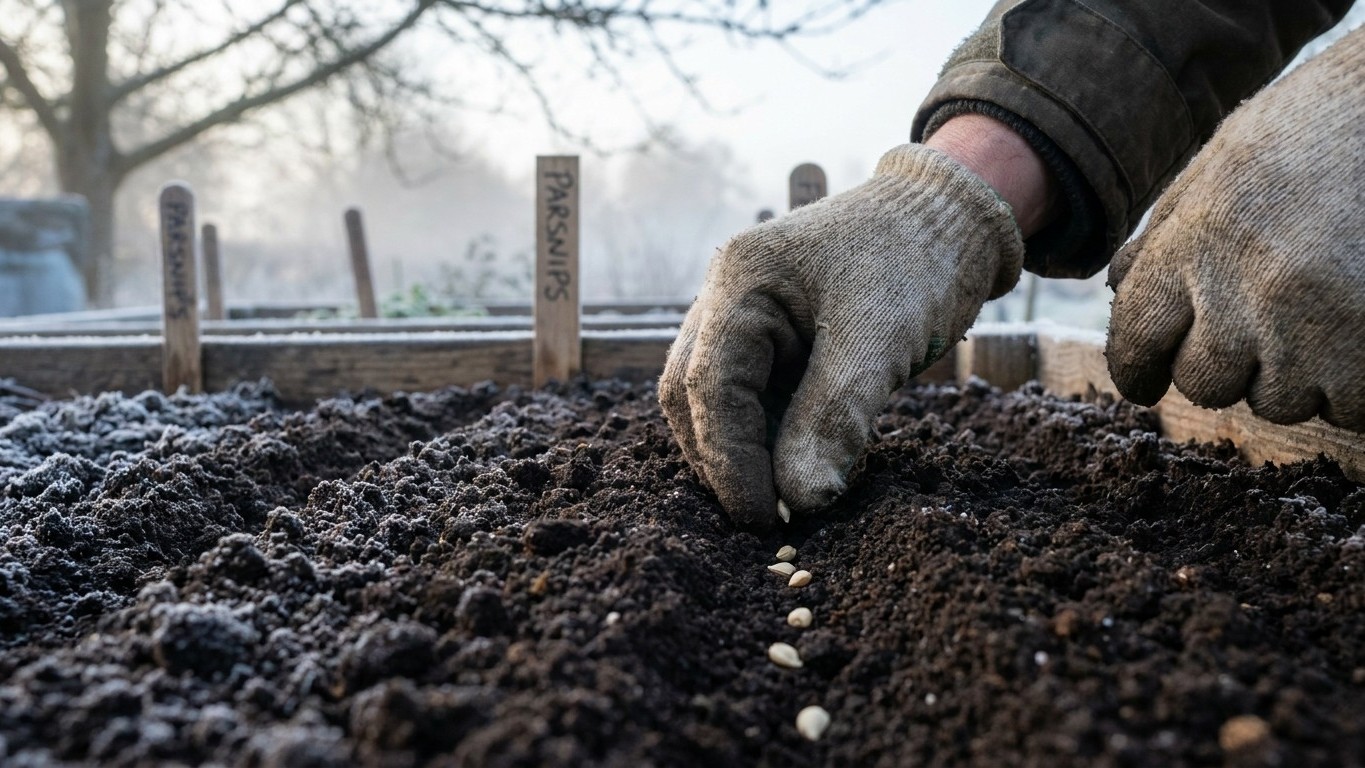

Aim for mid to late April, roughly two to three weeks ahead of South Dakota’s typical last spring frost. Parsnip seed takes 14 to 21 days just to germinate, and the roots then need 100 to 120 days to size up. The real payoff comes later: South Dakota’s cold winters deliver the frosty weeks parsnips need to turn stored starch into sugar, something a milder climate simply can’t offer.
The short answer
Does South Dakota deliver enough cold to sweeten a parsnip, or just enough to grow one? That’s the question that actually matters here, and it has nothing to do with which hardiness zone shows up on a map. What decides flavor is how deep and how long the cold sits on the garden bed once the roots have reached full size.
Frost exposure decides flavor
Near Sioux Falls, the reference station used for South Dakota’s climate normals, the average daily minimum temperature during the coldest month sits at 8.5°F. That figure isn’t a rare cold snap or a record low pulled from some unusual winter. It’s the typical overnight low, night after night, through the coldest stretch of the year. A number that low means the ground doesn’t just dip below freezing once or twice, it stays cold for weeks on end.
That sustained cold is exactly what parsnips are built to use. According to Utah State University Extension, parsnip roots convert their stored starch into sugar only after several weeks of cool, frosty weather. A garden that barely brushes freezing a handful of times won’t trigger much of that conversion. A garden that sits at 8.5°F on average through its coldest month gives the roots plenty of frost exposure to work with.
So the short answer for South Dakota is straightforward: this climate doesn’t just let you grow a parsnip, it lets you grow a genuinely sweet one, as long as the roots stay in the ground long enough to catch those frosty weeks before harvest.
Does the season fit?
Fitting a 100 to 120 day crop into a specific climate comes down to counting backward and forward from two dates: the last spring frost and the first fall frost. Here’s how that math plays out for a garden near the Sioux Falls reference station.
- Start with the last spring frost. Near Sioux Falls, that date typically falls between April 29 and May 9. Gardens farther out, in suburban or rural spots away from the airport station, often see it a week or two later.
- Sow two to three weeks before that date. That puts seed in the ground somewhere around mid to late April, depending on how close a given county sits to the reference dates.
- Wait out germination. Parsnip seed is notoriously slow, taking 14 to 21 days to sprout. Seedlings typically won’t be visible until late April or into May, right around the last frost itself, which the seed tolerates fine while dormant in cool soil.
- Count 100 to 120 days from seeding, not from germination. That window lands the roots at harvest size somewhere between mid-July and late August.
- Compare that to the first fall frost. Near Sioux Falls, that date falls between September 24 and October 4. That leaves several weeks between a mid-summer maturity date and the first freeze.
- Use the gap for sweetening, not for panic. Roots that reach size in July or August don’t need to be pulled right away. Left in the ground through September and into October, they sit through the frosty nights that actually build sugar.
Add it up and the frost-free stretch near Sioux Falls runs roughly 138 days, from a late last-frost date of May 9 to an early first-frost date of September 24. That comfortably covers even the longer end of a 120-day parsnip, with weeks to spare for the frosty finish the crop needs. This is a season that fits with room, not one that fits by a matter of days.
What goes wrong here
- Forked roots from heavy or stony ground. Parsnips need loose, deep soil to grow a single straight taproot, and South Dakota’s clay-heavy or rocky prairie soils can split a root into two or three legs as it hits resistance. Utah State University Extension recommends double digging heavy soil, or working sand and compost into the bed to a depth of 12 to 15 inches before sowing, so the root has nothing to fight on its way down.
- Forked roots from overwatering. This is a separate cause from soil texture. A root sitting in soil that’s kept too wet will branch as it searches for air pockets rather than growing straight down. Water deeply but infrequently, letting the top couple inches of soil dry between waterings, rather than keeping the bed constantly damp.
- A season that runs out before the roots size up. This is a real risk only if sowing gets delayed. Push seeding much past the last frost date and the 100 to 120 day clock may not finish before growth slows in the cool of fall. Sow on schedule, in mid to late April, and this isn’t a concern given how much frost-free time the region has to work with.
- Pulling the roots too early and missing the sweetness. Because South Dakota’s winters are reliably cold, with that 8.5°F average low in the coldest month, there’s no excuse for harvesting the moment roots reach size. Doing so leaves them starchy instead of sweet. Mulch the bed heavily once the roots are full-grown, then let several hard frosts pass before digging, harvesting into late fall or even after a light spring thaw.
Common questions
Can parsnips overwinter in the ground in South Dakota?
Many gardeners leave mature roots in place under heavy mulch through winter and dig them as the ground softens in spring. Given the coldest month’s average low of 8.5°F, roots left in the ground get more than enough frost exposure to sweeten well before that spring harvest.
What’s the best soil fix for South Dakota’s clay-heavy ground?
Double dig the bed or build a raised area at least 12 to 15 inches deep, working in sand and compost so the taproot has loose ground to grow through. This directly addresses the forked-root risk that heavy soil causes here.
How do I know parsnips are ready to harvest?
Wait until the roots have reached full size, generally 100 to 120 days after seeding, and then let them sit through several frosty nights. The flavor shift from starchy to sweet happens gradually during that frost exposure, not on a fixed calendar date.
Is there room in South Dakota for a second parsnip planting?
With a frost-free window of roughly 138 days near the Sioux Falls reference station, there isn’t enough spare time after a first sowing to fit a second full 100 to 120 day crop before fall frost arrives. One well-timed spring sowing is the practical approach here.