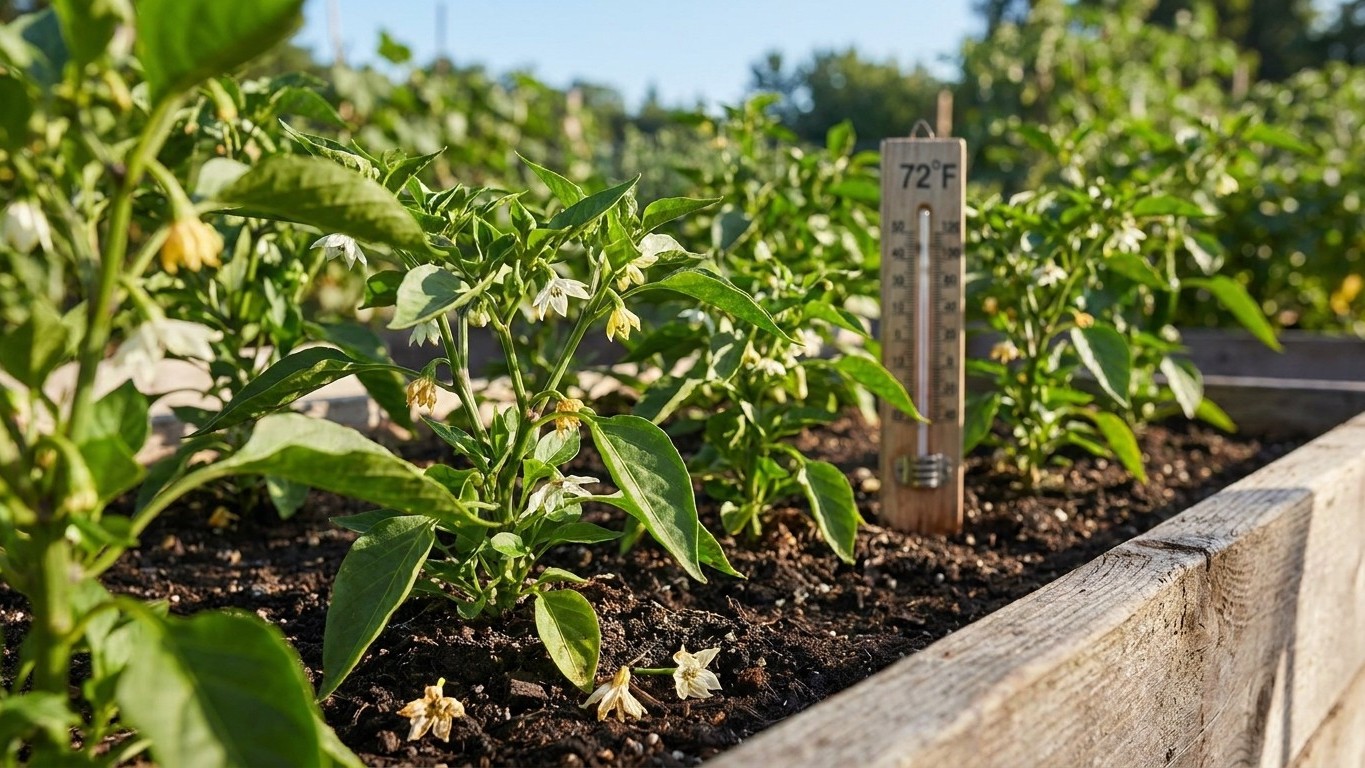

Start pepper seed indoors roughly 8 to 10 weeks before you plan to set transplants in the ground. In most of South Carolina that means sowing indoors sometime between mid-January and mid-February, timed backward from a transplant date that depends on your local frost and soil warmth, not a fixed calendar day.
The short answer
South Carolina runs hot for a long stretch of the growing season. The Charleston reference station averages 55.1 days a year at or above 90 F, according to NOAA NCEI Climate Normals for 1991-2020. That is not a handful of scorching afternoons. That is nearly two months of the year where daytime highs cross the threshold that pepper flowers cannot tolerate. Fruit set stalls when days stay above 90 F for any stretch, and a plant loaded with blossoms in July can drop nearly all of them in a heat wave, then sit and wait for cooler air before it tries again.
That heat load is only half the story, and it is the half this site can actually measure for you. Pepper fruit set fails at the other end too, when nights drop below 55 F, according to Utah State University Extension. A cool snap in early spring or a string of chilly nights in fall can stall flowering just as effectively as a heat wave does in midsummer. The catch is that this site does not carry summer night minimum temperatures for South Carolina locations. Days above 90 F, yes. Overnight lows in June or September, no.
That gap matters more than it sounds. Nights along the coast behave differently than nights forty miles inland, and elevation changes things again in the Upstate. A grower in a low-lying river bottom can see nights dip into the mid-50s well after everyone assumes summer has arrived, while a spot on higher, drier ground nearby stays warmer after dark. Latitude alone will not tell you this, and neither will the coldest month of the year on a chart. The only reliable fix is to watch your own thermometer through the nights when your plants are setting flowers, especially in late spring and again as temperatures ease down in early fall.
Put the two halves together and the practical picture looks like this: South Carolina peppers have a hot middle of summer where fruit set can pause for days or weeks at a time, bracketed by two cooler windows, spring and fall, where a stray cold night can do the same thing from the other direction. The growing season is long, but the productive window for actual fruit set is narrower than the frost-free calendar suggests.
When to start seed here
Working out a start date is arithmetic, not guesswork, and it holds for any county in the state if you plug in your own numbers.
- Find your last spring frost date. NOAA NCEI’s 1991-2020 Climate Normals put the 32 F freeze probability window for the Charleston airport station (USW00013880) between February 28 and March 17. Peninsular Charleston itself runs milder than that airport reading, while the Upstate runs several weeks tighter at both ends of the season, so treat this range as a starting point to check against your own location, not a statewide rule.
- Add time for soil to warm. Frost clearing does not mean the ground is ready. Pepper transplants need soil at 60 F, and soil lags air temperature by a few weeks in spring, so the real transplant date usually falls somewhen after the frost date has passed, not on it.
- Confirm night temperatures before you plant. Since fruit set fails below 55 F at night, an early transplant date on the calendar is only useful if the overnight lows have actually settled above that mark. This is the step growers skip when they go by the frost date alone.
- Count backward 8 to 10 weeks from that confirmed transplant date. That span, straight from Utah State University Extension’s guidance, is how long pepper seedlings need indoors to reach transplant size with a sturdy root system.
- Land on your indoor sowing date. For a transplant target in late March to early April, once frost has cleared and soil has caught up, that arithmetic lands seed-starting somewhere in the mid-January to mid-February range for much of the state, earlier for milder coastal spots, later for the cooler Upstate.
Redo this math for your own county rather than borrowing a neighbor’s date. A grower thirty miles away, on different soil or at different elevation, can have a transplant-ready date two or three weeks off from yours even within the same growing region.
What goes wrong here
South Carolina’s climate creates a specific, repeatable set of pepper problems tied directly to the heat and cold swings above.
- Blossom drop in a hot spell or a cool night. This is the direct result of the two thresholds already covered: days above 90 F and nights below 55 F. Plants keep growing but stop setting fruit until temperatures settle back into range. There is no product fix for this. The remedy is timing and patience: hold new transplants back from the hottest stretch of midsummer where possible, and expect a lull in fruit set during the peak of the 55-day average above 90 F, with production picking back up as nights cool into early fall.
- Sunscald where the sun is strong. Fruit exposed directly to intense afternoon sun develops pale, papery patches on the side facing the light, and those spots can rot. It happens most often on plants that have lost leaf cover from disease, pruning, or wind damage, leaving fruit unshaded during the hottest part of the day. The remedy is keeping foliage full and healthy through midsummer so leaves shade the fruit naturally, and avoiding heavy pruning during the hot stretch when the plant needs its canopy most.
- Blossom-end rot. A dark, sunken patch forms on the bottom of the fruit, usually showing up during rapid growth periods that follow uneven watering. It is a calcium delivery problem inside the plant, triggered by inconsistent soil moisture rather than a soil calcium shortage in most cases. The remedy is steady, even watering through the growing season, particularly during the same hot stretch that stresses fruit set, since drought stress and heat stress tend to arrive together and compound each other.
Common questions
Can I direct-sow pepper seed outdoors in South Carolina instead of starting indoors?
Peppers need 8 to 10 weeks indoors before they reach transplant size, according to Utah State University Extension, and South Carolina’s frost-free window on its own does not leave enough runway for seed sown directly outdoors to mature and set fruit before the hottest, most stressful stretch of summer arrives. Starting indoors and transplanting later remains the reliable route here.
Does the whole state share the same start date?
No. The last frost window from NOAA NCEI’s Charleston-area station runs February 28 to March 17, but peninsular Charleston itself is milder than that airport reading, and the Upstate runs several weeks tighter at both ends of the season. Use your own county’s frost pattern and soil temperature, not a single statewide date.
How do I know when my soil has actually reached 60 F?
A soil thermometer pushed a few inches into the bed, checked in the morning before the sun has warmed the surface, gives the most honest reading. Air temperature and frost dates are a rough guide, but soil habitually lags behind them by a couple of weeks in spring, which is exactly why the transplant date and the frost date are not the same day.
What if a heat wave hits right as my plants start flowering?
Expect blossom drop rather than plant damage. Fruit set pauses during days above 90 F and picks back up once temperatures ease, so a heat wave during flowering typically costs you a stretch of unproductive weeks rather than the plant itself. Keeping watering steady through the heat helps the plant recover and resume setting fruit as soon as conditions allow.