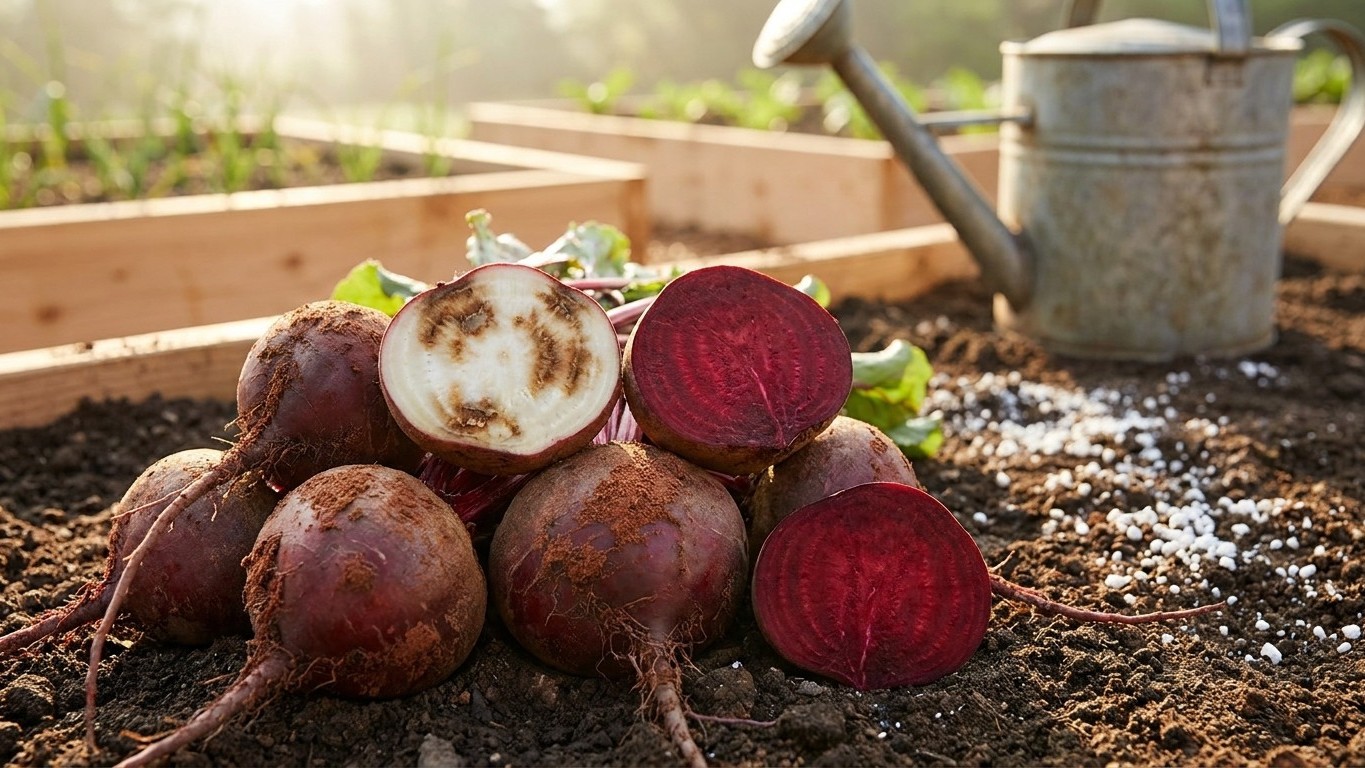

In South Dakota, two things eat into a beet crop, and they arrive at different times. Thirst during the first six weeks after seeding pushes plants toward premature flowering. Heat above 85 F, paired with water stress later on, turns the root woody. These are separate failures with separate fixes. The soil sets how fast the thirst arrives, and the state soil is a decent match for beets with a few caveats worth knowing before you sow.
The short answer
South Dakota’s official state soil is the Houdek series, written into state law as the state’s representative ground. It’s a Mollisol, the deep, dark prairie soil that built the Corn Belt. The USDA NRCS Soil Data Access database (the Soil Survey Geographic Database) records representative values for the surface horizon across 90 mapped components of the series: 38 percent sand, 22 percent clay and 40 percent silt, which lands it in the loam to silt range. Organic matter runs about 3.0 percent, surface pH about 6.7 (near neutral), and drainage is classed as well drained.
Set that against what Utah State University Extension says beets want: deep, sandy, well-drained soil rich in organic matter. Houdek checks the “deep” and “well drained” boxes. It’s less sandy than the ideal, though. With 22 percent clay and 40 percent silt, it holds more water than a true sandy loam and tends to firm up at the surface once rain gives way to sun, which can make life harder for small beet seedlings. The 3.0 percent organic matter is respectable, not rich. Utah State advises amending with no more than 1 inch of composted organic matter per 100 sq ft, so a bed like this doesn’t need a heavy dose of compost to get going.
Now the caveat, and it’s a big one. A state spans hundreds of soil series, and Houdek is the one chosen to represent South Dakota, not the one under every garden. River bottoms, hill country, and any lot a builder has scraped or filled will behave differently. Those figures describe the mapped surface layer of a natural soil, not a worked garden bed, and the 6.7 is not your pH. Treat this as a starting point, then get a soil test for your own numbers. The Beet Soil in South Dakota: What the Root Will Meet page goes deeper on what the root meets below the surface.
Heat is the other half of the answer. The number of days a year the reference station passes 90 F is not published here, so no count appears on this page. What the source does give is the trigger: heat above 85 F combined with water stress makes the root woody. A 90 F afternoon sits well past that line. Woodiness belongs to the back end of the crop’s life, when roots are sizing up, and it has nothing to do with the early thirst that causes bolting. For the full picture of the crop, start with Growing Beets in South Dakota.
The six weeks that decide it here
Utah State Extension is blunt about the window: water stress in the first 6 weeks causes premature flowering. Beets are grown from seed sown in place, so those six weeks start the day the seed goes in the ground. And the 60 to 80 days to harvest run from seeding, never from a transplant.
Sowing 2 to 3 weeks before the last spring frost pins that window to a known stretch of the calendar. The NOAA NCEI climate normals put the last spring frost at April 29 to May 9, a figure covering the 30 to 70 percent probability band for 32 F freezes at the Sioux Falls airport station. Count back 2 to 3 weeks and seeding falls in roughly early to late April at that station. The first six weeks then run through May and into early June.
Be careful with those dates, because they belong to an airport. Suburban and rural gardens typically see the last spring frost later than that, often by one to two weeks, and more at elevation. Check your own county before you pencil anything in. The When to Sow Beets in South Dakota page works through the dates in more detail.
What does that stretch of spring usually do? On the northern Plains it swings. Cold snaps give way to warm spells, and rain tends to arrive in bursts instead of a steady drizzle, so a wet week can be followed by a dry, windy one. This page holds no rainfall figures, so I won’t invent any. The practical consequence is where the bolting risk sits: in the rainless gaps inside that six-week window, especially in a well-drained soil like Houdek that sheds water instead of storing it. A seedling that goes thirsty in the middle of May has already taken the hit, even if June turns soggy.
The 60 to 80 days from seeding mean the first roots come out somewhere between early June and mid-July if you sow in that April window. The late end of that range runs straight into the season when afternoons climb past 85 F. So the two failures stack in sequence. Early thirst threatens bolting, and then, weeks later, heat with dry soil threatens woodiness. A rain gauge and a habit of checking the soil with a finger do more here than any variety choice, and the source gives no performance data on its five named varieties, so I won’t pretend otherwise.
What goes wrong here
- Bolting after an early dry spell. Water stress in the first six weeks after seeding triggers premature flowering, and a well-drained soil dries fast. Remedy: keep the bed evenly moist from seeding through week six, and water during any rainless stretch instead of waiting for a forecast to deliver.
- Woody roots in the heat. Heat above 85 F combined with water stress makes the root woody. That’s a different problem from bolting and it shows up later. Remedy: water steadily through hot spells, and time your sowing so roots aren’t finishing in the hottest part of the summer.
- Too much compost. More organic matter feels like a good deed, but the guidance is no more than 1 inch of composted material per 100 sq ft. Remedy: measure the layer, spread it, and stop there.
- Assuming your ground is Houdek. Your garden may be river bottom, hill country, or fill left by a builder. Remedy: send in a soil test before you amend anything, and trust that number over any state profile.
- Storing beets too cold. Most root crops like the coldest spot you have. Beets don’t. USDA Agricultural Handbook 66 says storage at 32 to 34 F produces more black spot and rot than slightly warmer conditions. Remedy: hold topped roots at 33 to 36 F and 98 percent relative humidity. Cut the tops off first, because bunched beets with leaves last only 10 to 14 days (at 32 F and above 98 percent humidity). Keep the large roots for storage, since they shrivel more slowly, and eat the small ones first. For pits or cellars, stay between 31 F and 41 F. The source is the USDA Handbook 66 commercial storage guide.
Common questions
Is South Dakota’s state soil good for beets?
Mostly yes, as a starting point. The Houdek series is deep, well drained and near neutral at the surface, with about 3.0 percent organic matter. It’s loamier than the sandy ground Utah State Extension describes as ideal, so it holds more water. Your own garden may differ a lot, and a soil test is the only way to know.
What’s the difference between bolting and woody roots?
Bolting is premature flowering caused by water stress in the first six weeks. Woodiness is a tough, fibrous root caused by heat above 85 F combined with water stress later in the crop. Different timing, different cause, and watering well in May doesn’t protect you from the July version.
How early can I sow beets in South Dakota?
The guidance is 2 to 3 weeks before the last spring frost. At the Sioux Falls airport station, that last frost falls between April 29 and May 9, so seeding lands roughly in April. Rural and suburban gardens usually see their last frost one to two weeks later, so check your county’s dates first.
Should I store beets in the coldest part of the cellar?
No. Topped roots keep best at 33 to 36 F and 98 percent humidity, and the 32 to 34 F range produces more black spot and rot. Whatever the temperature, the cellar or pit should never drop below 31 F or climb above 41 F. Pick the large roots to store, because small ones lose water and shrivel faster, and eat those first.