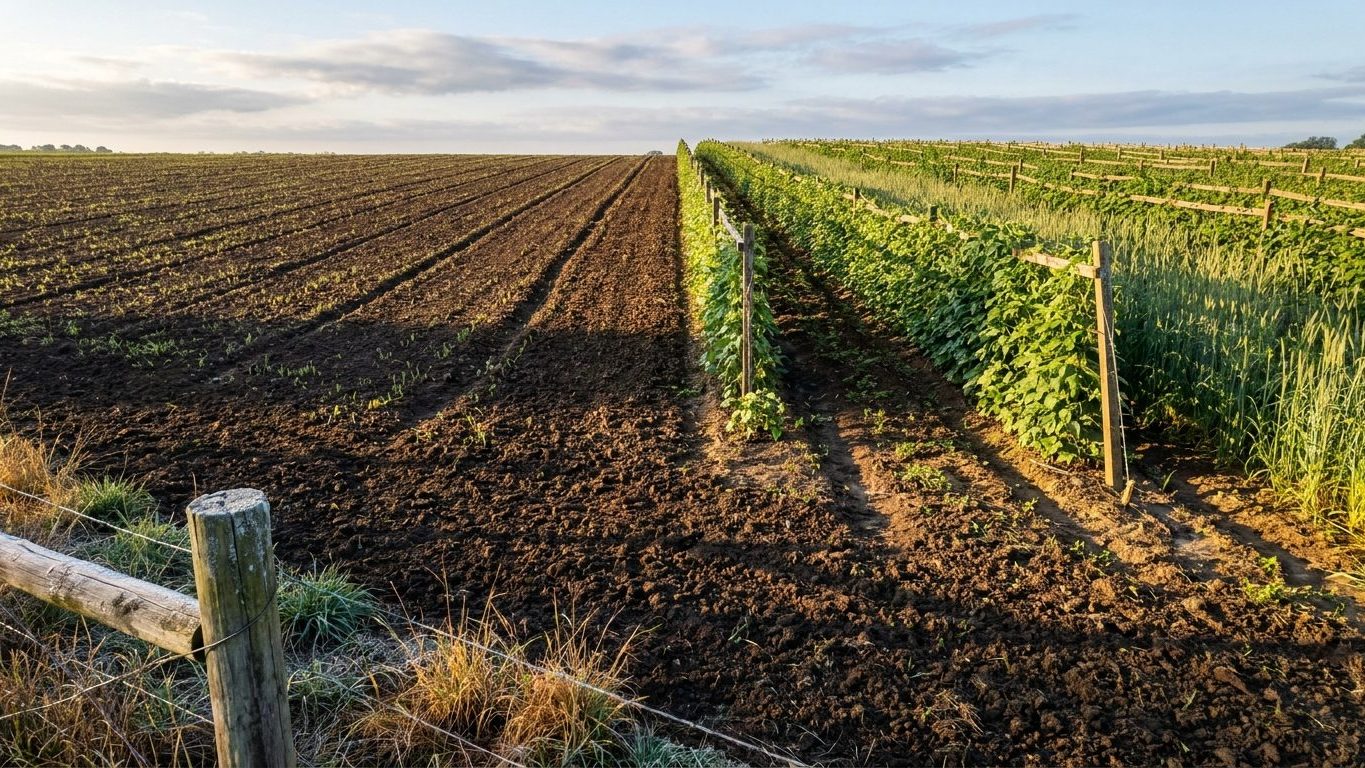

in South Dakota, cool-season covers like oats, field peas, and brassicas can go in as early as mid-April and tolerate the last frost, which lands April 29 to May 9 at the Sioux Falls reference station. Warm-season covers wait until after that window closes, and fall covers like cereal rye or hairy vetch need to be seeded 4 to 8 weeks ahead of the first fall frost, September 24 to October 4, to establish before dormancy.
The short answer for South Dakota
Those frost dates aren’t fixed calendar days. NOAA’s 1991-2020 Climate Normals present them as a 30-70% probability band for a 32°F freeze at station USW00014944, meaning the odds of a killing frost rise gradually through that stretch rather than flipping on a single date. That distinction matters more for cover crops than for tomatoes, because most cover crop species are chosen specifically for their tolerance, or intolerance, of that exact kind of light frost.
For the frost-tolerant group, oats, field peas, and mustard-family covers, sowing can start in mid-April and run through the April 29-May 9 window without much risk. These species germinate in cool soil and shrug off a light freeze once they’ve got a couple of true leaves. There’s no reason to wait for the “safe” date here.
Warm-season biomass builders, buckwheat, cowpeas, sorghum-sudangrass, and sunn hemp, are a different story. They need soil that’s genuinely warmed up, not just frost-free air. The practical move is to wait until after the last-frost window has passed, pushing sowing into late May or into June depending on how the spring is running that year.
Fall and winter covers work backward from the September 24-October 4 first-frost window. Cereal rye, winter wheat, hairy vetch, and crimson clover need roughly 4 to 6 weeks of growth before a hard freeze locks things down, which puts the sowing target in mid-August through early September for most of the eastern part of the state. Cereal rye is the exception: it germinates in cold soil and can go in later, even brushing up against the first frost, since it’s built to keep growing into winter dormancy rather than finish before it.
This page doesn’t have a fact on soil temperature thresholds by species, so treat the frost dates above as the anchor and adjust sowing by a week or two once you’ve read the section on your own garden further down.
What will not work here
South Dakota’s frost-free stretch, roughly May 9 to September 24 at the reference station, runs about 138 days. That’s a generous window for a garden vegetable, but the caution on those dates says suburban and rural sites typically see frost arrive one to two weeks earlier in fall and linger one to two weeks later in spring. Trim both ends and the real working season on many properties is closer to 110-120 days. Slow-maturing tropical legumes like sunn hemp, which want 90-plus warm days just to flower and build meaningful biomass, routinely run out of runway if sown any later than early June. Sow one in mid-June expecting a July planting date to still work, and it gets caught by frost before it’s done anything useful.
Winter survival is a separate problem, and it’s governed by the coldest month’s mean minimum, which sits at 8.5°F here. That’s not the record low, it’s the average daily low during the coldest month, and it’s the number that decides whether a “winter-hardy” cover crop actually makes it through to spring. Crimson clover, often marketed as winter-hardy, is reliably hardy into USDA zone 6 and struggles below that. With a state hardiness range of 3b-5b, most of South Dakota sits well outside crimson clover’s comfort zone, and gardeners planting it as an overwintering cover should expect stand loss, not a guaranteed spring green-up. Hairy vetch and cereal rye are the more dependable overwintering choices precisely because they’re rated for colder mean minimums than 8.5°F.
The third failure mode is moisture management, not cold. Buckwheat is shallow-rooted and wants consistent moisture to germinate evenly and keep growing. South Dakota’s summers are a continental pattern, not a humid one, and a buckwheat stand sown into dry topsoil in July without supplemental water will germinate patchy and stall. This isn’t a crop that forgives a skipped watering week the way a deeper-rooted sorghum-sudangrass does.
What changes across South Dakota
A hardiness range of 3b-5b isn’t a rounding error, it’s close to a 20°F spread in average extreme annual minimum temperature between the coldest corners of the state and the warmest. There is no single sowing calendar that fits both ends of that range, and this page gives the state-level picture built around the Sioux Falls reference station, which sits toward the milder, eastern end of that spread.
Gardeners in the northern tier and at higher elevations, closer to zone 3b, should shift every fall deadline earlier. If the state-level target for cereal rye is early September, a colder pocket of the state is better served aiming for late August, because the first fall frost likely arrives sooner there than the September 24-October 4 window measured further south and east. Spring sowing dates for cold-tolerant oats and peas can still start in April in most of these areas, since those species care more about soil workability than about the exact frost date.
Closer to the milder end of the range, near zone 5b, the fall sowing window stretches later into September, and warm-season covers like cowpeas or sorghum-sudangrass get a slightly longer stretch of reliably warm soil before the frost risk climbs back up. The practical upshot: treat every date on this page as a starting point tied to one station, then nudge earlier or later based on which end of the 3b-5b range a given county sits closer to.
This page won’t tell an individual reader which zone applies to their yard, that call depends on local topography, wind exposure, and elevation that a state-level page can’t see. The USDA Plant Hardiness Zone Map, built on 1991-2020 normals, is the tool for pinning that down at the address level.
Where to check this for your own county
South Dakota State University Extension is the source that goes past the state-level averages used above. This page draws on one weather station and one hardiness range spanning the whole state. A county-level recommendation from Extension accounts for local soil type, elevation, and the specific frost history of that county, which is a meaningfully different, and more accurate, number than what’s presented here.
Two things are worth hunting for once there. First, a local planting calendar, if the county or regional office publishes one, will replace the generic frost-date band from this page with dates tuned to that specific location, often narrower and more useful for timing a fall rye seeding down to the week rather than the month. Second, look for variety trial results run in South Dakota conditions. Extension services frequently test cover crop species and specific varieties, cowpea types, forage radish selections, rye varieties, under the exact soil and climate conditions found in-state, and publish which ones performed best for biomass, winter survival, or weed suppression in local trials. That kind of trial data beats a general species recommendation every time, because it’s been tested against the same freeze risk and moisture pattern a South Dakota grower is actually working with.
Treat this page as the broad framework, useful for understanding why the sowing windows exist and what mechanism drives them, and treat the county-level Extension material as the number to actually act on. The two aren’t in conflict, they’re built for different jobs.
Checking this against your own garden
Every date above comes from an airport weather station, and no station knows what a specific yard’s soil is doing this week. Three low-tech checks will tell more than any calendar date.
First, grab a handful of soil from where the cover crop is going and feel it. If it’s still cold and heavy in the hand rather than crumbly and just faintly cool, warm-season covers like buckwheat or sorghum-sudangrass are still too early, regardless of what the last-frost date says. Second, watch what’s germinating on its own nearby, volunteer weeds and grasses popping up in disturbed soil are a decent proxy for whether the ground has crossed the temperature threshold most seeds need. If nothing volunteer is coming up yet, a deliberately sown warm-season cover probably won’t either. Third, once a cover crop is in, check for the first true leaves rather than counting days since sowing. A cool-season cover that’s still at the cotyledon stage two weeks after the reference last-frost date is running behind that particular spring’s actual soil conditions, frost date or not, and that’s useful information for timing the next sowing rather than sticking rigidly to the calendar.