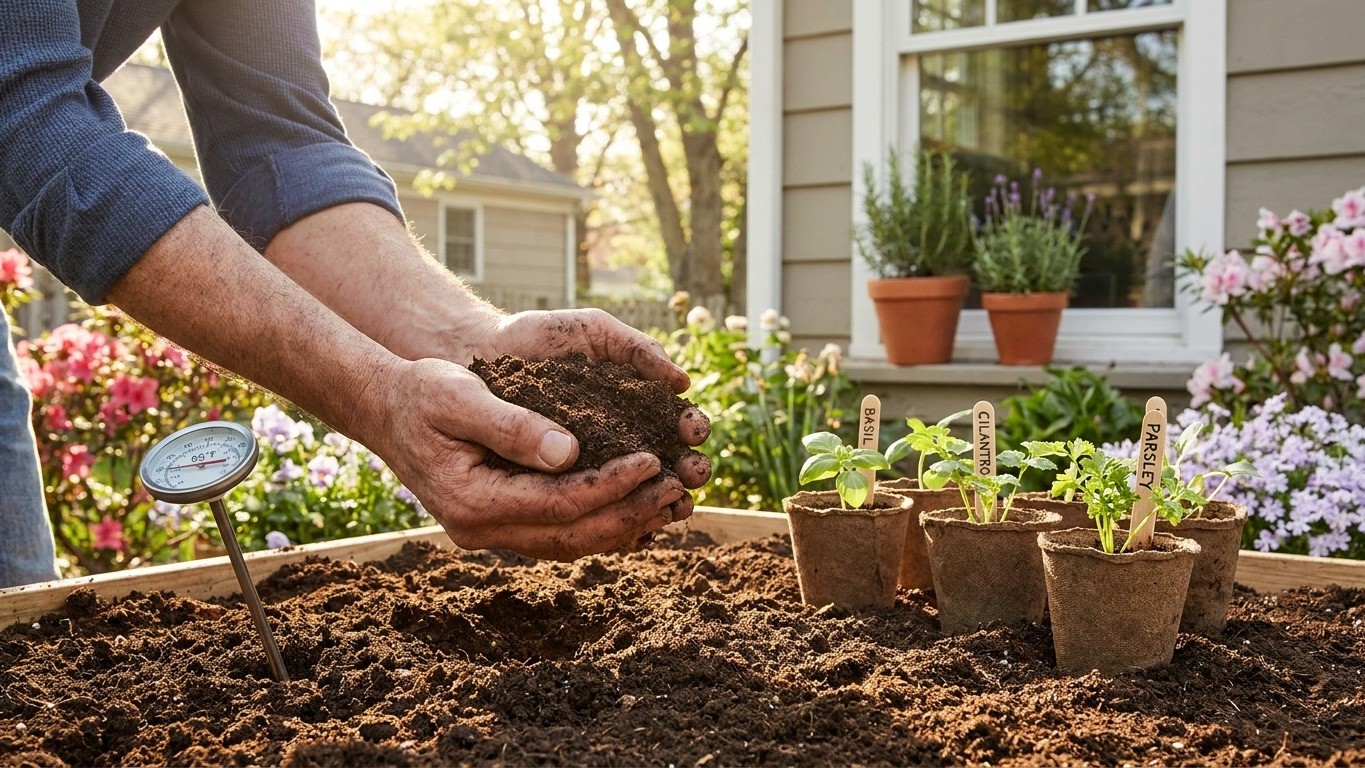

Herbs can go in the ground in Maine once soil temperatures climb past the mid-40s, which typically follows the last spring frost by two to three weeks. Hardy perennial types like chives and thyme tolerate a light frost and can go earlier; tender annuals like basil and cilantro need warmer soil and should wait. The exact date depends on where in the state you garden.
When the soil is warm enough in Maine

NOAA’s Climate Normals put the last spring frost for the Portland reference station (USW00014764) between April 22 and May 1, based on 1991-2020 data measuring the window when the chance of a 32°F freeze drops to between 30% and 70%. That’s a probability band, not a guarantee: some years the last frost lands earlier, some years it drags on. Treat the date as a planning tool, not a promise, and don’t be surprised if a cold snap shows up after it once in a while.
Here’s the part gardeners often miss: frost date and soil temperature aren’t the same thing. Air can clear the freeze risk while the ground underneath is still cold and slow to wake up. Herb roots respond to soil temperature, not to the calendar, so the real planting window opens a bit after that frost date passes, once the top few inches of soil have had time to warm in the sun.
That gap matters more for some herbs than others. Tender annual herbs, the kind grown fresh from seed or transplant each year, like basil and cilantro, sulk in cold soil. Basil in particular stalls out and can develop dark spotting if it goes into ground that hasn’t warmed enough, so gardeners who push it in right at the frost date often get a slower start than those who wait another week or two. Hardy perennial herbs behave differently. Chives, mint, oregano, and thyme are cold-tolerant enough to go into the ground close to that April 22 to May 1 window, sometimes a bit before it, because established roots and mature foliage on these types shrug off a light frost that would set back a young basil seedling.
One more thing the frost date doesn’t tell you: where you live in the state changes everything. Portland sits on the mild edge of Maine’s climate. Inland valleys and the northern half of the state run their last frost meaningfully later in spring and their first fall frost meaningfully earlier, which compresses the whole growing calendar. A gardener in Aroostook County working from the Portland date alone is planting on a schedule that doesn’t match their own soil.
How long the season lasts here
Put the two NOAA windows together and Maine’s frost-free stretch runs from a last spring frost of April 22 to May 1, to a first fall frost of October 9 to October 21. Doing the subtraction on the narrower combination (May 1 to October 9) gives a growing season of about 161 days. Stretching it to the wider combination (April 22 to October 21) gives closer to 182 days. In practical terms, that’s a season running somewhere between roughly 23 and 26 weeks, depending on where you sit in that probability band and where in the state you garden.
That length decides more than it looks like it does. A 26-week season leaves enough room for a second sowing of quick-cycling annual herbs, things like dill or cilantro, which tend to bolt in summer heat anyway and are often more useful sown twice, once in spring and again in mid to late summer for a fall harvest. A 23-week season is tighter. In the shorter version of Maine’s window, the first sowing of a slower annual herb is often the only one that has time to mature and be useful before fall frost shuts things down, which changes the math on whether to direct-seed or start indoors.
That’s also where transplanting decisions get real. In a short season, giving a tender herb a head start indoors and setting out a strong transplant buys back weeks that direct-seeding in cold ground would cost. But transplants come with their own tax: a rushed root check at the point of planting matters more here than it would in a territory with a longer runway, because a pot-bound or stressed root system has less season left to recover from transplant shock before frost arrives again. Gardeners weighing a second sowing, or timing a first one against these frost windows, will find more detail in this site’s succession sowing guide.
Heat and water in Maine

Maine doesn’t run hot, and that’s the fact that actually shapes an herb garden here more than any summer heat count. The territory’s defining climate number isn’t a summer statistic at all: it’s what happens in January. The coldest month’s mean daily minimum at the Portland reference station is 15.6°F, and the state spans USDA hardiness zones 3b to 6a, a range built on average annual extreme minimum temperatures. That single figure, more than any summer stretch, decides which herbs behave as permanent plants in Maine and which ones need to come inside for the winter or be treated as annuals.
This is where herb gardening splits into two very different tracks depending on the plant. Woody perennial herbs, rosemary being the clearest example, don’t reliably survive a Maine winter in the ground anywhere in that 3b to 6a range: a mean coldest-month minimum in the mid-teens is well below what rosemary tolerates outdoors, which is why it’s grown here as a container plant brought indoors for winter rather than left in a garden bed. Other perennial herbs, like thyme, chives, oregano, and mint, are bred for exactly this kind of cold and come back reliably from the same spot year after year once established, provided they’re planted in the zone range that matches their species’ hardiness rating.
Summer in Maine tends toward cool and damp rather than hot and dry, and that shift changes the disease pressure gardeners deal with more than it changes watering schedules. Cool, humid stretches are the conditions that favor fungal issues like powdery mildew on herbs with dense foliage, and slower ripening for anything that wants real heat to develop flavor and finish its cycle. That’s a different set of problems than a hot, arid territory faces. Instead of worrying about scorch or drought stress, Maine herb gardeners are better served thinking about airflow between plants, avoiding overhead watering late in the day, and not crowding herbs into the kind of dense, shaded bed that holds moisture on the leaves overnight.
Which herbs suit Maine
Reasoning from the numbers above, the herbs that fit Maine best fall into two clear groups, and the season length is what separates them. The hardy perennial herbs, chives, mint, oregano, sage, and thyme, are the backbone of a Maine herb bed. They match the winter cold defined by that 15.6°F coldest-month minimum and the 3b to 6a zone range, and once established they don’t need to be replanted each spring, which matters in a territory where the frost-free window is already compressed to somewhere around 23 to 26 weeks.
The tender annual herbs, basil, cilantro, dill, and parsley, are grown fresh from seed or transplant every year regardless of climate, but Maine’s short season pushes gardeners toward the earliest-maturing types within each of those groups, since a slow-to-develop plant simply runs out of runway before fall frost arrives. In a humid summer climate, disease resistance becomes the first thing worth checking for within any of these types, ahead of flavor or leaf size, because the cool damp stretches common to Maine summers are exactly the conditions that let fungal problems take hold on dense foliage.
What this page won’t do is recommend a specific variety. Naming a cultivar without local trial data is a guess dressed up as advice, and Maine’s own growing conditions, from coastal Portland to the northern interior, vary enough that a variety proven in one part of the state can underperform in another. The gardeners who actually know which specific varieties of basil, thyme, or cilantro have done well in Maine’s trial plots are the researchers at the University of Maine Cooperative Extension, and that’s the resource worth checking before buying seed, because their variety trials are run on this exact soil and this exact climate rather than on a national average that may not apply here at all.