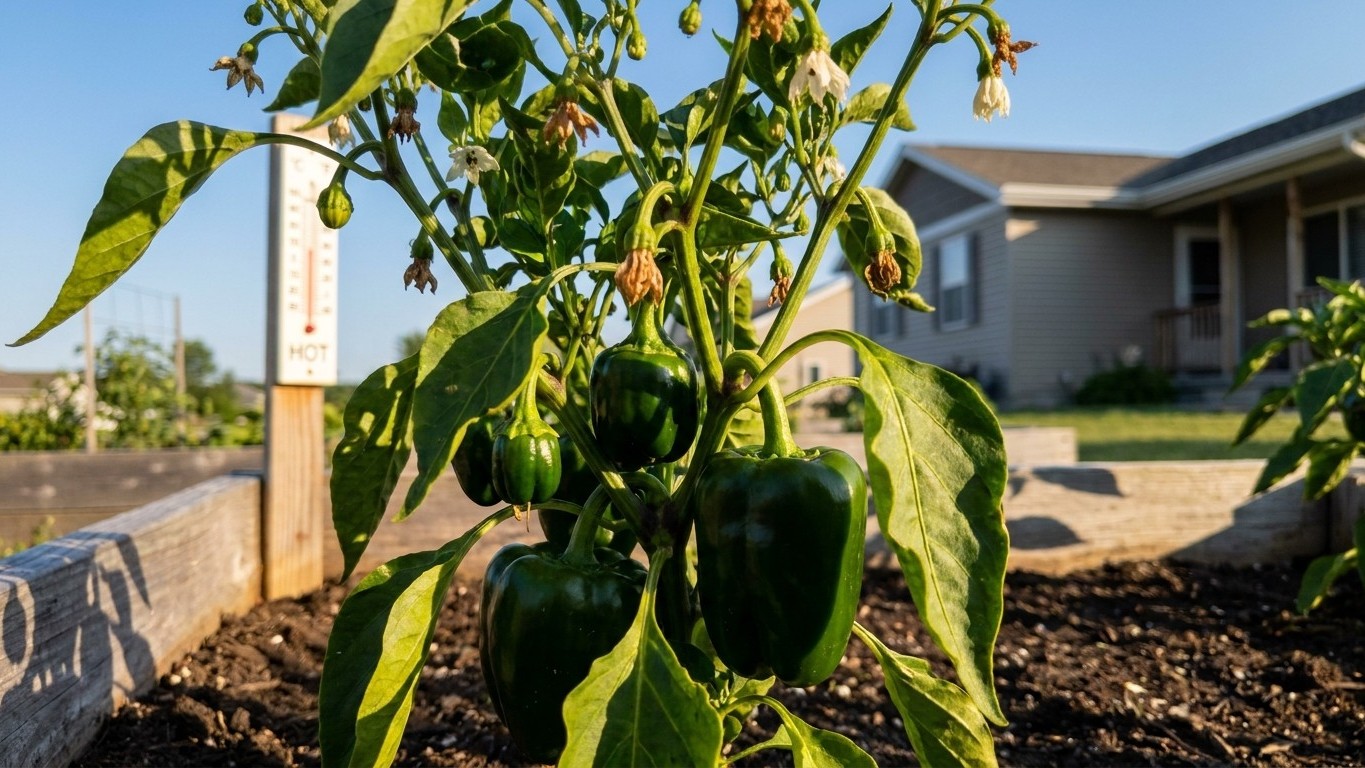

South Dakota gardeners can grow peppers, but the window is narrow on both ends. Sioux Falls averages 13.8 days a year at or above 90 F, hot enough to stall pollen and drop blossoms. The reverse problem, nights under 55 F, matters just as much for fruit set, and this site doesn’t track summer night lows for any territory, so you’ll need to watch your own thermometer through June and July.
The short answer

Start with the heat side, because it’s the number this site actually carries. The reference station at Sioux Falls records 13.8 days a year at or above 90 F, based on NOAA NCEI Climate Normals for 1991-2020. That’s not a heat wave here and there. Spread across a South Dakota summer, it’s enough consecutive hot afternoons to push pepper flowers past the point where pollen stays viable. According to Utah State University Extension, pepper fruit set fails once daytime temperatures climb above 90 F, and the plant responds by dropping blossoms rather than setting fruit it can’t support. Thirteen and a half days doesn’t sound like much until you realize it often clusters into a run of five or six days in a row during late July, right when your plants should be loading up on peppers for the fall harvest.
The other failure point sits at the opposite end of the thermometer, and it’s the one growers tend to forget. The same Utah State University Extension guidance is clear that pepper fruit set also fails when nights drop below 55 F. A cool snap in late May or an early September chill can shut down pollination just as effectively as a heat spell, even if the daytime temperature looks perfectly pleasant. This matters in South Dakota because spring nights can stay cool well past the last frost date, and fall can turn cold fast once the calendar tips toward September.
This is where the data gap becomes the reader’s job. This site tracks days above 90 F for South Dakota because that figure is published in the NOAA Climate Normals record. Summer night minimums aren’t part of that same dataset, and no reliable state-wide figure exists here to substitute. Don’t try to guess your overnight lows from your county’s latitude or from how cold your winters get. Those numbers don’t correlate closely enough with June and July night temperatures to be useful. Instead, get a simple min-max thermometer in your pepper bed and read it every morning during the six weeks after transplant, and pair that with guidance on When to Start Pepper Seed in South Dakota so your transplant timing works with, not against, those night temperatures. For a deeper look at both failure points together, see Why Peppers Fail to Set Fruit in South Dakota. If you’re consistently seeing nights below 55 F during that stretch, your flowers may be dropping for reasons that have nothing to do with watering or fertilizer, and no amount of adjusting either one will fix it. Choosing from the Pepper Varieties That Ripen in a South Dakota Season can also help you avoid banking on a cultivar that needs more heat days than this climate reliably provides.
When to start seed here
Working backward from transplant day is the most reliable way to time pepper seeding in this climate, and the math is simple enough to redo for your own address.
- Find your transplant window. Peppers go into the ground only after your last frost has passed and once soil temperature has reached 60 F, per Utah State University Extension. At the Sioux Falls reference station, NOAA NCEI’s 1991-2020 normals put the last spring freeze (32 F) in the window of April 29 to May 9. That’s a probability band from a specific airport weather station, not a promise for every yard in the state.
- Adjust for your actual ground. Suburban and rural gardens away from the reference station often see their last frost land later, sometimes by one to two weeks, and gardens at higher elevation can lag further still. Soil temperature usually trails air temperature by several days after a warm spell, so don’t assume 60 F soil just because the air finally feels like spring.
- Count back 8 to 10 weeks for seed starting. Utah State University Extension recommends starting pepper seed indoors 8 to 10 weeks before that transplant date. If your realistic transplant target falls in mid-May because your ground runs cooler than Sioux Falls, count back 8 to 10 weeks from mid-May, which lands seed-starting in early to mid-March.
- Build in a buffer, not a shortcut. Pepper seed germinates slowly compared to tomatoes, and a cool spring can push your safe transplant date later than the historical average suggests. Starting on the 10-week end of the range rather than the 8-week end gives you sturdier transplants if the ground takes its time warming up.
None of this arithmetic works if you skip the local check. The Sioux Falls dates are a starting reference, not a fixed rule for a county two hours away with different soil, tree cover, or elevation.
What goes wrong here
- Blossom drop from a hot spell. When afternoon temperatures push past 90 F, which happens on average close to 14 days a year at the Sioux Falls reference point, pepper flowers can abort before setting fruit. The remedy is timing your planting so peak flowering doesn’t line up with the hottest stretch of July, and providing afternoon shade cloth over plants during a forecasted heat run rather than trying to fix it after blossoms have already dropped.
- Blossom drop from a cool night. The same failure shows up when nights fall below 55 F, whether that’s a late-spring cold snap right after transplant or an early autumn chill. Because this site doesn’t carry night-temperature data, the fix starts with tracking your own overnight lows with a simple thermometer, and using row cover or cloches to buffer transplants during any stretch of nights that dip into the low 50s.
- Sunscald on exposed fruit. Strong summer sun on peppers that lose leaf cover, often from stress, uneven watering, or aggressive pruning, can bleach and blister the fruit skin. Keeping the plant’s canopy full through consistent watering, and avoiding heavy pruning during the hottest weeks, keeps developing peppers shaded by their own foliage.
- Blossom-end rot on developing fruit. Irregular watering, especially swings between bone-dry soil and a heavy soak, interrupts calcium uptake and shows up as a dark, sunken spot on the bottom of the pepper. Mulching to hold soil moisture steady and watering on a consistent schedule rather than reacting to a hot afternoon addresses the underlying cause more reliably than a calcium spray after the fact.
Checking this against your own county
The figures here come from a single reference station and a single extension guide, and neither one accounts for your specific yard. A pepper bed against a south-facing brick wall in Rapid City behaves nothing like an open row crop near Aberdeen, even though both sit in the same state. For frost dates, soil temperature guidance, and variety notes suited to your part of South Dakota, South Dakota State University Extension is the named authority to check against what’s written here. Their county-level staff can also tell you whether your local growing season runs closer to or further from the Sioux Falls averages used in this guide.
Common questions
Can peppers still set fruit during a South Dakota heat wave?
Not reliably. Utah State University Extension notes that fruit set fails once daytime temperatures climb above 90 F, a threshold Sioux Falls crosses on average 13.8 days a year. Blossoms that open during those stretches tend to drop rather than develop into fruit.
Do I need to worry about cool nights even in summer?
Yes. Fruit set also fails when nights drop below 55 F, according to the same Utah State University Extension guidance. This site doesn’t publish summer night-temperature data for South Dakota, so track your own overnight lows rather than assuming your area is warm enough based on daytime heat alone.
When is it safe to transplant peppers outdoors in South Dakota?
Transplant after your last frost has passed and once soil has warmed to 60 F. At the Sioux Falls reference station, NOAA NCEI’s 1991-2020 normals place the last spring freeze between April 29 and May 9, though many yards away from that station see frost end later.
How far back should I start pepper seed indoors?
Count back 8 to 10 weeks from your realistic transplant date. If your local frost-free, 60 F-soil window lands in mid-May, start seed indoors in early to mid-March, adjusting earlier if your county tends to warm up later than the Sioux Falls average.