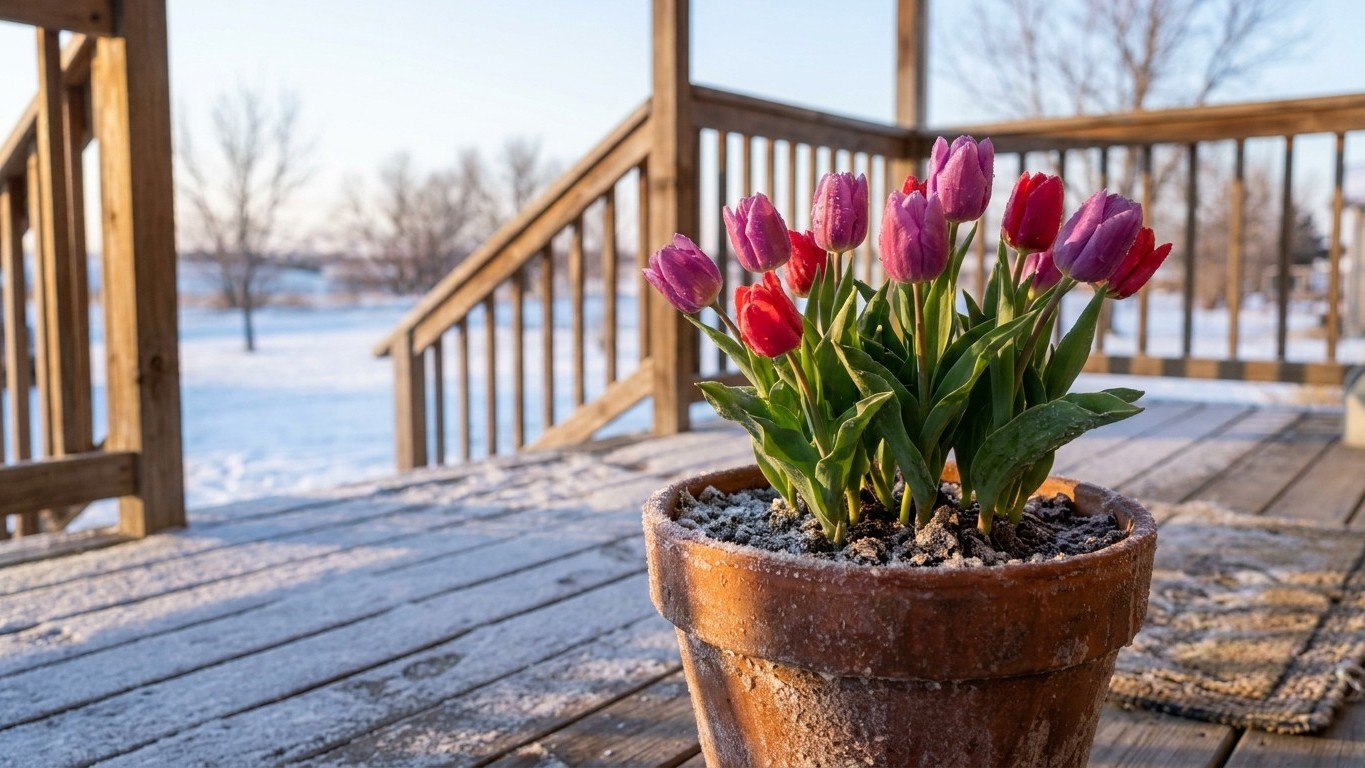

In South Dakota, growing bulbs in containers means picking one of two different jobs. If you want blooms indoors in the dead of winter, you force the bulbs yourself, using a cold spell you control. If you want a pot of tulips or crocus blooming on the porch next spring, the fight is against the pot freezing solid, not against a lack of cold. The state has cold to spare; the container is what struggles.
Why this matters in South Dakota

Eight and a half degrees Fahrenheit. That’s the average daily low for the coldest month at the Sioux Falls reference station, according to NOAA NCEI’s 1991-2020 climate normals. A spring bulb like a tulip or daffodil needs somewhere between twelve and fourteen weeks with temperatures under 45 degrees to build the flower inside it before it emerges. At 8.5°F average lows, South Dakota blows past that requirement before the holidays are over. This isn’t a state where winter falls short. It’s a state where winter arrives early and stays late, which means forcing bulbs indoors here has nothing to do with compensating for a mild climate. It’s a matter of timing: forcing pulls a bloom into January or February instead of waiting for the ground to warm in April or May.
The USDA Plant Hardiness Zone Map, its 2023 edition built on the same 1991-2020 normals, places South Dakota across a 3b to 5b range, a spread that covers the coldest river valleys of the northeast down to milder pockets near the Missouri River. That range describes the ground. A bulb rated for zone 5 will generally survive an in-ground planting anywhere in the milder half of that range, because surrounding soil acts as a buffer, holding heat from deeper layers and slowing how fast the freeze reaches the bulb.
A container gets none of that buffering. A pot sitting above grade is exposed to cold air on every side, not just the top, so it tracks the ambient air temperature far more closely than garden soil does. In practice, a potted bulb behaves as though it’s living one to two zones colder than the same spot in the ground. That means a bulb rated hardy to zone 5, perfectly safe in a border anywhere in South Dakota’s milder stretches, can freeze solid and die in a pot on the same patio. This is the real problem for anyone growing spring bulbs in containers here: not too little cold, but too much of it reaching roots that have no insulation left to hide behind. Whatever zone number applies to a specific yard, the pot needs to be treated as colder than it looks on the map.
How to do it here
The steps differ depending on which of the two goals applies, but both start with a decision made before a single bulb touches soil.
- Decide the goal first. An indoor bloom for midwinter calls for forcing; an outdoor pot that flowers on its own next spring calls for winter protection instead. Mixing the two techniques wastes both bulbs and time.
- For forcing, pot the bulbs in fall in a container with drainage holes, using a standard well-draining potting mix, and water once to settle the soil.
- Move the potted bulbs to a cold spot that stays reliably above freezing but under 45 degrees for twelve to fourteen weeks. An unheated garage works if it’s the kind that hovers a few degrees above outdoor lows rather than tracking them exactly, since South Dakota’s coldest-month average minimum of 8.5°F will kill the bulbs outright if the garage gets that cold. A thermometer left in the garage for a few days before committing the pots there is the only way to know for sure.
- A refrigerator crisper drawer is the alternative when no reliably cold, frost-free space exists. Keep the pots away from any ripening fruit stored in the same fridge, since fruit gives off ethylene gas, and ethylene kills the flower bud forming inside the bulb before it ever opens.
- After the full chilling period, bring the pot into warmth and light gradually, starting in a cool, dim room for a few days before moving it to a sunny window. A bulb pulled straight from a cold spot into a warm, bright room often produces a short, stunted stem instead of a full-height bloom.
- For an outdoor container meant to bloom next spring, match the bulb to a hardiness rating at least two zones colder than the pot’s actual location. In a spot that falls in zone 5a, for example, that means choosing bulbs rated hardy to zone 3.
- If the bulb isn’t rated that hardy, move the pot rather than leave it exposed. Sinking the whole container into a garden bed up to its rim, or relocating it to an unheated garage or shed for the winter, gives the soil mass the insulation a raised pot never gets on its own. A heavy mulch layer over the pot’s surface, four to six inches deep, adds a further buffer for a container that has to stay outdoors.
Which bulbs are worth it
Not every bulb answers this effort with a flower worth the trouble. The ones that force reliably tend to share a short cold requirement and a compact, sturdy stem, since a shallow pot doesn’t offer the anchorage that a few feet of garden soil gives a tall stalk. The ones that sulk usually fail for the opposite reasons: a cold period long enough to test anyone’s patience, or a stem tall enough to topple on a windowsill.
- Crocus, short cold requirement and a low stem that stays upright in a small pot
- Grape hyacinth (Muscari), compact and sturdy, tolerant of a rushed timeline
- Dwarf iris (Iris reticulata), low growth habit suited to shallow containers
- Hyacinth, a strong stem that holds its own weight even indoors
- Miniature daffodils such as ‘Tete-a-Tete’, shorter than standard trumpet types and far less prone to toppling
These sulk more often than not:
- Standard trumpet daffodils, tall stems that flop without garden soil to anchor the roots
- Tall tulip varieties like Darwin types, top-heavy blooms that outgrow a small pot’s stability
- Alliums with tall flower stalks, the same top-heavy problem, worse once the seed head forms
Tulips are worth a separate note. Most modern tulip varieties bloom well only once regardless of where they’re planted, garden bed or container, so forcing one for a single indoor display costs nothing in the long run. The bulb was never going to come back reliably next year anyway. That math doesn’t hold for crocus or muscari, both of which will often persist and rebloom for several seasons if planted out in the garden after their forced display fades, rather than composted.
What goes wrong, and when you can still fix it
Leaves but no flower
A bulb that pushes up plenty of green growth but never produces a bud almost always spent too little time in the cold. The flower forms inside the bulb during the chilling period; skip a few weeks of that twelve-to-fourteen-week window and the bulb has the energy for leaves but not for a bloom. There’s no fixing this season’s pot. The options are to plant the bulb out in the garden and let a full natural winter finish the job for next spring, or to start over with a fresh bulb and a properly timed cold period.
Flower on a stem too short to see
A bloom that opens practically at soil level, barely clearing the rim of the pot, usually means the bulb went from cold storage to a warm, bright room too fast. The stem elongates during a gradual transition; skip that step and the plant rushes straight to flowering without stretching upward. This one can’t be rescued once it’s happened, the stem has already set its final height. The fix applies to the next batch: move future pots to a cool, dim spot for several days before a sunny window, rather than straight from the garage or fridge into full light.
Rot in the pot
Soft, mushy growth or a sour smell at the soil line points to a bulb sitting in water it couldn’t drain away, usually because the container had no drainage holes or the potting mix stayed soggy through the cold period. If the bulb still feels firm when checked, repotting immediately in fresh, well-draining mix and cutting back watering can save it. Once the bulb itself has gone soft, though, it’s finished for this season, and the pot needs a wash before it’s trusted with another bulb.