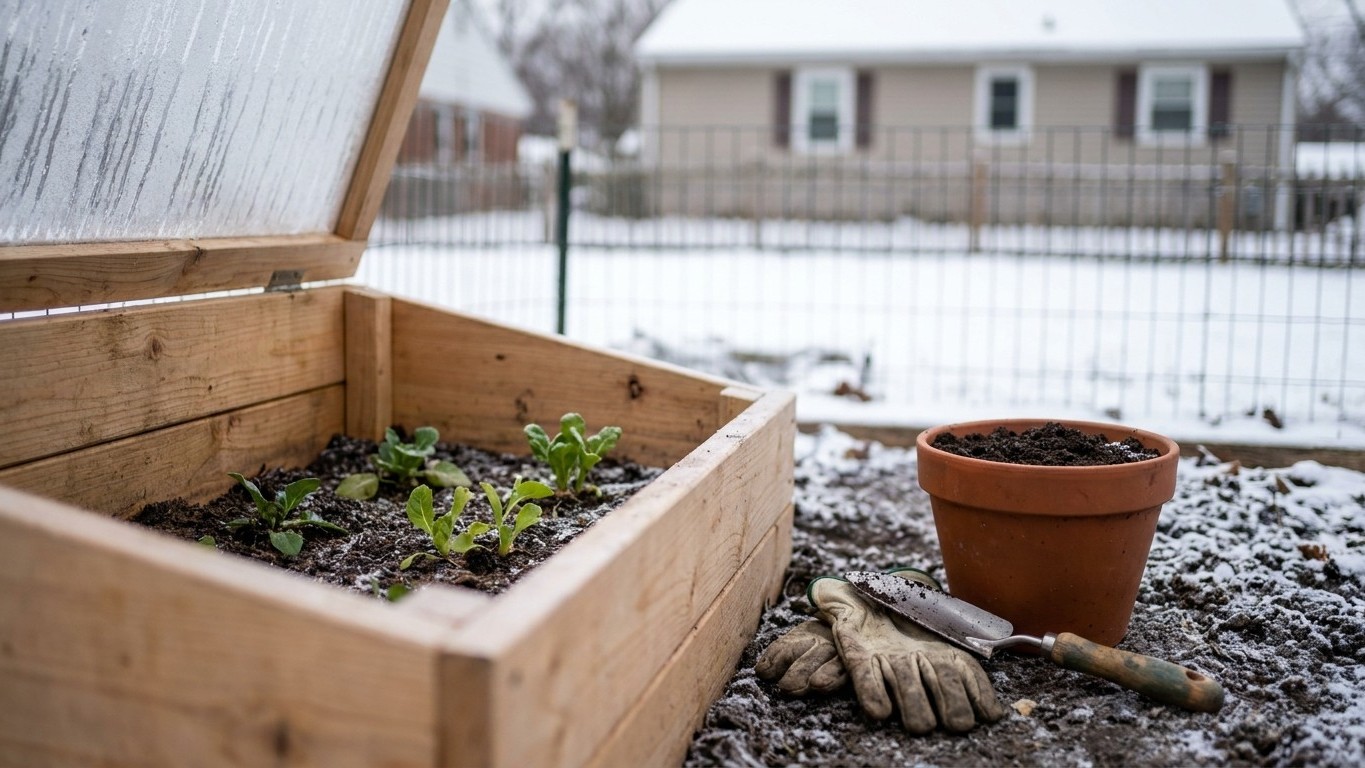

January in South Dakota means frozen ground, not planting weather. The soil across the state sits well below the frost line, so nothing goes into open beds this month. What actually happens now is indoor seed starting on a strict schedule, dormant pruning, seed ordering before good varieties sell out, and a hard look at what’s stored in the root cellar or garage.
What goes in the ground in January

Nothing goes into open ground in South Dakota in January. Soil temperatures statewide sit far below what any seed or transplant needs, and with a hardiness range of zone 3b-5b (USDA Plant Hardiness Zone Map, 1991-2020 normals), the ground is frozen solid from the Black Hills to the eastern border. Even hardy alliums like garlic, which normally go into the soil in fall before the ground locks up, are already in the ground or they missed their window. There’s no catching up on that one in January.
That doesn’t mean the garden goes untouched. A cold frame or low tunnel that was set up in fall and still holds a crop of spinach or mâche can keep producing if it was insulated before the deep freeze hit. The plants aren’t growing much, but they’re not dead either, and a sunny stretch can wake them up enough for a light harvest.
Forcing is where January earns its keep. Rhubarb crowns dug and brought into a dark, cool space (a basement corner works) will push tender, pink stalks within weeks, no sunlight required. Belgian endive and chicory roots do the same trick in a bucket of sand in the dark. Both give you something fresh to cut when the garden itself is offering nothing.
Bare-root fruit trees, cane berries, and asparagus crowns are worth ordering now even though they won’t go into the ground until the soil thaws and works easily, generally not before late April at the earliest given the state’s frost pattern. Buying now means the varieties you actually want are still in stock. Store them in their packaging in a cool, unheated space until planting day arrives.
What to start under cover
Seed starting in January should be counted backward from the last spring frost window, not forward from the calendar. At the reference station used for South Dakota climate data, the last spring freeze typically falls between April 29 and May 9 (NOAA NCEI 1991-2020 Climate Normals, station USW00014944). Onions and leeks are the crops that make sense to start now: they’re slow, cold-tolerant once hardened off, and transplant out several weeks before that last frost date rather than after it. Counting back 8 to 10 weeks from an early-to-mid March transplant target lands seed-starting squarely in January.
That’s a different math than tomatoes or peppers. Those crops go outside only after the frost risk has passed, meaning early May at the soonest, and they’re started 6 to 8 weeks before that. Starting them in January puts six extra weeks on the clock that the plants don’t need, and the result is exactly what any gardener recognizes: tall, thin, rootbound seedlings straining against their cell packs weeks before it’s safe to plant them out.
The opposite mistake shows up with celery and some slow perennial herbs. Skip January entirely on those, and by the time you start them in March, they haven’t built enough of a root system to handle transplant shock when the ground finally warms. Both failure modes come from ignoring the frost window and going by feel instead.
A heat mat and a grow light matter more in January than in any other starting month, simply because the ambient light and warmth in a South Dakota house in winter are both working against germination.
What is ready to pick
Outdoors, January offers almost nothing. Anything left standing in the garden is either buried under snow or frozen solid, and pulling it now risks a wasted trip more than a harvest. The one exception is kale or leeks that were left in the ground under a heavy mulch or snow layer; both can survive and still taste sweet (cold actually improves their flavor) if you can get a spade through the crust to reach them.
A cold frame that’s still holding greens is worth checking on the mildest days. Spinach, mâche, and claytonia can sit nearly dormant for weeks and then offer a real cutting the moment temperatures climb even a little above freezing under the cover.
Indoors is where the real production happens this month. Sprouts (mung bean, alfalfa, broccoli) are ready in 3 to 5 days from a jar on the counter. Microgreens on a tray under a grow light are cuttable in 10 to 14 days and give a fresh, crunchy addition to winter meals with almost no equipment.
Storage crops need a hands-on check now, not later. Squash should feel firm with no soft spots; press gently near the stem end where rot usually starts first. Potatoes that have gone soft, sprouted, or green need to be pulled from the batch before they spread rot to their neighbors. Onions that feel mushy at the neck are past saving. Going through the bins every few weeks in January catches problems before they take out half the harvest.
The jobs that matter this month

Dormant pruning tops the list. Fruit trees and cane berries are pruned while they’re fully dormant and the structure of the branches is easy to see without leaves in the way. Cutting now, rather than waiting for a late winter thaw, also avoids the risk of pruning wounds meeting a sudden warm spell that encourages disease to move in before the cuts have callused.
Seed ordering has a real deadline attached, even if it doesn’t feel like it. Popular varieties, especially anything that got attention the previous season, sell out from seed catalogs by late winter. Ordering in January means getting the actual variety on the list instead of a substitute.
Soil testing is easiest to schedule now, before the spring rush hits the extension lab and before planting decisions are locked in. A test run in January gives enough lead time to order lime, sulfur, or amendments and have them ready when the ground finally works in spring.
Compost piles still need turning even in cold weather; it slows the process but doesn’t stop it, and a pile left untouched all winter compacts and goes anaerobic, which sets back the whole batch. Tools deserve the same attention: pruners, loppers, and shovels cleaned of last season’s dirt and sap, blades sharpened, and any wooden handles checked for cracks before the season demands them.
Bed frames, trellises, and fencing that took a beating from wind and snow are far easier to repair now, while nothing is planted and there’s no risk of stepping on emerging growth. Planning next season’s crop rotation on paper, while the previous season is still fresh in memory, also belongs on this month’s list.
What not to do in January
The most common mistake is trusting a mild afternoon over the calendar of averages. A 45-degree day in the middle of January doesn’t mean spring arrived; soil temperature lags well behind air temperature, and a single warm afternoon does nothing to thaw ground that’s frozen a foot or more down. Planting anything, even a “cold-hardy” crop, into that ground is a waste of seed.
Uncovering cold frames or removing mulch after a warm stretch is the second classic error. That mulch or row cover isn’t just blocking cold, it’s also protecting roots and crowns from the freeze-thaw cycling that heaves plants out of the ground. Pull the cover on a 50-degree day and a hard freeze two nights later can undo months of protection.
Feeding nitrogen this month, whether to a lawn, a fruit tree, or an overwintering perennial, pushes soft new growth at exactly the wrong moment. That growth has no chance to harden off before the next cold snap, and it’s usually the first tissue lost when temperatures drop again.
Starting warm-season seedlings too early, discussed above, deserves a second mention because it’s the single most common January mistake home gardeners make. The fix isn’t complicated: work backward from the frost window for your specific crop, not from a fixed date on the calendar, and resist starting anything before its actual math says so.
Checking this against your own county
Every figure here comes from a single reference station, and South Dakota’s geography moves those numbers around more than most states. Elevation changes in the Black Hills, wind exposure across the open plains, and the simple distance between the northern and southern borders of the state can shift a frost date by two weeks or more in either direction. A garden in a low-lying valley will also see frost linger longer into spring and arrive earlier in fall than one on higher, better-drained ground nearby.
Treat every date in this article as a starting point for your own research, not a guarantee. For local planting calendars and soil test services tailored to your specific county, contact South Dakota State University Extension.
Common questions
Can I plant garlic in South Dakota in January?
No. Garlic goes into the ground in fall, before the soil freezes. By January the window has closed statewide; plan on planting garlic again the following fall instead.
Is it too early to start tomato seeds indoors in January?
Yes, for most of the state. With a last frost window of April 29 to May 9 at the reference station, tomatoes started in January will be leggy and rootbound long before it’s safe to transplant them outside.
What can I actually harvest from a South Dakota garden in January?
Very little outdoors. Overwintered kale or leeks under deep mulch or snow, cold-frame greens on mild days, and indoor sprouts or microgreens are the realistic options this month.
Why do frost dates matter more than the calendar for planting decisions?
Soil temperature and frost risk, not the date on a wall calendar, determine whether a seed germinates or a transplant survives. A warm afternoon in January doesn’t change frozen ground several inches down, which is why gardeners count backward from frost windows instead of forward from fixed dates.
Gardeners who plant by the Moon can check the January 2027 moon planting calendar, a tradition rather than a proven method.