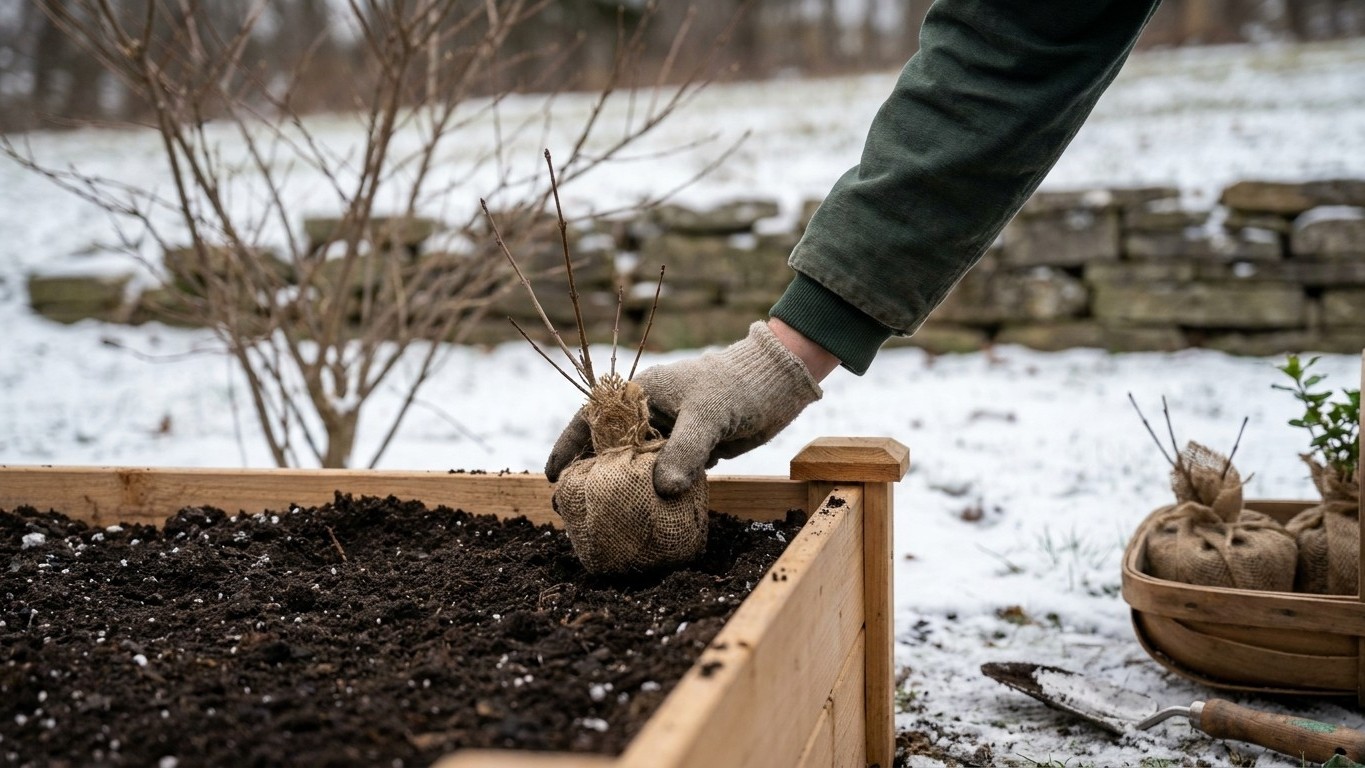

December in South Dakota means frozen ground statewide, so nothing new goes into open garden soil this month. What actually happens in the garden now is indoor work: forcing rhubarb or chicory roots, winter-sowing cold-hardy seeds in jugs outdoors, dormant pruning on the milder days, and getting seed orders in before the short-season varieties sell out.
What goes in the ground in December

The decision here isn’t the calendar, it’s the soil. South Dakota’s average first fall frost lands between September 24 and October 4 at the reference weather station (NOAA NCEI, USW00014944), which means by December the ground has been through weeks, sometimes months, of hard freezes. Across the state’s USDA hardiness range of zone 3b to 5b, soil at planting depth is frozen solid almost everywhere, and it stays that way well into next spring. That’s the mechanism that decides everything else in this section: no soil temperature, no root growth, no planting.
Say it plainly: nothing goes into open garden ground in South Dakota this month, not even in the milder southeastern pockets that sit closer to zone 5b. Garlic and shallots, which are the classic fall-planted alliums, needed to go in back in October while the ground was still workable and before that first frost window closed. If yours are already tucked under a few inches of mulch, leave them be. If they’re not in yet, December is too late for outdoor planting anywhere in the state; hold the bulbs indoors and plan for a very early spring planting instead.
What’s genuinely possible this month happens off the ground or under it in a controlled way. Cold frames and low tunnels aren’t for new planting now, but they’re worth checking and resealing so whatever hardy greens are already inside keep their little pocket of warmth. Bare-root fruit trees and canes are a spring or late-fall job, not a December one, since nurseries hold that stock dormant until soil workability returns. The one true December planting move is forcing: dig a few chicory or rhubarb roots that have already had their cold exposure, pack them in a box of moist sand in a dark, warmish spot indoors, and you’ll have fresh forced chicons or rhubarb stalks in a few weeks, grown entirely without garden soil.
What to start under cover
Count backward from the frost window instead of a fixed date, and December turns out to be earlier than it feels for most seed starting. South Dakota’s last spring frost runs April 29 to May 9 at the reference station. Tomatoes and peppers only need 6 to 8 weeks indoors before that window, which puts their real start date in late February or March, not now. Start them in December and you’ll be babying rootbound, leggy seedlings for two extra months before they can go outside, which is the classic too-early failure mode.
Onions and leeks are the long-season exception people reach for, needing 10 to 12 weeks under lights before transplanting a few weeks ahead of the last frost. Even counting back from the earlier April 29 date, that lands in early-to-mid February, so December is still a touch soon for those too.
What legitimately belongs on the December calendar is winter sowing: seeds of prairie natives and hardy perennials that need a stretch of cold, moist stratification before they’ll germinate. Milkweed, coneflower, and other native perennial seed sown into vented jugs and left outdoors right now will get exactly the weeks of freeze-thaw cycling they need, then sprout on their own once the weather warms. It’s low-effort and it’s one of the few sowing jobs where December’s cold is doing the work for you rather than working against you. Waiting too long into late winter to start this process is the opposite failure mode, since some natives need a longer stratification period than a rushed six weeks in February can supply.
What is ready to pick
Honestly, next to nothing is coming out of open ground in South Dakota this month. Any kale or leeks left in the garden without heavy mulch or deep snow cover have almost certainly succumbed to the extreme minimum temperatures that define zones 3b and 4a across most of the state. If you built a cold frame or covered a bed with a low tunnel earlier in fall, check under it: spinach, mâche, and some hardier kale varieties can still hold in there, sometimes right through a layer of insulating snow, and they’re worth a careful look after a storm rather than being written off.
Indoors is where the reliable harvest is. Sprouts and microgreens grown on a sunny windowsill or under a simple grow light take one to two weeks from seed to harvest and give you fresh greens with zero dependence on outdoor conditions. It’s the closest thing to a guaranteed December crop in this climate.
The other harvest job this month is really an inspection job: go through the root cellar, basement shelf, or wherever squash, potatoes, and onions are stored, and look for the ones starting to turn. A soft spot on a squash, a sprouting potato, or an onion going soft at the neck all spread faster than people expect once they start, and pulling the failing ones now protects everything stored around them.
The jobs that matter this month

Dormant pruning tops the list, and December’s timing matters here more than it looks. Fruit trees and cane berries are fully dormant now, which means cuts heal cleanly without the disease and pest exposure that pruning in active growth invites. The one caveat: pick a milder day, above roughly 20 degrees Fahrenheit, to do it, since cutting brittle, deeply frozen wood during a hard cold snap can crack branches beyond the intended cut.
Seed ordering has a real deadline attached to it even though it doesn’t feel urgent. Short-season varieties bred for northern climates like South Dakota’s sell out from suppliers well before spring, and gardeners who wait until February often find their preferred varieties already gone. Ordering now, while you’re also planning next season’s crop rotation, means you’re not settling for whatever’s left.
A few other jobs earn their place on the December list:
- Turn and check the compost pile, since even a slowed winter pile needs moisture checked and shouldn’t be left bone dry or waterlogged under snow melt
- Clean and sharpen tools that got put away dirty at the end of the season, so they’re ready the moment soil is workable
- Repair raised beds and fencing while the garden is empty and easy to work around, especially fencing against deer and rabbits, which forage more aggressively on garden bark and buds once other food is scarce
- Test and amend soil where beds are bare rather than snow-covered, spreading compost or lime now so it has all winter to work in before spring planting
What not to do in December
The biggest mistake this month is trusting a warm afternoon. A mild stretch in the 40s can feel like an invitation to pull mulch off perennials or uncover a cold frame fully, but South Dakota’s winter temperature swings are sharp, and the freeze that follows a thaw is often harder on plants than steady cold ever was. Leave protective mulch and row covers in place until there’s a real, sustained shift in the weather, not just a warm day or two.
Starting warm-season transplants because the house feels ready for spring is the second classic error. Tomato and pepper seedlings started now, months ahead of the true start window discussed above, don’t get bigger and better; they get leggy, rootbound, and stressed long before it’s safe to plant them out.
Nitrogen is the other trap. Feeding a lawn, a fruit tree, or a perennial bed nitrogen now can push soft, tender new growth right before the coldest part of winter arrives, and that new growth has no chance of hardening off before it gets hit by extreme cold. Hold any nitrogen feeding until active growth actually resumes in spring, and use this month instead for phosphorus- or potassium-focused amendments if a soil test calls for them.
Pruning during an active deep freeze belongs on this list too: wood cut when it’s brittle from extreme cold is more likely to split raggedly than heal cleanly, so wait for one of the milder days scattered through the month.
Checking this against your own county
A statewide December guide is a starting point, not a set of instructions for your specific yard. South Dakota’s hardiness range spans zone 3b to 5b, and elevation, especially in the Black Hills, along with the difference between the state’s northern tier and its milder southeastern counties, can shift real-world conditions by weeks in either direction. A garden near Sioux Falls and a garden near Lead are not living through the same December.
For frost dates, hardiness data, and planting guidance calibrated to your own county, check the South Dakota State University Extension Service, which maintains local planting resources county by county.
Gardeners who plant by the Moon can check the December 2026 moon planting calendar, a tradition rather than a proven method.
Common questions
Can I still plant garlic in South Dakota in December?
Only if the ground is still workable, which is unlikely almost anywhere in the state by this point. Garlic is best planted in October so it can root before the ground freezes; if it missed that window, hold the bulbs indoors and plant as early as possible in spring instead.
Is it too late to start onion or leek seeds indoors this month?
Not too late so much as too early. Onions and leeks need 10 to 12 weeks indoors before transplanting near the last spring frost (April 29 to May 9 at the reference station), which points to a start date in early-to-mid February rather than December.
Will anything survive outdoors in a South Dakota garden through December?
Only crops with real protection, such as hardy greens under a cold frame or low tunnel, or a few very cold-tolerant crowns buried under consistent snow cover. Unprotected kale and leeks generally don’t make it through the extreme minimum temperatures typical of zones 3b and 4a.
What’s the one job I shouldn’t skip this month?
Dormant pruning of fruit trees and cane berries, done on a milder day rather than during a hard freeze. It’s the one task with a real seasonal deadline attached, since pruning after growth resumes in spring stresses the plant far more than pruning during full dormancy.