
By November, South Dakota’s growing season has already closed. The first fall frost window (September 24 to October 4, per NOAA climate normals) has come and gone, and most soil across the state is at or near freezing. The direct answer: nothing new goes into open ground for growth this month, but garlic, dormant plantings, cold frames, and indoor forcing keep a gardener busy.
What goes in the ground in November

The calendar isn’t what shuts down a South Dakota garden in November. Soil temperature does. Once ground temperature drops below roughly 40°F at planting depth, root development stalls and seeds simply sit, rot, or freeze. With the first fall frost already recorded between September 24 and October 4, most of the state has had three to five additional weeks of cooling by the time November opens. In the northern counties and anywhere above 2,000 feet, that soil is often frozen solid on the surface before the month is half over.
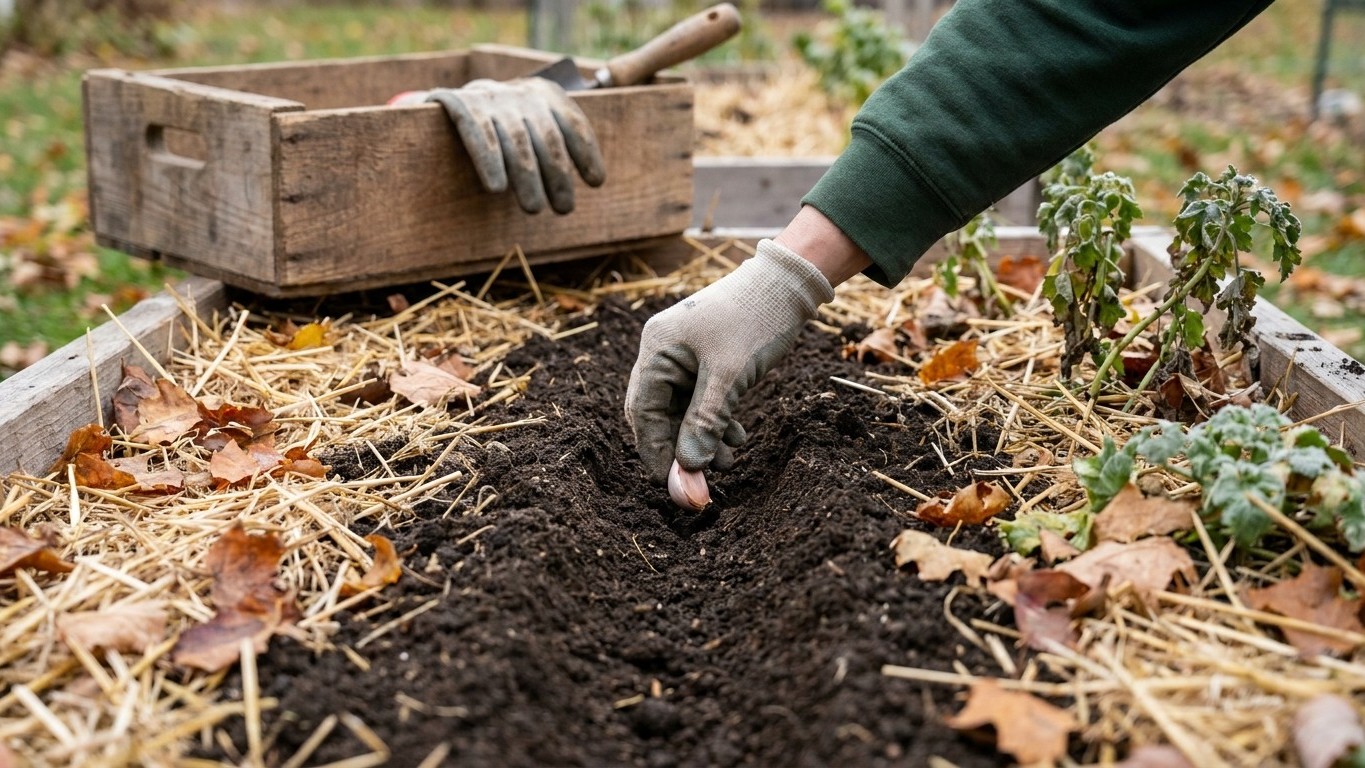
That makes direct-sown vegetables a non-starter this month across nearly all of South Dakota. But there’s still real work for the ground itself. In the southern tier and in any bed where the soil hasn’t locked up yet, garlic cloves and shallot bulbs can still go in, pointed end up, four inches deep, under a thick mulch layer. Planted this late, they won’t sprout until spring, but they need the cold exposure to form proper bulbs.
Cold frames and low tunnels extend the season for crops already established, not for new sowings. Spinach, mache, and claytonia that went in during late summer will keep producing slowly under cover even as outdoor beds freeze. Bare-root fruit trees, roses, and dormant shrubs can still be planted wherever a shovel goes into the ground without a fight, since dormant roots settle in without needing warm soil to grow. Indoors, this is also the month to force rhubarb crowns or chicory roots in a dark, cool space for an early harvest of tender shoots weeks ahead of anything the garden could produce.
What to start under cover
Seed-starting math in South Dakota usually runs backward from the last spring frost window of April 29 to May 9. Most warm-season transplants, tomatoes, peppers, and the like, get counted back six to eight weeks from that window, which lands in March. Onions and leeks, started ten to twelve weeks ahead, land in late January or early February. November falls well outside that arithmetic. Starting summer vegetable seed now guarantees rootbound, leggy plants sitting under grow lights for four extra months before the soil is warm enough to take them.
What does make sense under cover in November is anything counted backward from a bloom date instead of a frost date. Paperwhite narcissus bulbs planted in shallow bowls of gravel and water typically bloom four to six weeks after planting, so setting them now targets flowers by midwinter. Amaryllis bulbs run six to eight weeks from planting to bloom. Hyacinths and tulips destined for forced indoor bloom need eight to twelve weeks of cold storage first, so bulbs chilled now come into flower by late winter.
Microgreens and sprouts are the other honest answer. Sown in trays under a sunny window or basic grow light, radish, pea shoot, and sunflower microgreens are ready to cut in seven to fourteen days, giving fresh greens on a rolling cycle all winter regardless of what’s happening outside. The failure mode to watch for isn’t starting too late this month, it’s starting food-crop seed too early for spring transplant, which wastes both seed and shelf space before the soil is anywhere near ready.
What is ready to pick
Outdoors, harvest is mostly finished. Anything left unprotected in the open garden after the first fall frost has likely already been damaged by cold, particularly tender crops like tomatoes, squash vines, and basil. But a few things still hold on. Kale, Brussels sprouts, and leeks that were left in the ground often improve after frost, since cold converts stored starches to sugars and sweetens the flavor. These can be dug or cut right up until the ground freezes hard enough to stop a shovel, sometimes later if there’s an insulating layer of snow.
Cold-frame greens, spinach, arugula, mache, keep producing small but usable leaves through the month, just at a much slower rate than summer growth. Indoors, sprouts and microgreens are the most reliable fresh food source, ready on a continuous cycle in a matter of days.
The other job this month is checking storage, not the garden. Winter squash, potatoes, and onions put up earlier in fall need a weekly look. A soft spot on a squash, a sprouting potato, or an onion with a wet neck means that item gets used or composted immediately, since one rotting piece in storage spreads to its neighbors fast. Storage rooms should stay cool, dark, and reasonably dry; squash prefers slightly warmer and drier conditions than potatoes and onions, so separating them if possible saves losses.
The jobs that matter this month

In the garden and orchard
Dormant pruning of fruit trees and cane fruits like raspberries can begin once leaves have fully dropped and the plant is truly dormant, not just cold-stunned. Pruning too early, while sap is still moving, invites dieback at the cut. November is also the window for wrapping young tree trunks against rabbit and rodent gnawing, a real risk once snow cover pushes hungry animals toward bark as a food source. Mulching perennial beds and newly planted garlic pays off now specifically because the goal is insulating already-cold soil, not warming it, so mulch goes down after a hard freeze rather than before.
In the shed and on paper
Seed catalogs are already circulating, and ordering early matters because popular varieties, particularly regionally adapted ones bred for a short season, do sell out before spring. This is also the natural point to sketch next year’s rotation plan while the current season’s successes and failures are still fresh, rather than trying to reconstruct it from memory in March. Soil testing can be done now through a lab or the local extension office, and results come back in time to plan amendments before spring planting. Turning finished compost, cleaning pruners and shovels with a wire brush, and sharpening blades all take an afternoon and save frustration when the ground opens up again. Fencing and raised bed frames are easier to repair now, before snow buries the damage, than in the scramble of early spring.
What not to do in November
The most common mistake this month is misreading a mild afternoon as a sign the season isn’t really over. A 55°F day in early November doesn’t mean warm-season crops or grass seed will take; soil temperature lags air temperature by days, and a planting decision based on how the air feels usually ends with rot or a wasted bag of seed.
Uncovering cold frames or removing mulch during a warm spell is another frequent error. Plants that have hardened off for winter can be shocked by a sudden return to cold once they’ve been exposed, and new growth pushed out by a few warm days often dies back hard on the next freeze, weakening the plant more than if it had been left alone.
Fertilizing with nitrogen this late does more harm than good. Nitrogen encourages soft, leafy new growth exactly when a plant should be shutting that growth down and hardening its tissues for winter. Any feeding this month, if it happens at all, should be limited to phosphorus and potassium sources that support root development, not top growth.
Leaving root vegetables in the ground past a hard, sustained freeze is a smaller but real mistake too. Light frost sweetens carrots and parsnips; a deep freeze that penetrates the whole root can turn them mushy and unusable once thawed, so watching the forecast and pulling the last of a root crop before a serious cold snap protects the harvest.
Checking this against your own county
Everything above is a state-wide starting point, not a fixed instruction for any one yard. South Dakota’s elevation changes, the moderating effect near the Missouri River, and the plain difference between the state’s northern and southern counties can shift both frost windows by two weeks or more in either direction. A garden in the Black Hills or in a low frost pocket will see conditions that don’t match a garden near the state’s southeastern border. Hardiness zones across the state range from 3b to 5b under the USDA system, which is based only on extreme minimum winter temperature, not on frost timing. Before making a planting decision, check current conditions and local guidance through South Dakota State University Extension.
Common questions
Can I still plant garlic in South Dakota in November?
Yes, as long as the soil hasn’t frozen solid. Garlic planted this late still needs a period of cold exposure to bulb properly, so a late planting under thick mulch generally still works, though it’s safer to plant it in October where possible.
Is it too late to plant grass seed in November in South Dakota?
For germination and establishment, yes. Grass seed needs consistently warmer soil than November provides across most of the state. Dormant seeding, where seed is scattered on frozen ground to germinate naturally in spring, is a different technique and can work, but it’s not the same as expecting a fall lawn to fill in this month.
What vegetables survive winter in South Dakota gardens?
Kale, leeks, and Brussels sprouts left in the ground often survive light freezes and even improve in flavor. Under a cold frame or low tunnel, spinach, mache, and arugula can keep producing small harvests well into the month.
When should I start seeds indoors for South Dakota’s growing season?
Most warm-season transplants are started six to eight weeks before the last spring frost window of April 29 to May 9, putting that work in March. Onions and leeks, needing more lead time, are typically started ten to twelve weeks out, in late January or early February. November is too early for either.
Gardeners who plant by the Moon can check the November 2026 moon planting calendar, a tradition rather than a proven method.
Related guides
Elsewhere? See what to plant in November in every state and province.