
October in South Dakota lands after the first fall frost window at the reference station (September 24 to October 4), so the answer is short: garlic and shallots go in, cold frames and low tunnels extend a few hardy greens, and everything else outdoors is done for the season. The real work this month happens under cover, in storage, and with pruning shears.
What goes in the ground in October

The mechanism that matters here isn’t the calendar, it’s soil temperature and the freeze line moving down through the ground. At the reference weather station used for South Dakota (USW00014944), the first fall freeze arrives somewhere between September 24 and October 4 in a typical year. By October, that threshold has already passed for most of the state, which means the open-ground planting window for anything tender is closed. Say that plainly: this is not the month to direct-sow lettuce, peas, or spinach and expect a harvest.
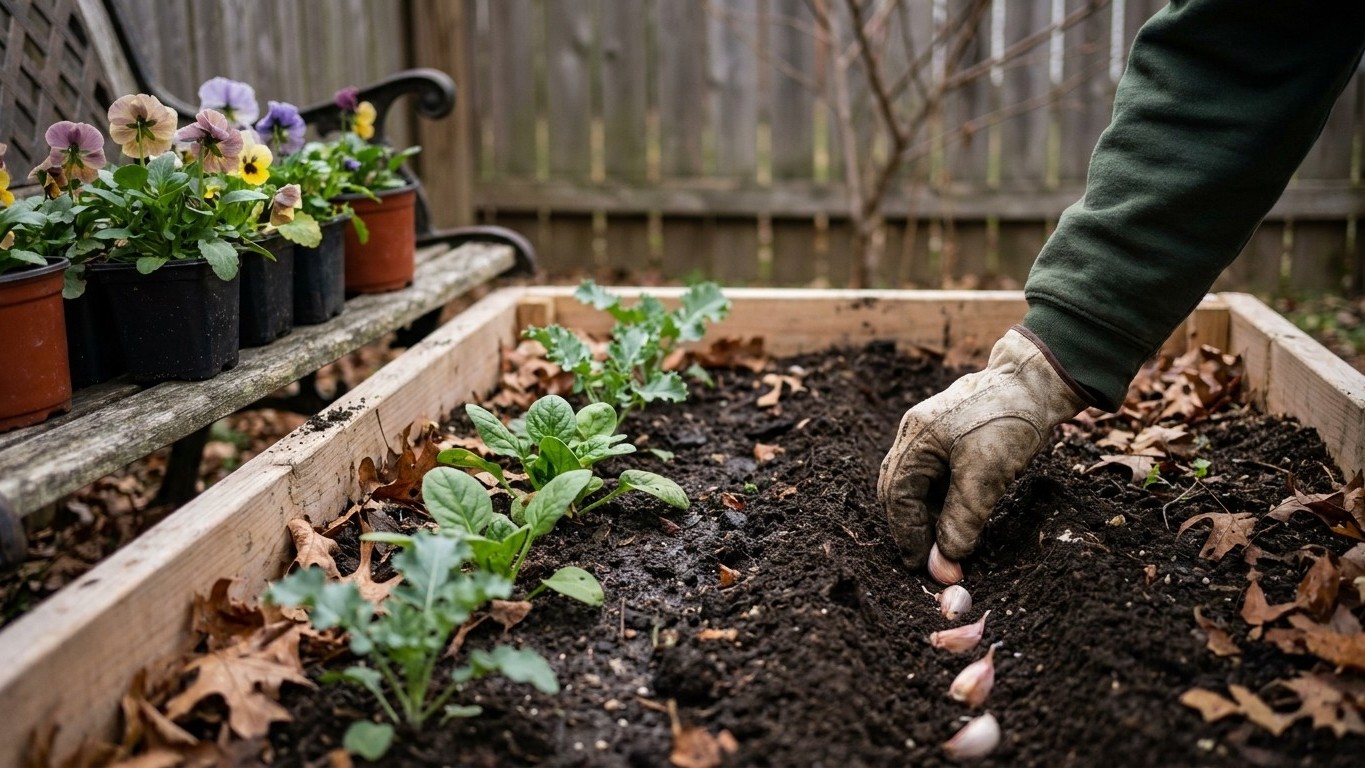
What still works is garlic and shallots. Both want six to eight weeks of root growth before the ground freezes solid, and they’re planted precisely because they tolerate hard freezes once established, going dormant through winter and pushing up again in spring. Push individual cloves or bulbs root-down, two inches deep, into loosened soil, and mulch heavily with straw once the ground has cooled but before it locks up. That mulch layer is what protects the root systems through the coldest stretch.
Cold frames and low tunnels buy a little more time for the toughest greens: spinach, mache, and claytonia can be started under cover this month and will often carry through winter with minimal fuss, especially in the milder eastern counties. Bare-root fruit trees, roses, and perennials also go in during dormant fall planting windows in regions where the ground stays workable, though in much of South Dakota that window is narrowing fast by mid-month.
A few less obvious options round out the list. Forcing rhubarb or chicory indoors, using dug roots kept dark and cool, gives a harvest of tender stalks or chicons through the darkest months without needing garden soil at all. None of this replaces a summer harvest, but it’s real food from real plants, and it’s honest about what October actually allows.
What to start under cover
Counting backward from a frost date that’s already behind you changes the math. Instead of asking “how many weeks until it’s safe to plant outside,” the question becomes “how many weeks of usable light and warmth are left indoors or under glass before winter dark sets in.” That’s a shorter, blunter calculation, and it rules out anything meant for eventual outdoor transplant.
What still makes sense: microgreens and sprouts on a windowsill or under a grow light, which finish in one to three weeks and don’t care that it’s dark and cold outside. Herbs like chives, parsley, and basil can be potted up from the garden before a killing frost and moved indoors, giving a few more weeks or months of fresh cuttings. Some gardeners start a second round of leafy greens in trays under cover purely for microgreen-stage harvest, never intending full-size heads.
The two failure modes both come from applying a spring mindset to a fall month. Starting slow-growing crops now, expecting to transplant them outdoors later, wastes light and space because there’s no outdoor window left to receive them: they’ll sit rootbound and leggy with nowhere to go. The opposite mistake is waiting too long to start anything under cover at all, assuming the season is simply over, and missing out on months of indoor greens that cost almost nothing to grow. October under cover is about matching the crop’s speed to the light you actually have left, not to a transplant date that no longer applies.
What is ready to pick
Outdoors, October offers little in most of South Dakota once the first freeze has passed through, and it’s honest to say so rather than pad the list. What survives a light frost and keeps producing is narrow: kale and leeks, both of which improve in flavor after cold exposure, can stay in the ground under a layer of mulch or row cover and be pulled as needed well into the colder weeks. Brussels sprouts, if they were planted in summer, often hold on the stalk through several frosts.
Cold-frame greens started earlier in the season, spinach and mache especially, can be harvested a few leaves at a time without pulling the whole plant, which stretches a small planting across weeks. Indoors, sprouts and microgreens fill the gap for anyone wanting fresh, crisp food without relying on the garden at all.
The bigger job this month is checking what’s already in storage. Winter squash, potatoes, and onions all fail the same way: a soft spot, a sweet smell, or a shriveled patch on one squash or onion means it’s starting to break down, and it needs to be pulled and used before it spreads rot to its neighbors. Going through the root cellar or pantry shelf every week or two, turning each squash and feeling for soft spots, is a small habit that saves a much larger loss later in winter.
The jobs that matter this month

October carries more real deadlines than any harvest list suggests, and slipping on them costs the following season, not just this one.
Pruning, ordering, and soil work
Dormant pruning of fruit trees and berry canes can begin once leaves drop and the plant has gone fully dormant, and doing it now, rather than waiting for late winter, reduces the wound-healing stress on the tree going into the coldest months. Raspberry and blackberry canes that fruited this season should be cut back to make room for next year’s growth.
Ordering seed for next spring is a task that feels early but isn’t. Popular varieties, especially open-pollinated and heirloom types, sell out from seed catalogs well before spring planting season, and ordering now guarantees the varieties actually wanted instead of whatever’s left on the shelf. This is also the month to sketch out next season’s crop rotation while the current year’s layout is still fresh in memory, noting which beds grew tomatoes, brassicas, or legumes so the same family doesn’t repeat in the same soil.
Compost, tools, and structures
A soil test taken now, while the ground is still workable, gives time to add lime or amendments before spring without rushing. Turning the compost pile one more time before it freezes speeds up decomposition and keeps the pile from going anaerobic under snow. Cleaning and sharpening tools before they’re stored for winter, and checking raised beds, trellises, and fencing for rot or storm damage, are both jobs that take an afternoon now but take a full weekend to fix in spring after winter has made everything worse.
What not to do in October
The most common mistake this month is trusting the air temperature instead of the calendar of the freeze line. A warm, sunny afternoon in early October can feel like summer, but the ground has already cooled well below what warm-season crops need, and soil temperature, not air temperature, is what determines whether roots can function. Planting anything tender now, on the strength of one nice day, is a guaranteed loss.
A related error is uncovering cold frames or removing row covers during a mild stretch, assuming winter has backed off. One warm week doesn’t cancel the freeze that’s already moved through the region once, and pulling protection too early exposes tender greens to the next hard freeze with no buffer. Leave winter protection in place and vent it on warm days instead of removing it outright.
Feeding nitrogen at this point in the season is another classic misstep. Nitrogen pushes soft, leafy new growth, and on perennials, trees, and canes heading into dormancy, that new growth doesn’t have time to harden off before hard frost hits it, wasting the plant’s energy and increasing winter dieback. If soil needs amending, this is the month for phosphorus, potassium, or a soil test to guide lime application, not a nitrogen-heavy feed. Garlic is the one exception where a light, balanced starter can help root establishment, but even that should be modest.
Checking this against your own county
Everything above is a state-wide starting point, not a instruction specific to any one yard. South Dakota’s hardiness zones run from 3b to 5b under the USDA Plant Hardiness Zone Map, and that range alone signals how much elevation, latitude, and local terrain shift these windows. A garden in the Black Hills or a low-lying spot that collects cold air will see frost days, sometimes weeks, earlier than a garden in a warmer eastern river valley, and the reference-station frost dates cited here won’t match either exactly.
For a planting calendar tuned to local conditions, the South Dakota State University Extension is the direct source to check before finalizing any fall planting decision.
Common questions
Is it too late to plant garlic in October in South Dakota?
No, October is generally the right window for garlic across most of the state, as long as the ground is still workable and cloves get six to eight weeks before the ground freezes solid. Mulch heavily right after planting to protect against early hard freezes.
Can I still start a fall vegetable garden in October?
Not outdoors in open ground for most of South Dakota, since the first fall frost typically arrives between September 24 and October 4 at the reference station. Cold frames, low tunnels, and indoor microgreens are the realistic options this month.
Should I prune fruit trees in October?
Once trees have dropped their leaves and gone fully dormant, light structural pruning is fine and often preferable to waiting until late winter, since it reduces stress going into the coldest months. Avoid heavy pruning before full dormancy.
Why do frost dates vary so much within South Dakota?
Elevation, latitude, and local terrain all shift the freeze line by a week or more in either direction from the reference-station dates cited here. Low-lying areas that trap cold air and higher-elevation regions like the Black Hills both tend to see frost earlier than the state’s river valleys.
Gardeners who plant by the Moon can check the October 2026 moon planting calendar, a tradition rather than a proven method.
Related guides
- the South Dakota planting calendar
- What to Plant in South Dakota in September
- What to Plant in South Dakota in November
Elsewhere? See what to plant in October in every state and province.