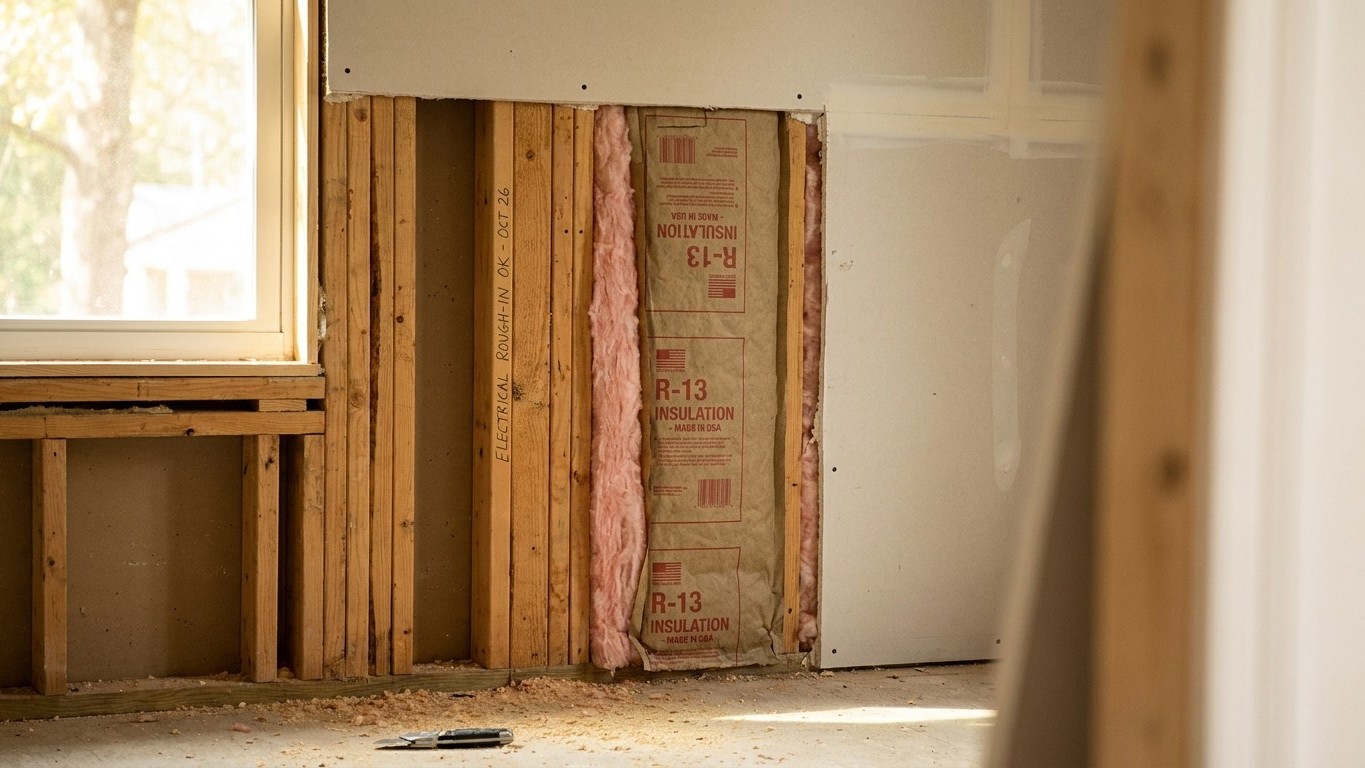

Yes. Under the National Building Code of Canada, a vapour barrier is required in insulated wall assemblies throughout Manitoba, and the requirement carries no climate-zone exception the way American code does. The material must have a water vapour permeance of at most 60 ng/(Pa·s·m2), placed near the warm-in-winter side of the wall. Manitoba’s cold winters, measured in heating degree days, are exactly why this rule exists here.
What the code asks for in Manitoba

The National Building Code of Canada answers this directly, and Manitoba doesn’t get an exemption. Part 9, Article 9.25.4 requires a vapour barrier in insulated assemblies, and it caps the material’s water vapour permeance at 60 ng/(Pa·s·m2). Sentence 9.25.4.3.(2) adds a positioning rule: the barrier has to sit close enough to the warm side of the assembly that condensation doesn’t occur at design conditions, no matter what other low-permeance materials the wall contains or where they happen to sit.
Here’s the part that trips up anyone who’s read about American building code first. The U.S. model code drops the vapour retarder requirement entirely in its three warmest climate zones. The National Building Code doesn’t do that. There’s no clause anywhere in Part 9 that says a Manitoba wall in some milder pocket of the province gets a pass. The requirement applies coast to coast, prairie to mountain, and Manitoba sits inside that blanket rule the same as every other province.
That said, “warm side” needs a precise definition or it gets misread. It means the side that’s warm in winter, which in almost every Manitoba house is the interior. Someone thinking about July heat will place the barrier backwards, and a wall built backwards doesn’t announce the mistake. It just sits there, quietly trapping moisture against cold sheathing every winter until the damage shows up as a soft spot, a musty smell, or a contractor’s flashlight finding black-stained studs behind the drywall.
Why this page can’t tell you what to install
The National Building Code is a model. Provinces adopt it, and some amend it, which means the code actually enforced in your municipality may differ in the fine print from the version summarized here. This page can give you the rule and explain what it depends on. It can’t tell you what to put in your own wall, because that answer belongs to whoever administers the building code in your specific jurisdiction. A wall built with the wrong vapour control doesn’t fail visibly at the time. It rots from the inside, and the owner usually finds out years later, when the fix costs far more than getting it right the first time would have.
Why the answer is the opposite in a warm climate
The reason Manitoba’s rule looks so different from what you’d read on a page written for Florida or Arizona isn’t bureaucratic inconsistency. It’s physics, and it’s about which direction the moisture is actually traveling.
In a cold climate like Manitoba’s, warm, damp household air sits on the inside of the wall all winter. That air wants to move toward the cold, dry exterior, carrying water vapour with it. If nothing stops it, that vapour reaches the cold sheathing, cools below its dew point, and condenses right inside the wall cavity. The vapour barrier’s job is to intercept that moisture near the warm side before it ever gets that far.
Flip the climate and the whole logic reverses. In a warm, humid region, the damp air is outside, pushing inward against air conditioning that keeps the interior cool and dry. Put an impermeable layer on the interior side of that wall and you’ve just built the coldest surface inside the assembly, right where the incoming humid air will hit it and condense. The U.S. Department of Energy describes what happens next in blunt terms: it results in “ruined Insulation, mould, and rot of structural members.”
That single sentence explains why vapour control rules split by climate zone rather than applying uniformly. It isn’t that one region’s code writers are stricter than another’s. It’s that the water is traveling in opposite directions depending on where you live, and a barrier placed to stop winter condensation in Manitoba would actively cause summer condensation in a humid southern climate. The National Building Code’s decision to apply the requirement everywhere in Canada reflects the fact that almost the entire country deals with the cold-climate version of this problem. There’s no equivalent stretch of Canadian territory where the warm-climate mechanism dominates the way it does across the U.S. Gulf Coast.
The three classes, and why the word matters
Vapour control materials aren’t a single category. They’re graded by how much moisture they let through, measured in perms, and the class matters more than whether a barrier is present at all.
| Class | Example materials | Permeance range |
|---|---|---|
| Class I | Polyethylene sheet, foil-faced materials | ≤ 0.1 perm |
| Class II | Kraft-faced batt insulation, certain coated papers | > 0.1 and ≤ 1.0 perm |
| Class III | Latex paint, standard drywall with primer | > 1.0 and ≤ 10.0 perm |
Notice that polyethylene sheeting only qualifies as a vapour barrier because it’s Class I, well under the 60 ng/(Pa·s·m2) threshold the National Building Code sets. Calling any plastic sheet “a vapour barrier” without noting its class skips the entire point of the regulation. The disagreement between a builder working in Manitoba’s cold-climate context and one working somewhere with a different assembly isn’t about whether to include a vapour barrier at all. It’s about which class belongs where, and that distinction is the whole conversation.
Most Manitoba homeowners already have a Class III vapour retarder on their walls and don’t know it. Ordinary latex paint falls into that range, which means every painted interior wall is doing some vapour control work, just not enough on its own to satisfy the code’s requirement for the primary barrier in an insulated assembly.
One more distinction worth keeping straight: a vapour retarder and an air barrier are not the same thing. One controls water vapour diffusing through a material; the other stops bulk air movement carrying moisture with it. Sometimes a single product does both jobs. Often it doesn’t, and confusing the two leads to gaps in protection that neither material was designed to cover.
Where the rule stops
The National Building Code’s vapour barrier requirement doesn’t apply to every assembly in a house. Three situations sit outside it:
- Basement walls
- The below-grade portion of any wall
- Construction where moisture won’t damage the materials involved
The basement exception is the one most Manitoba homeowners actually run into, because it contradicts the intuition built up from above-grade walls. A poured concrete foundation wall holds moisture and releases it slowly, sometimes over years, as groundwater migrates through the material and evaporates on the interior face. If you seal that wall with an impermeable barrier the way you would an above-grade stud wall, the moisture has nowhere to go. It gets trapped between the concrete and the barrier, and that trapped moisture is exactly what feeds mould growth and deteriorates whatever insulation sits against it.
Basement assemblies need to be able to dry inward, at least partially, which changes the entire vapour control strategy compared to a wall above grade. This site’s basement wall guide walks through how that assembly differs in more detail, since the mechanics don’t map cleanly onto the above-grade rule described here.
The third exception, construction where moisture won’t damage the materials, is narrower than it sounds. It doesn’t open a general loophole. It covers assemblies built from materials that simply don’t degrade from moisture exposure the way wood framing and standard insulation do, which is a small slice of residential construction, not a common workaround.
Who actually decides, in Manitoba
The National Building Code sets the model, but the code actually enforced on your street is whatever your province adopted, possibly with amendments, and administered by your local building department. That’s the office with the authority to answer for your specific house, not this page and not the model code text itself.
This distinction carries more weight in Manitoba than in milder parts of the country, because of how much winter the province actually deals with. At Winnipeg Richardson International Airport, the reference station for this region, the area logs roughly 5,648 heating degree days below 18 C every year, a figure that places it in NRCan climate zone 7a. Heating degree days measure demand for heat, not a temperature reading, and a number that size means a Manitoba home is fighting a much larger, longer heating load each winter than most of the country. That sustained demand is precisely the condition the vapour barrier requirement is built to address: warm, moisture-laden air pressing outward against cold sheathing for months at a stretch.
None of that changes the basic advice, though. Confirm the specific code edition and any local amendments with your municipal building department before you build or renovate, rather than relying on the model code’s general language. The consequence of skipping that step doesn’t show up on move-in day. It shows up years later, in a wall cavity nobody’s opened yet.