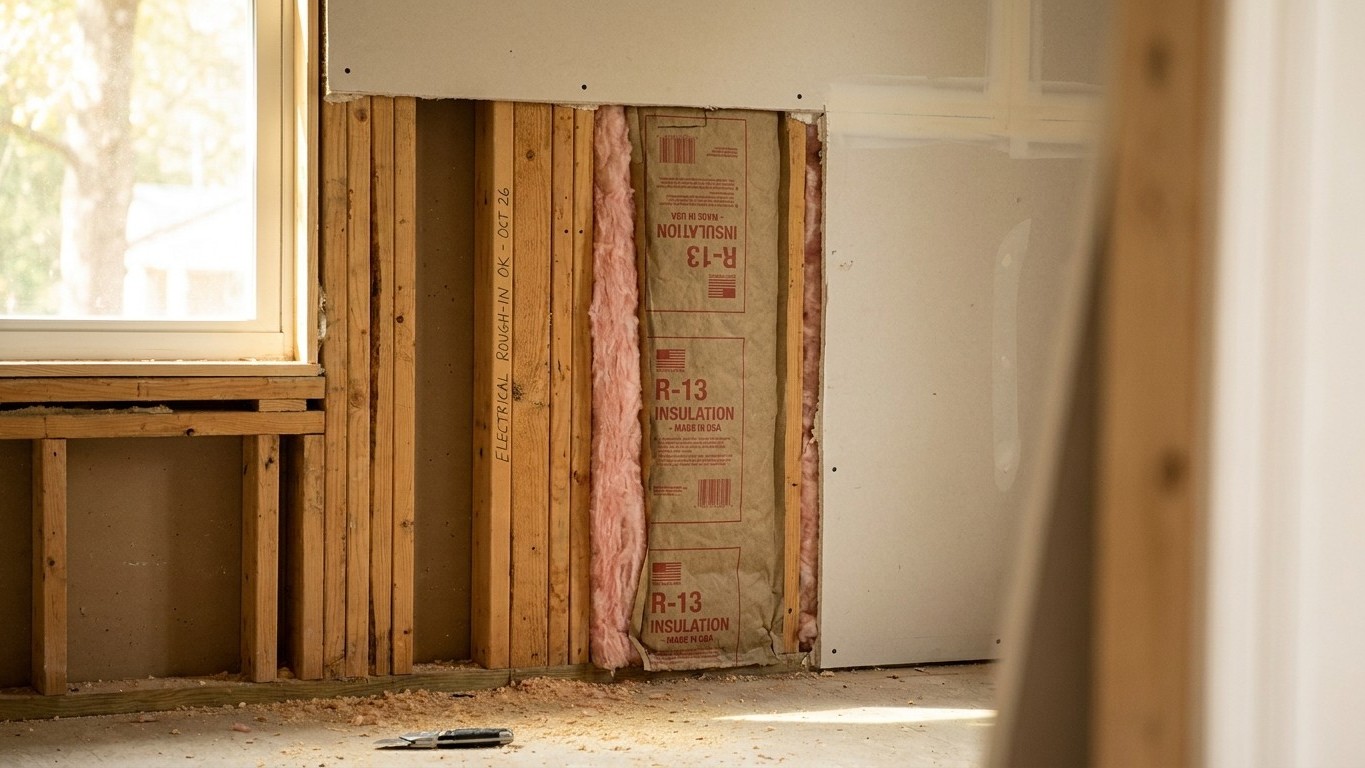

The 2021 International Residential Code answers this directly at R702.7: a vapor retarder is required on the interior side of frame walls, at a class set by Table R702.7(2), unless the wall sits in Climate Zone 1, 2 or 3. Nevada’s 17 counties split across three zones, so the state has no single answer: one county is exempt, sixteen are not.
What the code asks for in Nevada

Section R702.7 of the 2021 IRC states plainly that a vapor retarder of the class listed in Table R702.7(2) “shall be provided on the interior side of frame walls,” then carves out four exceptions, one of which removes the obligation entirely for Climate Zones 1, 2 and 3. Nevada’s county map, as classified under the 2021 International Energy Conservation Code, breaks down as 9 counties in Zone 5B, 7 counties in Zone 4B, and 1 county in Zone 3B.
That single 3B county falls inside the exception. A wall built there, under the base code, does not carry the R702.7 obligation to install an interior vapor retarder. The other sixteen counties, split between 4B and 5B, sit outside the exception list. Table R702.7(2) applies to them the same way it applies in Minnesota or Maine: a retarder of the specified class is called for on the interior side of the frame wall.
That is a striking split for one state. A homeowner in the 3B county and a homeowner two counties over in 4B are building under two different rules, even though both are pouring concrete and framing 2×6 walls under the same statewide adoption of the IRC. Neither rule is stricter or looser in some general sense, they answer to a different climate.
Not required is not forbidden
The exception for Zones 1, 2 and 3 removes an obligation. It does not prohibit a vapor retarder in that 3B county, and nothing in R702.7 makes one illegal there. What changes is whether an inspector can cite its absence. In practice, builders in exempt zones often still use a Class II or Class III product for other reasons, paint alone can double as a retarder, as the next section explains, so “not required” rarely means “not present” on site.
None of this tells an individual reader what to put in their own wall. The rule depends on which zone a given parcel sits in, and the county-level determination is not something to guess from a state average. The next step, covered in the last section, is the local building department, because the adopted code and any amendments are theirs to confirm.
Why the answer is the opposite in a warm climate
The split isn’t arbitrary paperwork. It tracks the direction water vapor is moving through the wall, and that direction reverses between a cold winter and a hot, humid summer.
In a cold climate, the warm, moisture-laden air sits inside the house all winter. Without a retarder, that vapor drifts through the wall cavity toward the cold sheathing, condenses there, and soaks the insulation and framing from within. A Class I or Class II retarder on the interior side stops the vapor before it reaches that cold surface. That’s the logic behind Nevada’s 4B and 5B counties carrying the requirement.
Flip the climate and the physics flips with it. In a warm, humid environment, the moisture is arriving from outside, driven inward by heat and humidity, while the interior stays cooler thanks to air conditioning. An impermeable layer on the interior side of the wall, the very thing that protects a cold-climate wall, becomes the cool surface where that incoming vapor condenses. The U.S. Department of Energy’s Building America program describes exactly this failure: “If the wall contains a vapor retarder on the interior side of the insulation, the water vapor will condense on this cool, impermeable surface,” a mechanism that produces “ruined insulation, mold, and structural rot of framing members.”
That sentence is the reason the code writes different rules for different zones. It isn’t bureaucratic inconsistency, it’s water tracking heat and humidity in opposite directions depending on the season and the region. Nevada’s single 3B county doesn’t carry the requirement because forcing an interior retarder there could recreate the same condensation trap the DOE describes, at least in principle, even though 3B is a dry-summer zone rather than the warm-humid zones the DOE example targets most directly. The letter after the zone number (moist, dry, or marine) shapes how severe that risk actually is, which is exactly why the code exception is written by zone number rather than by a single continent-wide rule.
The three classes, and why the word matters
Table R702.7(2) doesn’t just say “install a vapor retarder.” It sorts retarders into three classes by how much moisture they let through, measured in perms, and the class assigned to a wall depends on the climate zone and the wall assembly.
| Class | Example materials | Perm rating |
|---|---|---|
| Class I | Sheet polyethylene, nonperforated aluminum foil | 0.1 perm or less |
| Class II | Kraft-faced fiberglass batts, vapor retarder paint | Above 0.1 up to 1.0 perm |
| Class III | Latex or enamel paint | Above 1.0 up to 10.0 perm |
This is the detail that ends most kitchen-table arguments about vapor barriers. Sheet polyethylene is not “a vapor barrier” in some generic sense, it’s specifically a Class I material, the tightest of the three. A builder who insists on poly in a wall assembly where Table R702.7(2) calls for Class II or III has installed the wrong class, not simply “extra protection.” The whole disagreement between two builders in different zones is almost always a disagreement about class, not about whether a retarder belongs in the wall at all.
Class III deserves a second look because most homeowners already own one without knowing it. Ordinary latex or enamel paint, the kind on nearly every interior wall in the country, falls squarely in the Class III range. That means many walls already carry some vapor retarding function from their finish coat alone, long before anyone installed a dedicated sheet product.
One distinction is worth holding onto separately: a vapor retarder controls the diffusion of water vapor through a material. An air barrier stops bulk air movement, and air movement carries far more moisture than diffusion ever does. The two jobs are different, and a single product, like a taped sheathing membrane, sometimes does both. Confusing the two is common and it’s worth naming once and moving on.
Where the rule stops
R702.7 lists four exceptions to the interior vapor retarder requirement, and Nevada’s zone-based split is only one of them.
- Basement walls
- The below-grade portion of any wall
- Construction where accumulation, condensation, or freezing of moisture will not damage the materials
- Climate Zones 1, 2 and 3 (the exception that governs Nevada’s 3B county)
The basement exception is the one most readers actually run into, usually while finishing a basement. A poured concrete wall behaves nothing like a framed wall above grade. It holds groundwater moisture for years and releases it slowly, in both directions, long after the concrete has cured. If an interior vapor retarder is sealed against that concrete, moisture that would otherwise dry inward gets trapped between the concrete and the retarder, with nowhere to go. That’s a setup for the same rot and mold the DOE describes above grade, just triggered by groundwater instead of humid outdoor air. This site’s basement wall guide covers that assembly in more detail for anyone planning a finished basement in either a 4B or 5B county.
The third exception, for assemblies where moisture accumulation won’t damage the materials, covers cases like certain masonry or mass-wall constructions that don’t rely on the same cavity insulation logic as a stick-framed wall. It’s a narrower carve-out than the zone exception, and it depends on the specific assembly rather than the county.
Who actually decides, in Nevada
None of the above substitutes for a call to the local building department. The 2021 IRC is a model code, and each Nevada jurisdiction adopts, and sometimes amends, its own edition and its own local requirements. The code in force on a given parcel is the one the county or city has adopted, not automatically the current model code edition, and that’s the office with the authority to say which class of retarder, if any, applies to a specific permit.
This matters more in Nevada than in a state that sits in a single zone. Las Vegas McCarran Airport, a reference point for the southern part of the state, logs about 1,836 heating degree days a year against roughly 3,720 cooling degree days, a ratio that shows a heating season that exists but stays modest next to a long, demanding cooling season. Degree days measure heating and cooling demand accumulated over the year, not a single temperature, and they help explain why the southern part of the state can sit in a warmer zone than the counties toward the north and at higher elevation, where the heating load runs considerably heavier.
A wall assembled with the wrong class of vapor retarder for its zone doesn’t announce the mistake. Nothing looks wrong on move-in day. The moisture accumulates behind the wallboard, unseen, and the damage, soaked insulation, mold, framing rot, surfaces years later, usually during a remodel or a mold inspection, long after the builder has moved on to the next job. Confirming the adopted code and its local amendments before framing starts is the only way to avoid finding that out the hard way.