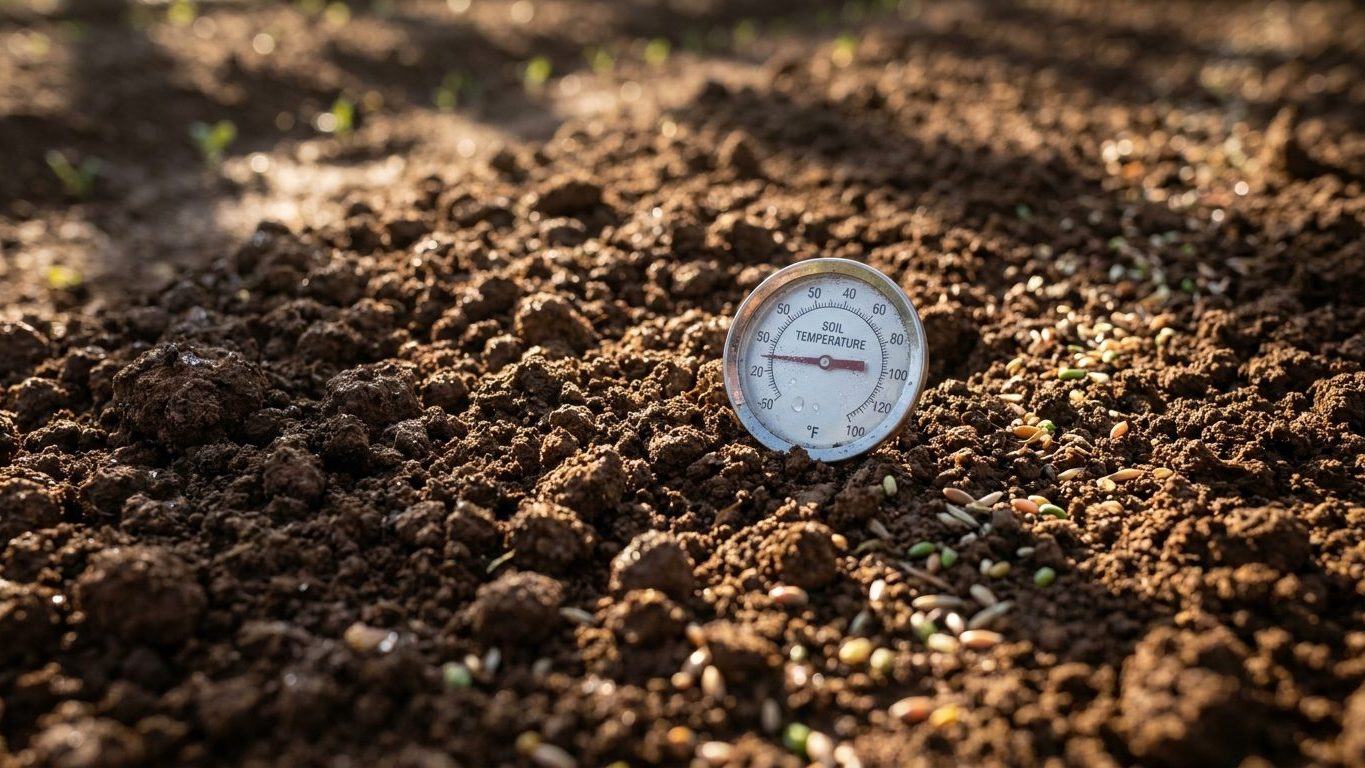

Cover crops go into Tennessee gardens twice a year: a late-summer or fall sowing that protects and feeds bare beds through winter, and sometimes a shoulder-season planting before spring vegetables go in. The right window depends less on the calendar than on soil temperature and how much frost-free time is left before the ground locks up. Tennessee spans three USDA hardiness zones, so the answer shifts depending on where in the state you garden.
When the soil is warm enough in Tennessee
Ask five gardeners in Tennessee when to plant cover crops and you’ll get five different dates, because most of them are answering the wrong question. The real trigger isn’t the calendar, it’s soil temperature, and soil temperature lags behind air temperature by days to weeks. That’s why the last spring frost date matters here only as a proxy, not as a planting instruction on its own.
For the Nashville reference station (NOAA station USW00013897), NOAA’s 1991-2020 Climate Normals put the last spring frost in the window between March 31 and April 12, based on the 30 to 70 percent probability band for a 32°F freeze. That’s a probability, not a promise: some years the last frost lands earlier, some years later, and the band exists precisely because no single date is safe to build a season around.
What happens on the ground is this: air temperature climbs out of frost range first, and soil temperature follows, several degrees behind and several days later. A cover crop sown in spring needs the soil itself warm enough to germinate, which in this territory usually means waiting past the tail end of that frost window rather than rushing in the moment the frost risk technically clears.
East Tennessee and the Cumberland Plateau complicate the picture. Both regions sit cooler and run later in spring than the Nashville station behind these normals, so a gardener in Knoxville or Crossville working off a Nashville date is working off the wrong reference point. Checking soil temperature directly with a simple probe beats trusting a date pulled from a station on the other side of the state.
How much seed to put down is a separate question, and this page won’t answer it with a number. Seeding rate depends on the species chosen, whether it’s broadcast or drilled, seed germination rate, and the purpose behind the planting, since a thick stand meant to smother weeds needs more seed than a thin nurse crop. A wrong rate wastes a season’s worth of effort and seed cost, so that figure belongs with University of Tennessee Extension, which calibrates its recommendations to the state’s soils and species mix.
Termination follows the same rule on this site: no herbicide recommendations, no product names. Cover crops in Tennessee gardens get terminated mechanically, by mowing, crimping, cutting, or letting a hard frost finish off a tender species on its own. That approach takes more labor than a spray program, but it keeps the bed usable for food crops without a chemical interval to wait out.
How long the season lasts here
Subtract one frost date from the other and you get the frost-free window, the span most vegetable growers think of as “the season.” Using the Nashville station’s 1991-2020 normals, the last spring frost falls between March 31 and April 12, and the first fall frost falls between October 28 and November 8. Depending on where in each band a given year lands, that puts the frost-free window somewhere around 200 to 220 days.
That’s a long season by national standards, and it matters more for cover crops than it might first appear. A window that wide means a bed isn’t just open for one planting; it’s open long enough to consider two.
The most common pattern here is a late-summer or early-fall cover crop, sown as soon as a vegetable bed clears, that grows through the cooling months and gets terminated the following spring ahead of the next food crop. But a window this long also supports a spring-sown cover crop on a bed that won’t be needed for vegetables until early summer, something gardeners in shorter-season states further north rarely have room for.
Whether a second sowing is worth it depends on what’s coming out of the ground and what’s going back in. A bed that finishes tomatoes in September still has months of usable window before frost; a bed that only frees up in late October doesn’t, and the fall cover crop becomes the only sowing that fits before winter. That staggering question, timing sowings against crops coming in and out of the same bed, is covered in more detail in the succession sowing guide on this site.
Season length also affects whether transplanting is worth the trouble. In a shorter window, gardeners often start seed indoors to buy extra growing time before frost. With 200-plus frost-free days on the Nashville normals, most gardeners here can direct-sow and still finish a cover crop’s cycle before winter, skipping the extra step and the root disturbance that comes with transplanting.
Heat and water in Tennessee
Summer heat and rainfall totals matter enormously for tomatoes, peppers, and anything else trying to set fruit through a Tennessee July. For cover crops, they matter far less than one number most gardeners never think about: the coldest month’s average low.
According to NOAA’s 1991-2020 Climate Normals for the Nashville reference station, the coldest month here averages a daily minimum of 30.1°F. That’s not the record low and it’s not the average for the whole month, it’s the mean overnight low, and it’s the figure that decides which cover crop species survive a Tennessee winter standing up and which ones don’t.
A mean low just above freezing puts Tennessee in an in-between zone for cover crops. It’s cold enough that tender species get knocked flat by a hard freeze, which is exactly what many gardeners want, since a plant that dies back into a mulch on its own saves a mowing or crimping pass in spring. But 30.1°F on average isn’t cold enough to reliably kill hardier species, which means some cover crops that winterkill conveniently further north simply keep growing here and need to be cut down by hand before spring planting.
The USDA places Tennessee across hardiness zones 5b through 8a, built on the average annual extreme minimum temperature. That’s a wide range for one state: a garden in the mountains of East Tennessee sits in a noticeably colder zone than one in the western part of the state near the Mississippi, and a species that winterkills reliably in one spot may overwinter and demand mechanical termination in the other.
The first fall frost date does the other half of the work. Falling between October 28 and November 8 on the Nashville normals, it sets the last realistic date to get a fall cover crop established with enough growth to survive winter and hold the soil. Sow too close to that date and the plant goes into winter small and shallow-rooted, with little of the erosion protection or biomass that’s the whole point of planting one.
None of this replaces a rain gauge or a thermometer in a specific garden. But for cover crop planning, the winter numbers, the coldest month’s low and the first fall frost date, do more work than any summer heat count could.
Which cover crops suit Tennessee
Given a mean winter low of 30.1°F and a hardiness range spanning zones 5b to 8a, Tennessee sits in a spot where cover crop choice is a real choice, not the foregone conclusion it is in much colder or much milder states.
| Type | Winter behavior in Tennessee | Primary role |
|---|---|---|
| Grasses (cereal rye, wheat, oats) | Ranges from reliably hardy (rye) to winterkill in cold pockets but surviving in mild ones (oats) | Erosion control, biomass, weed suppression |
| Legumes (crimson clover, hairy vetch, Austrian winter peas) | Some overwinter reliably; others winterkill depending on the local zone | Nitrogen fixation through root nodules |
| Brassicas (tillage or forage radish) | Least cold-hardy of the three; typically winterkills across most of the state | Compaction relief through a deep taproot |
Cereal rye tolerates cold reliably across nearly all of Tennessee’s zone range and usually needs mechanical termination, mowing or crimping, before it sets seed in spring. Oats sit at the opposite end: in a milder pocket of the state they can survive winter and turn into an unwanted spring weed, while in a colder pocket the same species winterkills cleanly and leaves a dead mulch that needs no termination at all. Same species, opposite outcome, depending on which side of that 5b to 8a range a garden falls on.
Legumes bring nitrogen into the system through their root nodules rather than from a bag. How much becomes available to the next crop depends on the species, how much biomass it built before termination, and the timing of that termination, not on a fixed number that applies everywhere in the state.
None of this substitutes for a variety trial done on Tennessee soil. Cultivar names aren’t listed here on purpose: a variety that performs well in a Kentucky or Georgia trial isn’t automatically the right pick for a Nashville backyard or a Knoxville hillside, and this page has no way of knowing which cultivars were tested locally this year. That information sits with University of Tennessee Extension, whose county offices track which varieties actually perform in the state’s specific soils and winters, plot by plot, year over year.