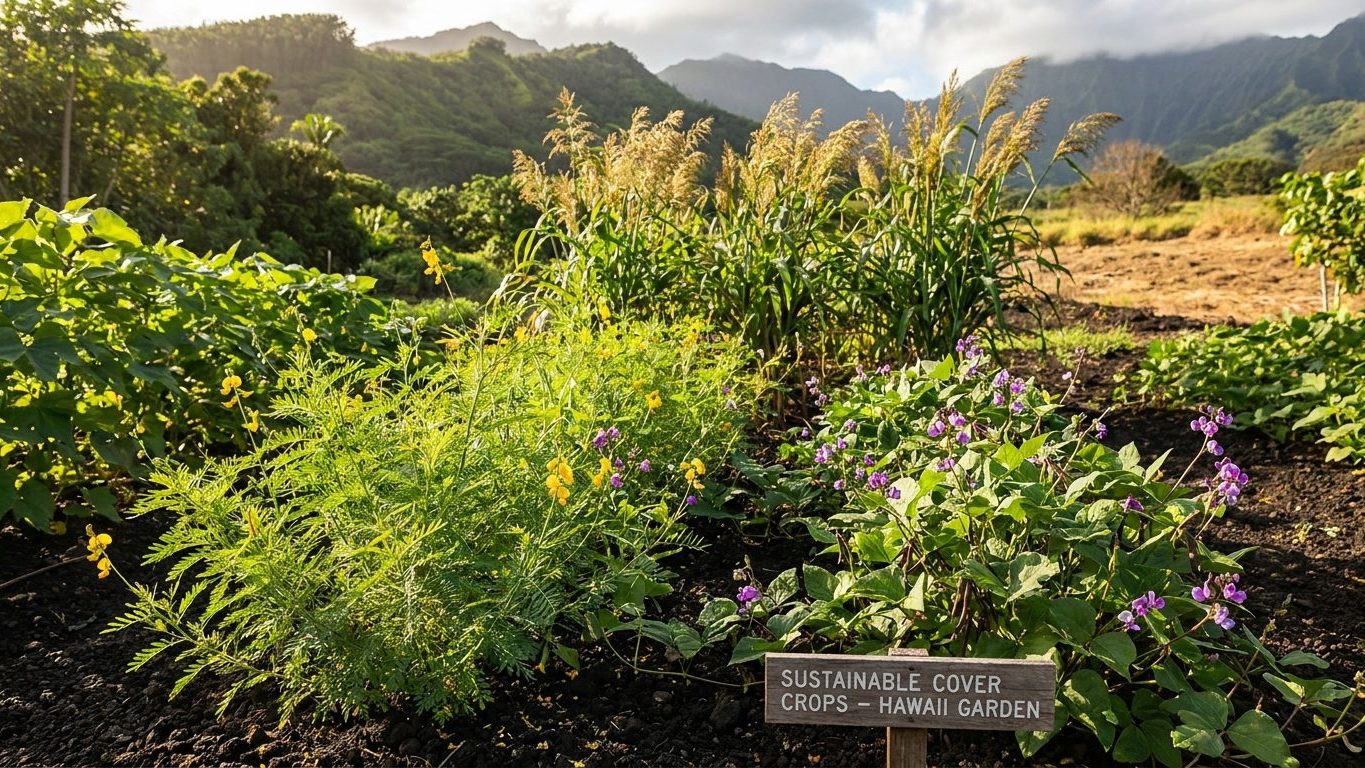

Tennessee’s frost-free window runs roughly 199 to 222 days depending on where you sit in the state, and that stretch decides everything. Cool-season legumes and small grains cover a winter fallow from October to April almost anywhere in the state, while warm-season covers like buckwheat and cowpeas fill a summer gap between spring and fall harvests without ever seeing frost.
The short answer for Tennessee
For a bed or field sitting empty over winter, crimson clover, hairy vetch, cereal rye, and winter peas are the safest statewide picks. For a gap between a spring harvest and a fall planting, buckwheat, cowpeas, and sorghum-sudangrass make better use of the long warm stretch this state gets between frosts.
That split comes straight from the numbers. The last spring frost in Tennessee falls somewhere between March 31 and April 12, and the first fall frost arrives between October 28 and November 8 (NOAA NCEI 1991-2020 Climate Normals, station USW00013897). Stack those against each other and you get a frost-free season of about 199 to 222 days, long enough to run a full warm-season cover crop through its whole cycle and still have time to establish a cool-season one before the ground freezes.
The winter side of that equation matters just as much. The coldest month at the Nashville reference station averages a daily minimum of 30.1°F, not a record low, but the figure that actually decides whether a plant survives the season here. That’s a mild number as far as winter cold goes, and it explains why crimson clover and hairy vetch, both rated hardy well below what this state typically delivers, come through a Tennessee winter without dying back to bare ground in most of the state.
Tennessee’s USDA hardiness zone spans 5b to 8a, a five-zone range for one state, which is wide enough that no single zone number describes the whole territory. The frost and cold-month figures above come from the Nashville station, so treat Nashville as the reference point for this recommendation rather than picking one zone to represent everywhere.
Put together, the type decision is simple: match the cover crop to the calendar gap you actually have. A winter fallow calls for a legume or small grain built to sit through a mild but real cold season. A summer gap calls for something that grows fast in heat and dies at the first real frost, doing its job and getting out of the way before fall planting.
What will not work here
Slow warm-season covers that need a long uninterrupted stretch of heat run into trouble at the cooler end of this state’s season. East Tennessee and the Cumberland Plateau run later into spring and cooler overall than the Nashville-area dates above, which shrinks the usable warm window well below the statewide 199-to-222-day figure. A cover crop that needs most of a full season to build real biomass may not finish before the first frost hits those higher, cooler pockets.
At the other end of the state’s zone range, winter-tender selections fail for the opposite reason. Tennessee’s hardiness zone stretches down to 5b in its coldest corners, and anything not genuinely hardy through a zone in that range shouldn’t be trusted as a true overwintering cover outside the warmest river-bottom sections. A legume rated hardy only to zone 7 or 8 may survive a mild year in the valley and still get wiped out the first time a colder-than-average winter reaches the plateau.
There’s a third failure mode that catches growers who plan on frost to do their termination work for them. In the warmest pockets of the state’s 8a range, western Tennessee’s river bottoms, the coldest month’s average low sits at 30.1°F, barely below freezing on paper and nowhere near the hard, sustained freeze that reliably kills back cereal rye or hairy vetch. Growers there who count on winterkill to clear the cover crop before spring planting often find it still green and growing, and end up needing a mowing, rolling, or herbicide pass instead of a free termination from the weather.
None of this means the plant list is short. It means the failures are predictable once you know which part of the state’s frost and cold numbers apply to your ground, and plan the termination method and maturity length around them rather than around a single statewide assumption.
What changes across Tennessee
A state that spans hardiness zones 5b through 8a isn’t one growing region wearing a single state name. That’s a five-zone spread, roughly the same range separating coastal Georgia from inland Ohio, packed inside one state’s borders.
At the cold, high end of that range, the Cumberland Plateau and the mountains of East Tennessee run cooler and later into spring than the rest of the state, per the caution attached to the frost-date data itself. Growers there should lean toward cool-season covers with genuine cold hardiness and toward warm-season covers with shorter maturity windows, since the usable frost-free stretch is real but shorter than the statewide figure suggests.
At the warm, low end, the river-bottom country of West Tennessee sits closer to zone 8a, with milder winters and a longer effective growing season on the warm-season side. The tradeoff there is the termination problem covered above: a milder winter means less reliance on frost to end a cover crop’s growth, so a mechanical or chemical termination plan matters more.
Neither this page nor any statewide guide can tell an individual reader which zone applies to their own yard or field. The USDA Plant Hardiness Zone Map, built from 1991-2020 temperature normals, is the tool for that, and it’s worth checking directly rather than assuming the state average applies to a specific address, especially near elevation changes or close to the plateau’s edge.
Where to check this for your own county
The University of Tennessee Institute of Agriculture Extension service is the state’s land-grant extension office, and its site is the right next stop: https://utia.tennessee.edu/extension/.
What to look for once there isn’t a general reading of the page but two specific things. First, a county-level planting calendar for cover crops, which will reflect the actual frost pattern of that county rather than the statewide range used on this page. Second, records of which cover crop varieties local agents have actually trialled in that county, since performance on the plateau and performance in the river bottoms can differ even within the same hardiness zone band.
A county-level recommendation from an extension agent who has watched a variety perform on local soil beats anything written at the state level, including this page. State data is useful for narrowing down the type of cover crop that fits the season length and cold pattern broadly, but it can’t account for a particular county’s soil drainage, local microclimate, or the specific varieties an agent has already tested against local pests and disease pressure. Treat this article as the starting filter, not the final word, and let the county office settle the details a statewide page simply doesn’t have.
Checking this against your own garden
Every date on this page is a probability drawn from thirty years of averages, not a promise about this particular year on this particular patch of ground. Three direct observations will tell a grower more than any calendar entry.
Soil warmth by feel comes first. Push a bare hand or finger a couple inches into the soil where a warm-season cover crop is headed. If it still feels cool or cold rather than comfortably mild, hold off on seeding buckwheat or cowpeas even if the calendar says the average frost date has passed, since a slow, cold spring can push real soil warm-up well past the statewide average.
Watch for the first bloom on an existing cover crop, particularly crimson clover or hairy vetch already in the ground. That first flush of flowers is the signal that soil temperatures have climbed enough to trigger reproduction, and it’s also the cue to terminate before the plant sets seed and turns into next year’s volunteer weed problem.
Look for the first true leaves on any newly emerged cover crop seedling, the leaves that appear after the initial seed leaves and actually resemble the mature plant. Their arrival confirms the stand has truly established rather than just sprouted, which matters most in a season that’s run cooler or wetter than usual and left a grower unsure whether the seeding actually took.