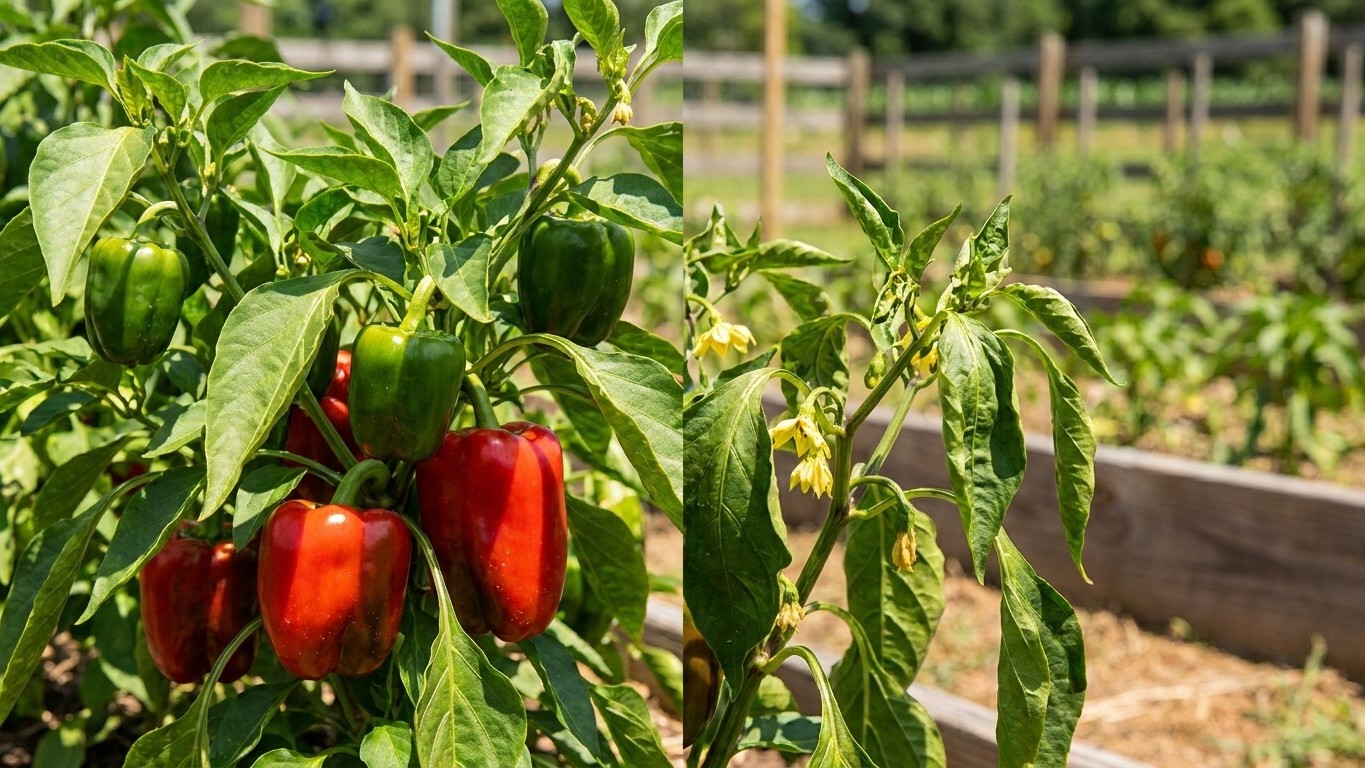

Tennessee peppers stall for two different reasons: heat that shuts down pollen at the top of summer, and cool nights that do the same thing in late spring and early fall. Nashville’s reference station logs 40 days a year at or above 90 F, enough to interrupt fruit set for weeks at a stretch. Timing your transplant around the state’s frost dates and watching your own nighttime lows matters as much as picking a variety.
The short answer

Forty days. That’s how many days a year the Nashville reference station sits at or above 90 F, based on NOAA NCEI’s 1991-2020 Climate Normals. Spread across a Tennessee summer, that’s roughly six weeks where afternoon heat can push pepper flowers to drop before they ever set fruit. Pepper pollen gets sluggish once daytime highs cross that 90 F line for several days running, and a plant that’s flowering hard in July can simply stop setting for a stretch, even while it keeps growing leaves and looking healthy.
That’s only half the equation. Pepper fruit set fails at the other end too, when nights drop below 55 F. That threshold matters most at the edges of the season, in the cooler stretches of April, May, September and October, when a string of chilly nights can stall a plant just as effectively as a heat wave does in mid-July. A grower who transplants too early into a cold spring, or who’s still hoping for a late fall crop, can lose blooms to cold nights without a single day of extreme heat anywhere in sight.
Here’s the part that trips people up: this site tracks days at or above 90 F for Tennessee, but it does not carry summer night minima. Nashville, Knoxville, Memphis and Chattanooga don’t share the same overnight lows, and even neighborhoods a few miles apart can differ by several degrees depending on elevation, tree cover and how close they sit to a river bottom or a ridge. There’s no published figure here you can borrow to answer “will my nights stay above 55 F this week.” You have to watch your own thermometer, especially in the shoulder weeks bracketing summer.
What that means practically: the 40-day heat count tells you when to expect a midsummer lull in fruit set and to plan around it rather than panic over it. But the cool-night risk is something no state-level number can answer for you. If you’re setting transplants out in April or trying to squeeze a second flush of peppers into September, track your actual overnight lows for a week before you assume you’re clear, and consider choosing Pepper Varieties That Ripen in a Tennessee Season to give yourself more of a buffer at both ends. For a deeper look at both ends of this problem, see Why Peppers Fail to Set Fruit in Tennessee. A single string of nights under 55 F, even with warm days on either side, can knock blossoms off a plant that otherwise looks fine.
When to start seed here
Pepper transplants need 8 to 10 weeks indoors before they go in the ground, according to Utah State University Extension, and they shouldn’t go outside until the soil has reached 60 F and the last frost has passed. That gives you two fixed points to count backward from, but the second one shifts depending on where in Tennessee you garden.
- Find your last spring frost window. NOAA NCEI’s 1991-2020 Normals put the 32 F freeze probability window at March 31 to April 12 for the reference station used here. That’s a 30-70% probability band, not a guarantee, so treat it as the middle of your risk period rather than a hard cutoff.
- Adjust for where you actually garden. East Tennessee and the Cumberland Plateau run cooler and later in spring than the Nashville-area reference station. If you’re gardening at elevation or east of the Highland Rim, push your working frost date later than the March 31 to April 12 window rather than earlier.
- Wait for 60 F soil, not just a frost-free calendar date. Soil temperature lags air temperature, sometimes by two or three weeks in a wet spring. A frost-free date on the calendar doesn’t mean the ground has caught up. Check soil temperature directly with a probe thermometer a few inches down rather than assuming it tracks the air.
- Count back 8 to 10 weeks from your transplant date. If your soil typically hits 60 F in the last week of April, an 8-week count puts your seed-starting date around the last week of February; a 10-week count moves that back to mid-February. Split the difference if you’re not sure which end of the range fits your setup, or lean toward 10 weeks if your indoor growing space runs cool or dim.
- Build in slack for a slow spring. Since the frost window itself spans nearly two weeks, and soil warms unevenly year to year, treat your seed-start date as a target with a few days of flex rather than a fixed appointment.
Redo this arithmetic for your own county rather than borrowing Nashville’s numbers wholesale. A grower on the Cumberland Plateau working from a later frost date should push their seed-starting date back to match, not start on the same February timeline as someone in Middle Tennessee.
What goes wrong here
- Blossom drop in a hot spell. When daytime highs stack up near or above 90 F, which happens on roughly 40 days a year at the reference station, flowers can drop without setting fruit. The remedy is patience more than intervention: keep plants watered evenly through the heat, avoid heavy nitrogen feeding that pushes leaf growth over flowering, and expect a lull rather than a total loss. Fruit set typically resumes once a heat spell breaks.
- Blossom drop from a cool night. The same failure shows up at the other end of the thermometer, when nights fall below 55 F. This is most likely in April, May and again in September, and since this site doesn’t track summer night minima, the only remedy is watching your own overnight lows during those shoulder weeks and expecting a pause in fruit set if a cold stretch moves through, rather than assuming a pest or disease problem.
- Sunscald on exposed fruit. Strong summer sun can scorch pepper fruit that isn’t shaded by the plant’s own foliage, leaving pale, papery patches on the side facing the sun. The remedy is keeping the plant’s canopy full through balanced watering and feeding, and avoiding heavy pruning of leaves during the hottest stretch of summer, since that foliage is doing real work shading the fruit underneath it.
- Blossom-end rot. Dark, sunken patches at the bottom of the fruit usually trace back to uneven watering rather than a soil calcium shortage outright, since calcium can’t move to the fruit if the plant goes through dry-wet-dry cycles. The remedy is consistent, even watering, especially during the hot stretch when 90-degree days push soil to dry out fast between waterings.
Checking this against your own county
State-level numbers are a starting point, not a forecast for your specific yard. Soil type, elevation, tree cover and even which side of a hill you’re on can shift your real frost dates and heat exposure well away from the reference-station figures used above. Before you commit to a seed-starting date, check it against local guidance from the University of Tennessee Institute of Agriculture Extension, which runs county offices across the state and can speak to conditions specific to your area rather than a single statewide reference point.
That’s especially worth doing if you garden in East Tennessee, on the Cumberland Plateau, or in a low spot prone to holding cold air, since all of those situations can push your real frost-free date and your summer night lows well away from what the state averages suggest.
Common questions
Why do my pepper plants have flowers but no fruit?
Fruit set fails at both ends of the thermometer: nights below 55 F and days at or above 90 F can each cause flowers to drop before they set. Since the reference station logs 40 such hot days a year, a midsummer lull is common and usually temporary.
How do I know when my soil has reached 60 F?
Use a soil probe thermometer a few inches deep rather than guessing from the air temperature or the calendar, since soil warms more slowly than air and can lag well behind a frost-free date.
Is the March 31 to April 12 frost window the same across Tennessee?
No. That window comes from the reference station’s 1991-2020 Normals data, and East Tennessee and the Cumberland Plateau typically run cooler and later in spring, so growers there should expect their safe transplant date to fall later.
Can I start seed earlier than 8 weeks before transplant to get a head start?
Utah State University Extension’s guidance calls for 8 to 10 weeks indoors, and starting much earlier than that risks leggy, rootbound transplants that struggle after they go in the ground, rather than actually gaining you earlier fruit.