
Yes, Insulation helps Maryland homes stay cooler in summer, but the payoff depends on where you sit in a state that spans two different climate zones and on how many days each year actually push past 90°F. The mechanism is the same one that keeps a house warm in January, just running in reverse, and that reversal is worth understanding before you decide how much attic material is enough.
The short answer for Maryland

How hot, how often
At the Baltimore reference station, the average is 24.6 days a year above 90°F, based on NOAA’s 1991-2020 climate normals. That’s a real but moderate number. It’s not the string of 60 or more scorching days a Gulf Coast city racks up, and it’s not the handful of days a northern New England town might see either. Maryland sits in the middle of the country’s heat spectrum, which means summer cooling costs are a genuine part of the household budget here, but they don’t dominate the year the way they do farther south.
Two zones, one state
That middling summer heat load shows up in how the state is coded for energy purposes. Under the 2021 International Energy Conservation Code, 22 of Maryland’s 24 counties fall into climate zone 4A, while 2 counties are in zone 5A. Both are “moist” zones, meaning the model code assumes humid air rather than dry air working against the building envelope. The zone split matters because it decides which Insulation table row applies to a given house, and no single answer covers the whole state, a homeowner needs to confirm their own county’s zone before shopping for material.
What that split does confirm is the honest middle-ground answer: Insulation in Maryland is not a luxury reserved for August, but it’s also not carrying the same weight it would in a climate where cooling season stretches from April to October. Roughly 25 days a year of true 90°F heat is enough to make attic performance count, without making it the single biggest line item on an energy bill the way it might be in Phoenix or Baton Rouge.
What happens above the ceiling
A hotter space than the outdoors
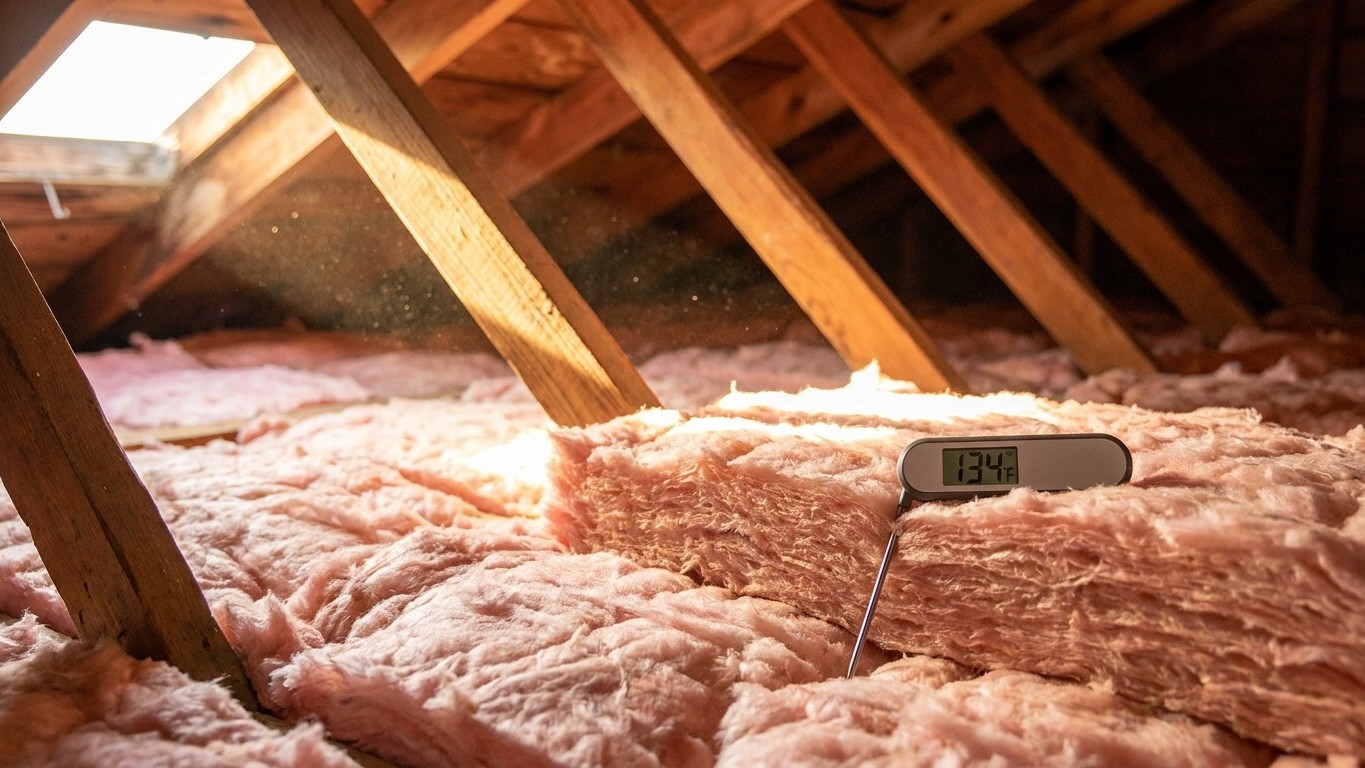
A sun-loaded roof deck absorbs solar radiation all afternoon, and that heat has to go somewhere. In a typical attic, it drives air temperatures well above whatever the thermometer says outside, sometimes by 40°F or more on a clear July day. Everything sitting under that roof deck, including the ceiling drywall, any ductwork routed through the attic, and the cardboard boxes stored near the hatch, sits inside that superheated layer. The ceiling Insulation is the only barrier between that heat and the living space below it.
The same material, working in reverse
Here’s the point that gets missed: attic insulation isn’t a winter product that happens to also help in summer. It resists heat flow in either direction, and in July that flow is downward, from the hot attic into the cooled rooms below. A house with too little insulation loses cool air upward in summer the same way it loses warm air upward in winter, the physics doesn’t change with the season, only the direction of travel.
ENERGY STAR publishes recommended retrofit levels for existing wood-framed homes by climate zone, and the table below shows the rows that apply to Maryland’s two zones. These are retrofit targets, not new-construction code minimums, and the numbers cover three separate measurements, not three attic values.
| Zone | Attic if uninsulated | Attic if you already have 3-4 inches | Floor |
|---|---|---|---|
| Zones 4A and 4B | R60 | R49 | R19 |
| Zones 6, 5 and 4C | R60 | R49 | R30 |
Because Maryland has counties in both zone 4A and zone 5A, both rows are relevant somewhere in the state. A homeowner should check the ENERGY STAR zone map or their county’s listing before choosing between them, since buying to the wrong row means either underinsulating or overspending on material that does no extra good.
What homes in Maryland cool with
Where the ducts sit
According to the U.S. Energy Information Administration’s 2020 Residential Energy Consumption Survey, 91% of Maryland homes use air-conditioning equipment of some kind, and 80% use a central air-conditioning unit specifically. That’s a wide majority running central systems, which almost always means ductwork, and in a large share of homes that ductwork runs through the attic, precisely the hottest space in the building during a July afternoon. Ceiling insulation does nothing to protect that ducting from the heat surrounding it. Sealing and insulating the ducts themselves is a separate job, and it matters just as much as what’s overhead.
Window units, mini-splits, and fans
The gap between the 91% figure and the 80% central figure, about 11 percentage points, represents households cooling with something else, and the survey separately reports that 20% of Maryland homes use an individual air-conditioning unit: a window unit, a wall unit, a ductless mini-split, or a portable. For those households, there’s no attic duct run to worry about; the room’s own walls, windows, and door seals are what determine how hard that single unit has to work. Another 66% of homes report using ceiling fans, which don’t lower temperature but do stretch the comfort range a thermostat setting can deliver. For the specifics of protecting ductwork or sizing a room unit, this site’s duct insulation guides and room air conditioner guides go into the details that a ceiling-only conversation skips.
What the heat asks for that the cold does not
Radiant barriers
A radiant barrier is a reflective material, usually foil-faced, installed to bounce radiant heat back toward the roof rather than resist it the way fiberglass or cellulose does. It carries no R-value and isn’t a substitute for insulation; it earns its keep only under a genuinely sun-loaded roof in a climate with long, intense cooling seasons. With Maryland averaging 24.6 days a year above 90°F, that’s a moderate load rather than an extreme one, which makes a radiant barrier a secondary consideration here at best, not the first upgrade to reach for. Getting attic insulation up to the recommended level does more for a Maryland home than adding a radiant barrier on top of inadequate insulation.
Vapor direction in summer
Moisture moves differently once the seasons flip. In winter, warm humid air inside a house pushes toward the cold, dry attic; in summer, in a humid climate, the damp air is often outside, working the other direction through the wall assembly. That’s part of why the model energy code doesn’t require an interior vapor retarder in its warmest, most humid zones. Maryland’s counties sit in moist zones 4A and 5A rather than the code’s hottest humid designations, so the vapor question here isn’t settled by the same logic that applies farther south. That’s a separate decision worth working through on this site’s vapor barrier page for Maryland rather than deciding it here.
What the work is worth
What the estimate covers
ENERGY STAR states it plainly: “EPA estimates that homeowners can save an average of 15% on heating and cooling costs (or an average of 11% on total energy costs) by air sealing their homes and adding insulation in attics, floors over crawl spaces, and accessible basement rim joists.” Both numbers matter together. Fifteen percent applies specifically to heating and cooling costs; 11% applies to the household’s total energy bill, a broader category that includes things insulation doesn’t touch, like water heating or running the dryer.
What it doesn’t cover
That figure comes from energy modeling of a typical existing U.S. home, an average, not a guarantee for any particular house. It also covers a specific set of locations: attics, floors over crawl spaces, and accessible basement rim joists. It says nothing about walls, windows, or doors, and it isn’t a stand-in for those separate upgrades. The reason this figure belongs on a page about summer heat rather than a page about winter heating bills is exactly this: it’s a heating-and-cooling number, not a winter number that happens to carry over. Insulating a Maryland attic to the recommended level is work that pays during both halves of the thermostat’s year.